When you click on links to various merchants on this site and make a purchase, this can result in this site earning a commission. Affiliate programs and affiliations include, but are not limited to, the eBay Partner Network.
Overlay of Splitter Downforce and Pressure Distribution at VIR
Figured I'd share this with the community. Here's an overlay of splitter downforce (measured with inline load cells attached to all splitter mounting points) and the pressure distribution (centerline pressure taps). The splitter height is measured with a laser.
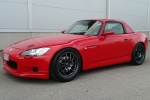
AP1 Honda S2000, stock drivetrain, wing, splitter (3.5” extension, 4” ride height), and RE-71RS.
As you can see, a simple splitter on the S2000 produces considerable downforce at a relatively high ride height (4").
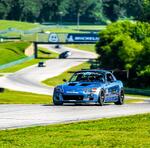
FYI, I added tunnels and tested them at VIR last week (picture attached); they made very little difference in downforce. Pressure taps confirm flow is attached to tunnel. However, drag seems to have been reduced.
Did you have a measurement of the AoA of the splitter?
Also, regarding tunnels, I believe that their effectiveness increases exponentially the lower/closer to the ground they get. But, very interesting to note from actual data that it didn't seem to make that much difference in downforce generated.
I've been considering raising my splitter up higher a little bit higher (currently 2" from the ground at the lowest point), trimming to 2.5" extension, and letting the tunnels do more of the work. I'm trying to improve street driveability. Obviously at 2" it scrapes on everything. Curious how much a 1" height difference will change the downforce generated.
AoA is approximately -1.0˚ (slightly tilted downward).
Yes, as should the splitter. But the substantial compression of the car after T10 (compression of about 1.5" at times) and the uphill back-straight braking zone at VIR showed no significant difference in downforce. I'm sure venting of the fenders would help draw air out, but the trailing edge of the tunnel – of which should roughly represent the wheel well zone – is still seeing a negative pressure of about -4 to -6 mBar at ~120mph air speed. I would think that's a good indicator that the flow out of the tunnel is not being sig. hindered from the wheel well, but of course it could be improved.
Tunnel pressure taps (forward of tunnel and along centerline of tunnel ) is shown in the data labeled "Side". The colored lines are with the tunnel, the white are without the tunnel (exact same placement of pressure taps). You can see there is a drop in pressure near the leading edge of the splitter (e.g., P1, P2), but it's not that significant and it's very tricky to exactly replicate conditions. This is the back straight braking zone at VIR, the dip in pressure is from the nose dipping under braking even with decreasing air speed.
Copy. I would destroy splitters at 2". You can use the scatter plot above to see approximately how much a -1" height difference makes from 4" datum. It only looks to be about 20-30 lbs at 100mph air speed, but of course the behavior is strongly non-linear when the splitter approaches the ground.
Nice. thanks for adding this. Looking at a splitter for next season, I just have to go through the TT5 mod factors to make sure it all plays out like I want
Any input on drag increase/top speed decrease on the long sections with your splitter set up?
This is awesome. Thank you for posting. Do you see any increase in downforce by extending the splitter rearward to the crossmember / center line of front wheels?
Did you only run the p-taps in the location shown along the centerline? It would be better to see the overall distribution rather than along one plane. The top high pressure taps aren't really needed. You can redistribute those along the bottom if you have a limit on how many pressure scanners you can run.
Also, can you explain where 0 is for the distance along splitter? I am guessing the leading edge is 0?
It does not seem like you have any taps on the tunnels. How are you determining that airflow is still attached? Either some flow-viz or a simple camera with tufts would be useful to see compared to different ride heights.
Did you tare the load cells beforehand?
I would recommend using Cp rather than absolute. You also have both metric and imperial units which is confusing lol.
Really cool work, though. It's fun to see some people take this stuff and use it for their hobby.
Centerline and side, there are two arrays. 9 points for center, 8 points for side. Side data is not shown but was used to compare with and without tunnel. Tunnel is tapped with 8 points.
I'm not limited on pressure taps; I could add as many as needed but that's not the point of this project. 9 points is plenty to map the distribution of the centerline. The gradient is sharp at the leading edge (where the tap density is largest) and then decreases gradually with increasing distance (where tap density tapers offs).
Leading edge = 0.
The high pressure taps are very close to the stagnation pressure at the pitot tube, but are not exactly the same at times. They are still important.
I would disagree. Nondimensionalization is good for comparison, not absolutes. For comparing with and without the tunnel then, yes, Cp would be better.
Metric and imperial units are mixed in Motorsport all the time. I know it's confusing, but switching between and using both is expected in this industry.
Yes, of course, load cells are always zero'd before each run and drift is checked afterwords. Thermal drift is minimal.
This isn't a hobby; I design and manufacture sensors for the Motorsport and Automotive industry. Just sharing data with the community as our test vehicle just so happens to be an S2000. This isn't meant to be an extensive study on an S2000's aero, simply a demonstration of the pressure scanner, load cells, and laser.
Nice. thanks for adding this. Looking at a splitter for next season, I just have to go through the TT5 mod factors to make sure it all plays out like I want
Any input on drag increase/top speed decrease on the long sections with your splitter set up?
Glad to share. You will see far more drag from the wing than splitter; if anything, the splitter reduces drag. I have not tested one or the other – sorry.
Originally Posted by AFK-S2K
This is awesome. Thank you for posting. Do you see any increase in downforce by extending the splitter rearward to the crossmember / center line of front wheels?
You're very welcome! Can't say as this hasn't been tested. May add flat floor in the future and could come back with data.
Centerline and side, there are two arrays. 9 points for center, 8 points for side. Side data is not shown but was used to compare with and without tunnel. Tunnel is tapped with 8 points.
I'm not limited on pressure taps; I could add as many as needed but that's not the point of this project. 9 points is plenty to map the distribution of the centerline. The gradient is sharp at the leading edge (where the tap density is largest) and then decreases gradually with increasing distance (where tap density tapers offs).
Leading edge = 0.
The high pressure taps are very close to the stagnation pressure at the pitot tube, but are not exactly the same at times. They are still important.
I would disagree. Nondimensionalization is good for comparison, not absolutes. For comparing with and without the tunnel then, yes, Cp would be better.
Metric and imperial units are mixed in Motorsport all the time. I know it's confusing, but switching between and using both is expected in this industry.
Yes, of course, load cells are always zero'd before each run and drift is checked afterwords. Thermal drift is minimal.
This isn't a hobby; I design and manufacture sensors for the Motorsport and Automotive industry. Just sharing data with the community as our test vehicle just so happens to be an S2000. This isn't meant to be an extensive study on an S2000's aero, simply a demonstration of the pressure scanner, load cells, and laser.
I'm an Aerodynamics engineer for a prominent motorsports team so just giving tips on how to improve.
Is your pitot also able to measure yaw? Does it have static pressure ports as well? If be interest to see a contour plot with no yaw and the difference side to side under yaw if you're able to measure that.
Thanks for the feedback. It's a simple Prandtl tube, so multiple static pressure taps around the circumference. It doesn't measure yaw, just total and static pressure.
To clarify, contour plots of the splitter's centerline? The car has an IMU so yaw rates and yaw angles can be calculated.
Last edited by Unbr3akable; Sep 6, 2025 at 04:50 AM.






 Overlay of Splitter Downforce and Pressure Distribution at VIR