


Time Travel


Thread Starter


Joined: Jan 2003
Posts: 10,868
Likes: 1,058
 Time Travel
"The passenger steamer SS Warrimoo was quietly knifing its way through the waters of the mid-Pacific on its way from Vancouver to Australia.
The navigator had just finished working out a star fix and brought Captain John DS. Phillips, the result.
The Warrimoo's position was LAT 0º 31' N and LONG 179 30' W.
The date was 31 December 1899.
"Know what this means?" First Mate Payton broke in, "We're only a few miles from the intersection of the Equator and the International Date Line".
Captain Phillips was prankish enough to take full advantage of the opportunity for achieving the navigational freak of a lifetime.
He called his navigators to the bridge to check & double check the ship's position.
He changed course slightly so as to bear directly on his mark.
Then he adjusted the engine speed.
The calm weather & clear night worked in his favor.
At mid-night the SS Warrimoo lay on the Equator at exactly the point where it crossed the International Date Line!
The consequences of this bizarre position were many:
The forward part (bow) of the ship was in the Southern Hemisphere & in the middle of summer.
The rear (stern) was in the Northern Hemisphere & in the middle of winter.
The date in the aft part of the ship was 31 December 1899.
In the bow (forward) part it was 1 January 1900.
This ship was therefore not only in:
Two different days,
Two different months,
Two different years,
Two different seasons
But in two different centuries - all at the same time!"
The navigator had just finished working out a star fix and brought Captain John DS. Phillips, the result.
The Warrimoo's position was LAT 0º 31' N and LONG 179 30' W.
The date was 31 December 1899.
"Know what this means?" First Mate Payton broke in, "We're only a few miles from the intersection of the Equator and the International Date Line".
Captain Phillips was prankish enough to take full advantage of the opportunity for achieving the navigational freak of a lifetime.
He called his navigators to the bridge to check & double check the ship's position.
He changed course slightly so as to bear directly on his mark.
Then he adjusted the engine speed.
The calm weather & clear night worked in his favor.
At mid-night the SS Warrimoo lay on the Equator at exactly the point where it crossed the International Date Line!
The consequences of this bizarre position were many:
The forward part (bow) of the ship was in the Southern Hemisphere & in the middle of summer.
The rear (stern) was in the Northern Hemisphere & in the middle of winter.
The date in the aft part of the ship was 31 December 1899.
In the bow (forward) part it was 1 January 1900.
This ship was therefore not only in:
Two different days,
Two different months,
Two different years,
Two different seasons
But in two different centuries - all at the same time!"








Joined: Oct 2009
Posts: 29,758
Likes: 5,389
From: Ontario Canada
Do you think that really counts as time travel ? I thought you were going to explain the Philadelphia Experiment to us and how a ship disappeared and travelled in time, now that would be interesting. lol.




Joined: Jul 2014
Posts: 13,806
Likes: 1,540
From: Chesterfield VA
Kool story except the 20th Century didn't start until January 1,1901 (oh one) 1900 being the last year of of the 19th Century. (There was no year zero way back when.)
We went thru this when the 21 Century arrived so the overly punctilious among us got to celebrate twice. Once (incorrectly) with the unwashed masses -- great party! -- and the second (correct) time with obnoxious intellectuals.
-- Chuck
We went thru this when the 21 Century arrived so the overly punctilious among us got to celebrate twice. Once (incorrectly) with the unwashed masses -- great party! -- and the second (correct) time with obnoxious intellectuals.
Share One ship in two centuries: the strange tale of the SS Warrimoo on LinkedIn 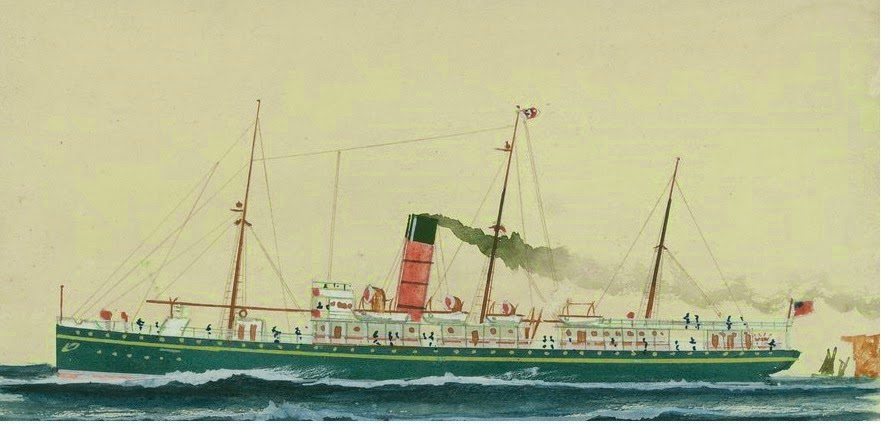 The SS Warrimoo, plying the waters of the Pacific. (Credit: Confederation Marine Modellers / Public domain)“Be good and you will be lonesome,” Mark Twain wrote under a photograph of himself. The author sits on a folding chair, his feet on a ship’s railing. Wearing a peaked cap and a grumpy face, he stares listlessly out to sea.
The picture was likely taken in 1895 on board the SS Warrimoo, as Twain was crossing the Pacific from Canada to Australia. It’s used as the frontispiece for Following the Equator (1897), a travelogue of his year-long round-the-world lecture tour. The tour and his bad mood had a common cause: Twain was bankrupt.
While on board the SS Warrimoo, Twain crossed the equator and the international date line, two events he noted in his book:
“A sailor explained to a young girl that the ship’s speed is poor because we are climbing up the bulge toward the center of the globe; but that when we should once get over, at the equator, and start down-hill, we should fly.
“Afternoon. Crossed the equator. In the distance, it looked like a blue ribbon stretched across the ocean. Several passengers kodak’d it.”
And a few days later:
“While we were crossing the 180th meridian it was Sunday in the stern of the ship where my family were, and Tuesday in the bow where I was. They were there eating the half of a fresh apple on the 8th, and I was at the same time eating the other half of it on the 10th — and I could notice how stale it was, already.
“The family were the same age that they were when I had left them five minutes before, but I was a day older now than I was then. The day they were living in stretched behind them half way round the globe, across the Pacific Ocean and America and Europe; the day I was living in stretched in front of me around the other half to meet it.
“Along about the moment that we were crossing the Great Meridian a child was born in the steerage, and now there is no way to tell which day it was born on. The nurse thinks it was Sunday, the surgeon thinks it was Tuesday. The child will never know its own birthday. It will always be choosing first one and then the other, and will never be able to make up its mind permanently. This will breed vacillation and uncertainty in its opinions about religion, and politics, and business, and sweethearts, and everything, and will undermine its principles, and rot them away, and make the poor thing characterless, and its success in life impossible.”
 Grumpy, old, and going places: frontispiece and title page of Mark Twain’s 1897 travelogue. (Credit: Art and Colour)Crossing the equator and the date line may have been memorable for Twain and other occasional passengers, but for the crew of the SS Warrimoo, a steamliner plying a regular connection hauling mail, cargo, and passengers between Canada and Australia, it was just another day at the office. The American satirist’s passage could have been the high-water mark (so to speak) of the ship’s wider notoriety, had it not been for an even more fateful encounter with both lines, a few years later.
Seeing a chance to pull a prank of historical proportions — big enough to be written about more than a century hence — Captain John Duthie Sydney Phillips ordered his crew to steer the ship toward the meeting point of both lines. Five experienced navigators checked the position of the sun and, after sunset, the stars. The ship’s position was checked every three hours. Helped by smooth seas and open skies, the SS Warrimoo at the stroke of midnight found itself right across the aforementioned intersection, its bow pointing south and its stern facing north.
This had some positively mind-boggling consequences. The forward part of the ship was in the southern hemisphere, where it was summer, and already January 1, 1900. The aft part of the ship was in the northern hemisphere, where it was winter, and still December 31, 1899.
It could be said, therefore, that the same ship was, for a brief moment:
It’s not that the story is entirely made up. In 1942, the Ottawa Journal reported that Captain Phillips, now retired, was able to verify the whole thing from his logbooks. And it’s not unheard-of for ships in the neighborhood to go out of their way to cross the equator on the date line. In nautical lore, this makes you a “golden shellback”.
And in theory, it’s certainly possible for a ship on that specific point at a specific time to be in different days, months, seasons, years, centuries, and hemispheres. However, even though the captain and his crew may have believed they were at exactly the intersection of the Great Meridian (180° E/W) and the equinoctial circle (0° N/S), it’s doubtful that with the navigational methods and instruments of that time that they would have been able to achieve and maintain a position that precise at the appropriate time.And then, of course, there’s the matter of the new century. As some may remember from the whole Y2K hullaballoo, centuries (and millennia) only end when the year ending in zero is over, not when it starts. So, just like the 21st century and the third millennium started on January 1, 2001, the 20th century began on January 1, 1901, not 1900. (Not that this chronological truth got in the way of popular opinion.)
Apart from that mention in the captain’s log, there is no record of that remarkable evening on board the SS Warrimoo. Mark Twain, had he been on board, probably would have had a witty thing or two to say about it. However, being the unreliable narrator that he was, we still wouldn’t have known what actually happened.
The SS Warrimoo, plying the waters of the Pacific. (Credit: Confederation Marine Modellers / Public domain)“Be good and you will be lonesome,” Mark Twain wrote under a photograph of himself. The author sits on a folding chair, his feet on a ship’s railing. Wearing a peaked cap and a grumpy face, he stares listlessly out to sea.The picture was likely taken in 1895 on board the SS Warrimoo, as Twain was crossing the Pacific from Canada to Australia. It’s used as the frontispiece for Following the Equator (1897), a travelogue of his year-long round-the-world lecture tour. The tour and his bad mood had a common cause: Twain was bankrupt.
A world tour to pay off creditors
In previous years, the former printer had sunk $300,000 of his (and his wife’s) money into an invention he thought would revolutionize printing, until then very much a manual, labor-intensive industry. But the Paige Compositor, a mechanical typesetter, was a disaster. Twain’s investment — about $9 million in 2022 money — was a total loss. He embarked on his world tour to pay off his various creditors.While on board the SS Warrimoo, Twain crossed the equator and the international date line, two events he noted in his book:
“A sailor explained to a young girl that the ship’s speed is poor because we are climbing up the bulge toward the center of the globe; but that when we should once get over, at the equator, and start down-hill, we should fly.
“Afternoon. Crossed the equator. In the distance, it looked like a blue ribbon stretched across the ocean. Several passengers kodak’d it.”
And a few days later:
“While we were crossing the 180th meridian it was Sunday in the stern of the ship where my family were, and Tuesday in the bow where I was. They were there eating the half of a fresh apple on the 8th, and I was at the same time eating the other half of it on the 10th — and I could notice how stale it was, already.
“The family were the same age that they were when I had left them five minutes before, but I was a day older now than I was then. The day they were living in stretched behind them half way round the globe, across the Pacific Ocean and America and Europe; the day I was living in stretched in front of me around the other half to meet it.
“Along about the moment that we were crossing the Great Meridian a child was born in the steerage, and now there is no way to tell which day it was born on. The nurse thinks it was Sunday, the surgeon thinks it was Tuesday. The child will never know its own birthday. It will always be choosing first one and then the other, and will never be able to make up its mind permanently. This will breed vacillation and uncertainty in its opinions about religion, and politics, and business, and sweethearts, and everything, and will undermine its principles, and rot them away, and make the poor thing characterless, and its success in life impossible.”
Grumpy, old, and going places: frontispiece and title page of Mark Twain’s 1897 travelogue. (Credit: Art and Colour)Crossing the equator and the date line may have been memorable for Twain and other occasional passengers, but for the crew of the SS Warrimoo, a steamliner plying a regular connection hauling mail, cargo, and passengers between Canada and Australia, it was just another day at the office. The American satirist’s passage could have been the high-water mark (so to speak) of the ship’s wider notoriety, had it not been for an even more fateful encounter with both lines, a few years later.A prank of historical proportions
This happened on the evening of December 30, 1899, as the SS Warrimoo was once more making the crossing from Vancouver to Sydney. By chance, the ship was just a few nautical miles from the intersection of the equator and the date line.Seeing a chance to pull a prank of historical proportions — big enough to be written about more than a century hence — Captain John Duthie Sydney Phillips ordered his crew to steer the ship toward the meeting point of both lines. Five experienced navigators checked the position of the sun and, after sunset, the stars. The ship’s position was checked every three hours. Helped by smooth seas and open skies, the SS Warrimoo at the stroke of midnight found itself right across the aforementioned intersection, its bow pointing south and its stern facing north.
This had some positively mind-boggling consequences. The forward part of the ship was in the southern hemisphere, where it was summer, and already January 1, 1900. The aft part of the ship was in the northern hemisphere, where it was winter, and still December 31, 1899.
It could be said, therefore, that the same ship was, for a brief moment:
- in two different days (on its forward half, it was already Monday, while on its aft part, it was still Sunday);
- in two different months (forward in January, aft in December);
- in two different seasons (summer and winter);
- in two different years (1900 and 1899);
- in two different centuries (the 20th and the 19th); and
- in all four hemispheres at once (the southern and the northern on either side of the equator, and the eastern and western on either side of the 180th meridian).
Did this really happen?
However, like many stories that sound too good to be true, this one is as well.It’s not that the story is entirely made up. In 1942, the Ottawa Journal reported that Captain Phillips, now retired, was able to verify the whole thing from his logbooks. And it’s not unheard-of for ships in the neighborhood to go out of their way to cross the equator on the date line. In nautical lore, this makes you a “golden shellback”.
And in theory, it’s certainly possible for a ship on that specific point at a specific time to be in different days, months, seasons, years, centuries, and hemispheres. However, even though the captain and his crew may have believed they were at exactly the intersection of the Great Meridian (180° E/W) and the equinoctial circle (0° N/S), it’s doubtful that with the navigational methods and instruments of that time that they would have been able to achieve and maintain a position that precise at the appropriate time.And then, of course, there’s the matter of the new century. As some may remember from the whole Y2K hullaballoo, centuries (and millennia) only end when the year ending in zero is over, not when it starts. So, just like the 21st century and the third millennium started on January 1, 2001, the 20th century began on January 1, 1901, not 1900. (Not that this chronological truth got in the way of popular opinion.)
Apart from that mention in the captain’s log, there is no record of that remarkable evening on board the SS Warrimoo. Mark Twain, had he been on board, probably would have had a witty thing or two to say about it. However, being the unreliable narrator that he was, we still wouldn’t have known what actually happened.
-- Chuck

Joined: Aug 2012
Posts: 7,793
Likes: 3,346
From: Foothills East of Sacramento
Kool story except the 20th Century didn't start until January 1,1901 (oh one) 1900 being the last year of of the 19th Century. (There was no year zero way back when.)
We went thru this when the 21 Century arrived so the overly punctilious among us got to celebrate twice. Once (incorrectly) with the unwashed masses -- great party! -- and the second (correct) time with obnoxious intellectuals.
Chuck
We went thru this when the 21 Century arrived so the overly punctilious among us got to celebrate twice. Once (incorrectly) with the unwashed masses -- great party! -- and the second (correct) time with obnoxious intellectuals.
Chuck
Trending Topics
Joined: Aug 2012
Posts: 7,793
Likes: 3,346
From: Foothills East of Sacramento
The world does use Before Christ, BC and Anno Domini, AD. It may not be PC among some groups but it is still used especially in serious academia. Just saw it on the BBC last week. Obviously all the text and research over centuries uses it. We also use the Julian calendar for heavens sake (pun intended). Just talking about the years starting with 1 instead of 0 as there is no zero year when Christ was born.
Last edited by cosmomiller; Oct 15, 2023 at 04:53 PM.


Thread
Thread Starter
Forum
Replies
Last Post
Lainey
S2000 Vintage Owners
40
Nov 10, 2022 11:48 AM