


Why Inside Rear Wheel Lift?

Thread Starter
Former Moderator


Joined: Jul 2005
Posts: 4,634
Likes: 28
From: West Virginia
 Why Inside Rear Wheel Lift?
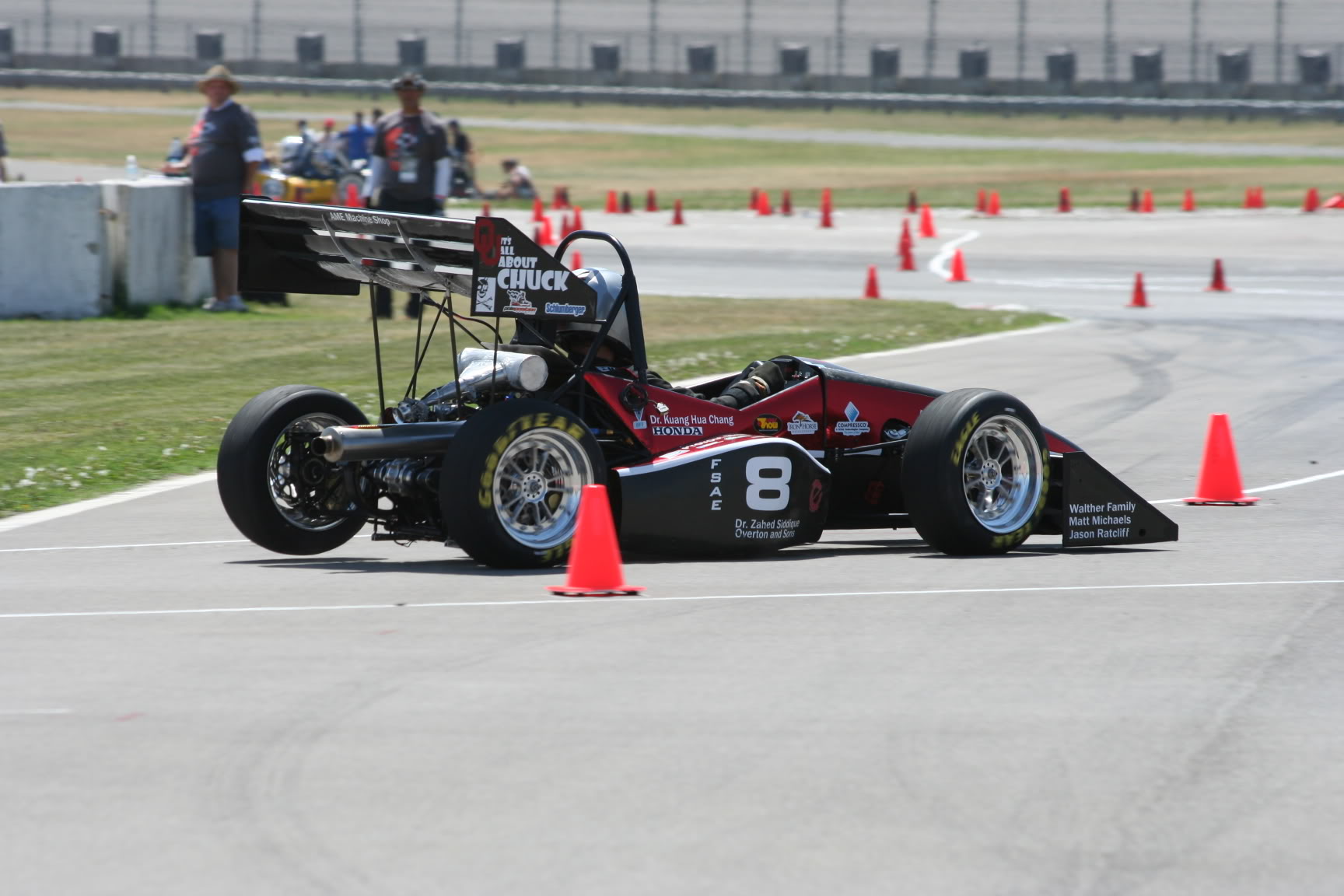
I'm having a problem with inside rear wheel lift when powering out of slow to medium speed corners. The wheel lifts enough to open the differential and spin up the wheel allowing the engine to hit the rev limiter.
I'm running KWV3s with 628 front and 571 rear springs, Comptech adjustable front anti-roll bar at the 4th stiffest position out of 5, and the stock 2001 rear anti-roll bar. I also have a full cage with very little chassis flex.
I've done the math and the front wheel rate is 308 lb/in and 257 in the rear (without consideration of the anti-roll bars)
If both outside wheels compressed the same amount in a corner then both inside wheels would stay in contact with the track (steady state).
With the stiffer springs and anti-roll bar up front it seems to me the front inside wheel should be lifting, especially under power.
But in actuality it appears body roll is causing the outside front suspension to compress more which allows the diagonal wheel (inside rear wheel) to be lifted by the rear anti-roll bar.
With a near 50/50 front/rear weight ratio and more spring and anti-roll bar up front why would the front outside wheel compress more than the outside rear?
Short Answer: The S2000's center of gravity is higher and the roll center is lower at the front of the car than at the rear. The front's greater distance between the CG and roll center (roll moment arm) gives centrifugal force a longer lever in which to roll the car in a corner so the front of the car rolls more than the rear. As the front of the car rolls more it compresses the outside front suspension more than the outside rear which allows the inside rear wheel to be lifted off the track by the rear anti-roll bar. Thanks to Derek (Suspension) for the answer.
This is also the reason a big-ass front anti-roll bar upgrade helps the handling so much.</div>
I'm running KWV3s with 628 front and 571 rear springs, Comptech adjustable front anti-roll bar at the 4th stiffest position out of 5, and the stock 2001 rear anti-roll bar. I also have a full cage with very little chassis flex.
I've done the math and the front wheel rate is 308 lb/in and 257 in the rear (without consideration of the anti-roll bars)
If both outside wheels compressed the same amount in a corner then both inside wheels would stay in contact with the track (steady state).
With the stiffer springs and anti-roll bar up front it seems to me the front inside wheel should be lifting, especially under power.
But in actuality it appears body roll is causing the outside front suspension to compress more which allows the diagonal wheel (inside rear wheel) to be lifted by the rear anti-roll bar.
With a near 50/50 front/rear weight ratio and more spring and anti-roll bar up front why would the front outside wheel compress more than the outside rear?
Short Answer: The S2000's center of gravity is higher and the roll center is lower at the front of the car than at the rear. The front's greater distance between the CG and roll center (roll moment arm) gives centrifugal force a longer lever in which to roll the car in a corner so the front of the car rolls more than the rear. As the front of the car rolls more it compresses the outside front suspension more than the outside rear which allows the inside rear wheel to be lifted off the track by the rear anti-roll bar. Thanks to Derek (Suspension) for the answer.
This is also the reason a big-ass front anti-roll bar upgrade helps the handling so much.</div>
Joined: Sep 2004
Posts: 851
Likes: 0
From: Long Beach, CA
Does this happen in both right and left turns? If no, check corner balance.
Do the rear springs have a lot of preload? If so, you don't have enough rebound travel in the rear so that is what is causing the lift...
I could go on, but let's start there.
Do the rear springs have a lot of preload? If so, you don't have enough rebound travel in the rear so that is what is causing the lift...
I could go on, but let's start there.

 Derek congrats on the wedding
Thread Starter
Former Moderator
Joined: Jul 2005
Posts: 4,634
Likes: 28
From: West Virginia
Does this happen in both right and left turns? If no, check corner balance.
Do the rear springs have a lot of preload? If so, you don't have enough rebound travel in the rear so that is what is causing the lift...
Do the rear springs have a lot of preload? If so, you don't have enough rebound travel in the rear so that is what is causing the lift...
The car was recently corner balanced and it happens in both directions.
My KWV3 shocks have keeper springs and I'm running about 1 inch lowered all around. The rear suspension goes to full droop when on a lift. What do you mean by preload?

Registered User
Joined: Nov 2010
Posts: 588
Likes: 1
From: Dallas, TX
Does this happen in both right and left turns? If no, check corner balance.
Do the rear springs have a lot of preload? If so, you don't have enough rebound travel in the rear so that is what is causing the lift...
Do the rear springs have a lot of preload? If so, you don't have enough rebound travel in the rear so that is what is causing the lift...
The car was recently corner balanced and it happens in both directions.
My KWV3 shocks have keeper springs and I'm running about 1 inch lowered all around. The rear suspension goes to full droop when on a lift. What do you mean by preload?

Joined: Sep 2004
Posts: 851
Likes: 0
From: Long Beach, CA
Preload is when the helper spring, and perhaps the main spring, are compressed even when the suspension is in full droop. As mentioned by Ron, it changes the ride height but also changes the vertical load at which the tire comes off the ground.
I am not sure what the recommended height for the V3s are, but you may be too high and it is just lacking in rebound travel at your current ride height. Has this always happened? Or just recently? Or only after putting the V3s on?
Thread Starter
Former Moderator
Joined: Jul 2005
Posts: 4,634
Likes: 28
From: West Virginia
rohde88 thanks for the pics. I know wheel lift is normal but I don't understand why the inside rear is lifting when there's so much more spring and anti-roll bar up front.
What I'm trying to say is in a steady state corner the outside suspension will compress. It seems with a stiffer front spring the outside rear spring would compress more which would tend to raise the diagonal wheel--the inside front.
Trending Topics
Thread Starter
Former Moderator
Joined: Jul 2005
Posts: 4,634
Likes: 28
From: West Virginia
Are the helper springs compressed any when the car is up on a lift and the suspension is at full droop?
Preload is when the helper spring, and perhaps the main spring, are compressed even when the suspension is in full droop. As mentioned by Ron, it changes the ride height but also changes the vertical load at which the tire comes off the ground.
I am not sure what the recommended height for the V3s are, but you may be too high and it is just lacking in rebound travel at your current ride height. Has this always happened? Or just recently? Or only after putting the V3s on?
Preload is when the helper spring, and perhaps the main spring, are compressed even when the suspension is in full droop. As mentioned by Ron, it changes the ride height but also changes the vertical load at which the tire comes off the ground.
I am not sure what the recommended height for the V3s are, but you may be too high and it is just lacking in rebound travel at your current ride height. Has this always happened? Or just recently? Or only after putting the V3s on?
Preload is compressing the spring more than the weight of the car will do at rest.
3/4 to 1 inch of ride height drop for V3s is pretty much the norm.
Inside rear wheel lift & spin is a pretty common problem with the S2000 with stiff springs and r comps.
I'm basically asking a theory question. It seems the front outside suspension must be compressing more than the outside rear to raise the diagonal tire--the inside rear, but we're all running more spring & anti-roll in the front.
Joined: Sep 2004
Posts: 851
Likes: 0
From: Long Beach, CA
Ok...
The s2000 has a higher rear roll center than front, requiring less roll stiffness in the rear due to the reduced roll moment. This high roll center also causes jacking forces that raise the chassis, contributing to rear inside wheel lift. ALSO, the s2000's rear suspension does not have as much travel as compared to the front. I think these factors lead to the s2000's knack of inside rear wheel lift.
Potential solution (if allowed in your rules or if you can take the points): lower rear roll center and increase rear roll stiffness (springs and/ordampers anti-roll bars [edit]) OR up front roll stiffness OR lower rear roll stiffness.
The s2000 has a higher rear roll center than front, requiring less roll stiffness in the rear due to the reduced roll moment. This high roll center also causes jacking forces that raise the chassis, contributing to rear inside wheel lift. ALSO, the s2000's rear suspension does not have as much travel as compared to the front. I think these factors lead to the s2000's knack of inside rear wheel lift.
Potential solution (if allowed in your rules or if you can take the points): lower rear roll center and increase rear roll stiffness (springs and/or
Thread Starter
Former Moderator
Joined: Jul 2005
Posts: 4,634
Likes: 28
From: West Virginia
That sounds good but I can lift the inside front wheel if I disconnect my rear anti-roll bar. I used to run like that and many people commented on my front inside wheel lift. This makes intuitive sense, without the rear anti-roll bar the outside rear suspension compresses easily raising the diagonal wheel--the inside front and this is helped with acceleration.
I'm running a full cage so there is very little chassis flex so if a corner comes off the ground the diagonal corner is compressing to allow it.
I'm running a full cage so there is very little chassis flex so if a corner comes off the ground the diagonal corner is compressing to allow it.