
The Future of Fun
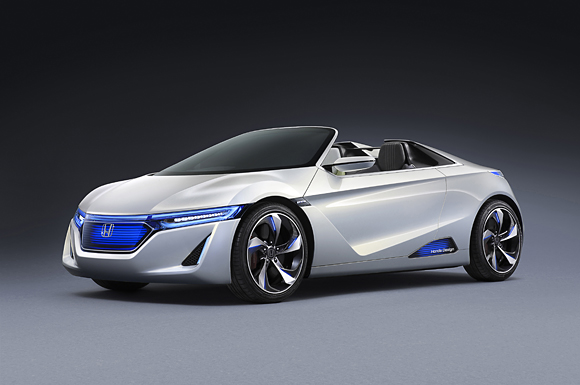
This is the EV-ster. It scares me.
I love everything about internal combustion. I love the noise, the mechanical complexity, the endless variation in character and delivery between motors; the smell of uncatalyzed exhaust wafting from the track is better than coffee on a cold morning.
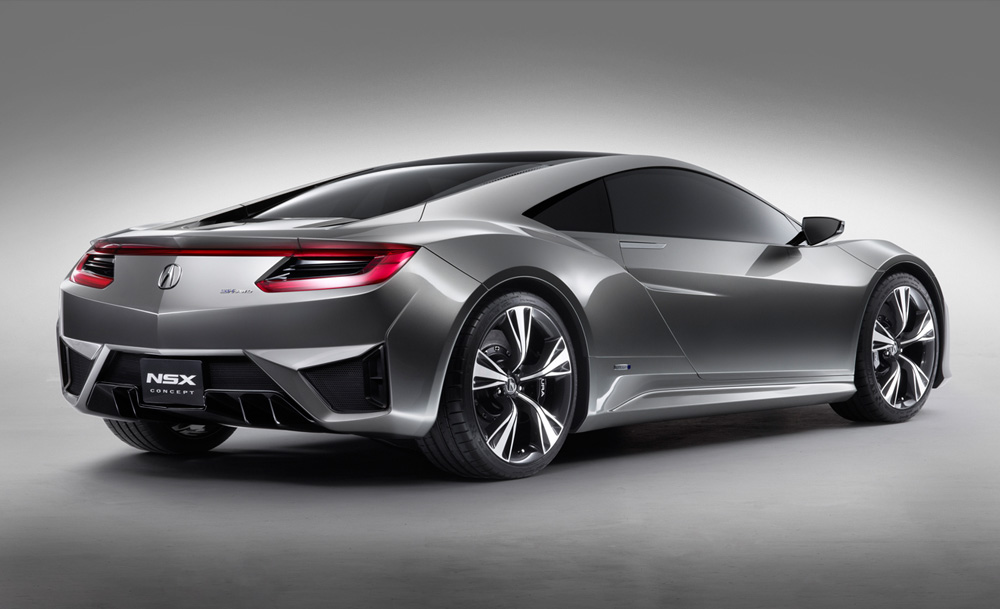
Electric motors have precisely none of these things, yet Honda seems to have embraced them for their next generation of sports cars. Even the new NSX will be a hybrid. It would be unprofessional to panic prematurely, so I set out to determine whether electric cars can still be fun.
Contrary to popular belief, the Tesla Roadster does not accelerate silently. In fact, the soprano howl of the motor is drowned only by the soprano howl of your passenger, as they realize you don’t intend to lift before entering a sweeping uphill corner.
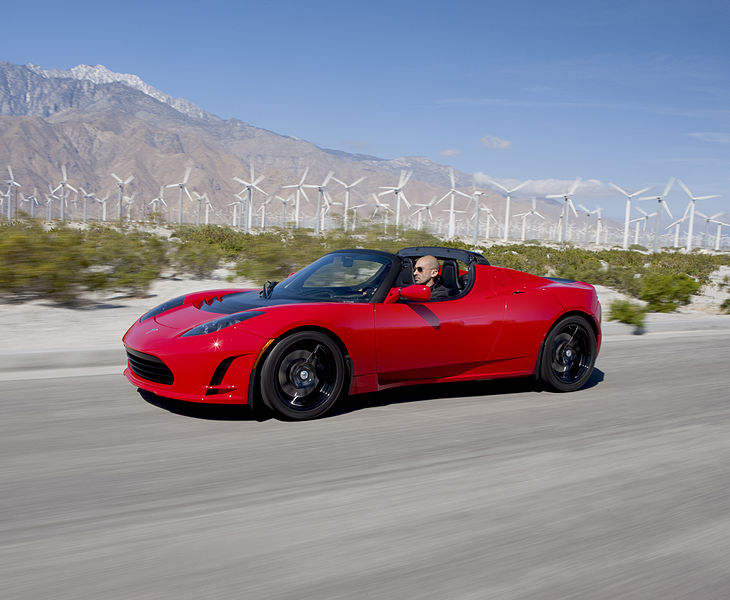
Fortunately, the Tesla’s chassis remains largely faithful to its Lotus roots, with predictable, responsive steering and well-controlled body motions. Even severe mid-corner bumps don’t seem to faze it, the 750lb battery pack giving the car a reassuring inertia in pitch that the nose-bobbing Elise lacks. That same inertia can, however, prove disadvantageous in yaw. At road speeds this is not readily apparent, but at a Porsche Club Tesla autocross event last year, every driver managed to exit at least one corner backward, despite many being accustomed to the unforgiving dynamics of older 911s. The tire selection is not solely to blame- the low-rolling-resistance eco-tires fitted to early models still offer a surprising amount of grip, although they let go more abruptly and with less textural warning than the 140-treadwear sports rubber of later cars, which grip ferociously and require real provocation to break loose, sometimes overrunning the ability of the dampers to keep the batteries’ mass in check.
In fact, never lifting is the best way to drive the Tesla; the regenerative braking effect when you hit zero throttle is strong enough to induce load-transfer oversteer at a normal, 8/10ths canyon-carving pace. In this, as in many other aspects, it feels surprisingly old-school; mechanical traits, both good and bad, are embraced and imparted to the driver, rather than being banished by artificial and overly complicated electronic “enhancements”. If only the prodigious torque output could be exploited more- the electric motor controllers are programmed to resist wheelspin and power oversteer wherever possible, resulting in an oddly inert feel from the back end under acceleration. No arguments with their effectiveness, though; the only other cars which put power down this effortlessly are 911s. This is a purist’s twentieth-century sports car gifted the best of future powertrain technology; the ME-262 of automobiles; the kind of vehicle futurists once speculated about in between wet dreams about jetpacks.
The only other “sporty” electric vehicle currently on sale in the United States could not present a more different experience. The Fisker Karma is fifty-three hundred pounds of gorgeous sheetmetal concealing an utterly overwhelmed drivetrain. That’s 2400kg, for those of you who prefer rationally constructed systems of measurement, or roughly the same as two S2000s, and yet I still can’t fit in the back seat. It uses an my least favorite sports-car motor, the horrendously unreliable Ecotec 2.0 Turbo, as a generator to recharge 600lb of batteries; has a steering wheel that can only be grasped firmly if you have tentacles; and possesses an interior seemingly inspired by the first season of Stargate sets. You know, the ones before they had money. Strange clear panels and pyramidal mounds of buttons abound. I half-expected the knobs to be labeled in hieroglyphics. That would have made the gauges more legible, at least. And why does it have shift paddles? It only has ONE GEAR RATIO.
Fortunately, it also drives like something from science fiction. The 22-inch wheels glide over potholes, which in southern California more closely resemble moon craters, like they’re hovering, Back to the Future II style. It corners, if not with alacrity, at least perfectly flat and with genuinely alarming grip levels. The astronomical mid-corner speeds, combined with the astronomical (in the literal sense) mass, leave you feeling that if the back end ever did let go, you’d continue spinning for a very long time. Not that there’s any risk of that- the acceleration is moderate at best, and the steering is well-weighted, highly accurate, and surprisingly full of feel. If that’s not enough to keep the car in check, the brakes have the tenacity of a tractor beam. They’re an artificial gravity generator that leaves you suspended from the seatbelt, contemplating your new, close-up view of the steeply raked windscreen. Such are the capabilities of this car to defy physics that I’m lost for words, so I’ll let the infamous Dwight Weist step in, adenoidal accent and all: “THE FUTURE IS NOW!”
What are your experiences with, or thoughts about, electric cars? Please share in the comments.
Images courtesy of Honda Worldwide, Acura and Tesla Motors via Wikipedia