


Advantages of rear engine over front engine


Thread Starter
Registered User
Joined: Aug 2003
Posts: 4,403
Likes: 1
From: Lusby, MD
 Advantages of rear engine over front engine
I was just curious to know why so many super cars or exotics are rear engine. Is there a huge benefit in handling and performance that rear engine cars have. I really like the look of front engine cars. I think a long hood is appealing and that is one reason I love the S2k so much. Is the purpose for so many rear engine super cars weight distribution. In terms of best performance around a road track , what would be the ideal weight dist. If two cars with the same driver, HP, weight, weight dist. and other affecting variables and the only difference was engine location (rear engine vs. front engine) would the cars perform the same.
Ryan
Ryan


Joined: Mar 2002
Posts: 6,014
Likes: 1
From: Seattle, WA
Originally posted by Highrpmek
I was just curious to know why so many super cars or exotics are rear engine.
I was just curious to know why so many super cars or exotics are rear engine.
The reason why a mid-mounted engine is preferable is that it decreases a car's polar moment of inertia. This in turn makes it easier for the car to change directions rapidly. A side effect of having a non-front-mounted engine is that it keeps the car's weight distribution from being excessively biased towards the front tires, which causes understeer.
Steve
Registered User
Joined: Oct 2000
Posts: 15,323
Likes: 28
From: Longmont, CO
Quick note - the cars you are talking about are more properly termed "mid-engine." The Porsche 911 is the only rear-engine car produced today that I know of. (The other one, the original Beetle, recently ceased production I think.)
The advantage of a mid-engine layout is that the heavy metalic mass of the engine is located close to the center of the car. This helps with front/rear weight balance, plus reduces the car's rotational inertial so it can rotate more quickly.
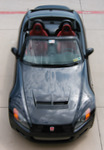
The S2000, by the way, has the engine entirely behind the front axel so is often considered a "front-mid" engine car.
Ideal? Who knows. Race cars come in all flavors. F1 and most ALMS prototypes are mid-engine, for what that's worth.
The advantage of a mid-engine layout is that the heavy metalic mass of the engine is located close to the center of the car. This helps with front/rear weight balance, plus reduces the car's rotational inertial so it can rotate more quickly.
The S2000, by the way, has the engine entirely behind the front axel so is often considered a "front-mid" engine car.
Ideal? Who knows. Race cars come in all flavors. F1 and most ALMS prototypes are mid-engine, for what that's worth.

Registered User
Joined: Nov 2001
Posts: 594
Likes: 0
From: Rochester
From what little I know on this, you've received two accurate answers above. Another benefit is to move the weight bias to favor the rear. Now, there's a lot of talk about "perfect 50/50" weight distributions, so this may be controversial. However, moving the weight to a rearward bias allows better traction for putting the power down in high powered rear-drive cars. Also having a static rearward bias prevents a too high forward bias on braking. Mid-engine cars like the NSX, etc all the way through F1 have weight distn's of about 45/55 to 40/60.

Registered User
Joined: Mar 2002
Posts: 2,360
Likes: 0
Like PedalFaster said, Mid-engined layouts give a low polar moment of intertia, which is very useful for quickly changing directions (i.e. turns on a road course). Look at the McLaren F1. Mid-engined, very little front and rear overhangs, extremely low polar moment of intertia.

Trending Topics

Thread Starter
Registered User
Joined: Aug 2003
Posts: 4,403
Likes: 1
From: Lusby, MD
Accroding to the 04 S2k brochure the weight dist is now 49/51 if i'm not mistaking. Its in the work truck so i'l confirm it tomorrow. I figure the three heaviest objects in a race car are the driver, gas tank (when full) and motor. If you were to squeeze those three objects towards the middle of the car you are more likely to have a more balanced race car.

Registered User

Joined: Jan 2001
Posts: 4,282
Likes: 0
From: Melbourne
The more weight you have over the rear wheels, the better the power-down traction out of corners is (ie. get on power sooner), and the better the car brakes (ie. rear wheels doing more braking).
So the more power you have the better off you are in shifting some weight over the rear wheels.
So the more power you have the better off you are in shifting some weight over the rear wheels.