Days til WTD9 2011






Joined: Aug 2005
Posts: 3,614
Likes: 11
From: Northern VA


# Commissioned, USS Kilauea (AE-26), 10 August 1968
# During the Vietnam War USS Kilauea (AE-26) participated in the following campaigns:
Vietnam War Campaign Vietnamese Counteroffensive - Phase VII
7 to 23 August 1970
1 to 25 September 1970
1 to 2 October 1970
12 to 24 October 1970
2 to 11 November 1970
30 November to 11 December 1970
5 January to 26 January 1971 Consolidation II
1 to 8 December 1971
25 December 1971 to 3 January 1972
12 to 21 January 1972
28 January to 22 February 1972
5 to 29 March 1972
Consolidation I
3 to 11 September 1971
22 to 30 September 1971
19 to 26 October 1971
5 to 24 November 1971 Vietnam Ceasefire
30 March to 15 April 1972
21 April to 6 May 1972
13 to 23 May 1972
30 May to 12 June 1972
# Decommissioned. and placed in service with the Military Sealift Command (MSC) as USNS Kilauea (T-AE-26), 1 October 1980
# USNS Kilauea is part of the 33 ship Naval Fleet Auxiliary Force (PM1) currently in reduced operating status (ROS 90)
# Kilauea was towed from San Francisco, 28 March 2008, bound for Point Hueneme and ultimately for lay up in the Pacific Reserve Fleet at Pearl Harbor in August 2008
# Placed out of service and struck from the Naval Register, 15 September 2008
# USS Kilauea earned four campaign stars for Vietnam War service
Joined: Aug 2005
Posts: 3,614
Likes: 11
From: Northern VA

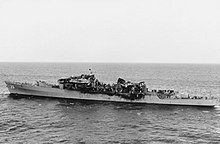
USS Belknap (DLG-26/CG-26), named for Rear Admiral George Eugene Belknap USN (1832–1903), was the lead ship of her class of guided missile cruisers in the United States Navy. She was launched as DLG-26, a guided missile frigate under the then-current designation system, and reclassified as CG-26 on 30 June 1975.
Belknap was severely damaged in a collision with John F. Kennedy on 22 November 1975 in heavy weather off the coast of Sicily. A fire broke out on Belknap following the collision, and during the fire her aluminium superstructure was melted, burned and gutted to the deck level. Seven personnel were killed on Belknap and one on Kennedy. The ammunition ship USS Mount Baker (AE-34) was involved in the rescue of the Belknap, escorting her to an ammunition depot and then providing electric and water services as the Mount Baker's Explosive Ordnance Disposal team retrieved all of the remaining ammunition from the Belknap. Mount Baker also assimilated most of the Belknap crew until they could be transferred to a way station for re-assignment. This fire and the resultant damage and deaths, which would have been less, had Belknap's superstructure been made of steel, drove the US Navy's decision to pursue all-steel construction in its next major classes of surface combatants, though the first USN combatant ships to revert to all steel superstructure were the Arleigh Burke class (DDG-51) which did not commission until the 1990s.[citation needed] Belknap was reconstructed by the Philadelphia Navy Yard from 30 January 1976 to 10 May 1980.
She was converted to a flagship by the Norfolk Navy Yard from May 1985 to February 1986.
On 27 May 1989, Belknap participated in Barcelona in a naval parade with ships from 10 countries.