


Installed a


Joined: Aug 2002
Posts: 1,602
Likes: 3
From: St. Louis

Originally Posted by Su2uKa,Mar 24 2008, 01:54 PM
I follow the reasoning but am still unclear how a stiffer roll bar means more weight transfer at the front - I'd have thought the delta was in favor of a weaker bar since that allows mass transfer as well as the centripetal acceleration...
Isn't centripetal acceleration dependant on / constant for the whole car, & independant of the roll of the car, so the additional roll from a weaker bar would increase the mass transfer at the front => increasing grip at the rear relative to the front, & reducing oversteer - i.e. the opposite of what you're describing?!?
Isn't centripetal acceleration dependant on / constant for the whole car, & independant of the roll of the car, so the additional roll from a weaker bar would increase the mass transfer at the front => increasing grip at the rear relative to the front, & reducing oversteer - i.e. the opposite of what you're describing?!?
This should be much easier to explain to you than the average American, because we can talk metric
 What is happening in the corner is not a transfer of the kilograms of car. That does happen slightly on this car. Only very slightly though. It might seem like a lot inside, but in reality is only a few degrees with a moment arm of only a few feet at the greatest (the distance from the roll center, above the ground in this car, to the top of the roof), with the center of gravity not being very far away at all. Think about an F1 car and it's suspension that moves almost no where...as you might imagine, it has a much greater weight transfer through a corner while rolling 0.1 degrees than a Civic that rolls 20 degrees.
What is happening is a transfer of Newtons. At rest, the acceleration vector of the car is pointing straight into the ground and entirely due to gravity. If you add a horizontal centripetal acceleration, the two vectors (centripetal and gravity) combine to create a diagonal acceleration vector. So now the acceleration vector has gone from pointing down to pointing diagonal (the higher the centripetal g's, the more horizontal this vector becomes). Therefore the Force vector (since F = ma) must also shift. Hence the transfer of Newtons due to the change in acceleration, not mass.
Again, think about how this still works on the F1 car that did not roll while going through the corner. Even though the F1 car does not roll, it still has the greater "weight" (force) transfer than the Civic:
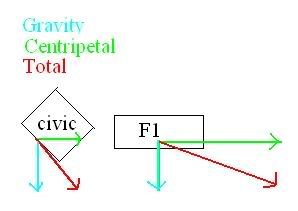
Now, that's still basically a two dimensional explanation. When we look at the entire four wheel system, we have to take into account the torsional stiffness of the chassis (the ability of the chassis to resist twisting the front relative to the rear). This is important, but in our case the giant steel frame of the chassis is much less compliant than our springs and roll bars (this becomes more of a concern when designing say a formula car with a super stiff suspension but only a carbon tub for a chassis). So basically, we can approximate that in a steady state corner with 50/50 front/rear weight distribution, the front of the car is rolling the same degrees as the rear of the car. Given that the front of the car is stiffer than the rear (or at least relative to what is was), that means that more of the force is being transfered at the front to roll it the same amount.
Looking at it the opposite way, every time we try to roll the car, we must exert more force on the front than the rear (remember they are linked by the chassis, if you roll one end you must roll the other the same amount).

Registered User
Joined: Jun 2006
Posts: 1,628
Likes: 0
Originally Posted by FormulaRedline,Mar 24 2008, 03:16 PM
This should be much easier to explain to you than the average American, because we can talk metric
.. every time we try to roll the car, we must exert more force on the front than the rear...
.. every time we try to roll the car, we must exert more force on the front than the rear...
 ...
... 

Registered User
Joined: Jun 2006
Posts: 1,628
Likes: 0
Originally Posted by FormulaRedline,Mar 24 2008, 03:16 PM
.. we have to take into account the torsional stiffness of the chassis (the ability of the chassis to resist twisting the front relative to the rear)...


Also, Inge says thanks for using a Civic in the example, & not a Fit

Seriously, thanks for taking the time & trouble to explain

Registered User
Joined: Aug 2003
Posts: 4,306
Likes: 0
From: Saint Louis (O'Fallon)
What's oversteer? 
That's when you get to eat those fig-things, right?

p.s. - FormulaRedline, excellent explanations. Don't forget the F1 car has ginormous wings and body panels that provide some serious down force to counteract the centripetal force.
What is happening is a transfer of Newtons.
p.s. - FormulaRedline, excellent explanations. Don't forget the F1 car has ginormous wings and body panels that provide some serious down force to counteract the centripetal force.
Registered User
Joined: Jun 2006
Posts: 1,628
Likes: 0
[QUOTE=rehile,Mar 24 2008, 07:10 PM]What's oversteer?
Too many Texans
That's when you get to eat those fig-things, right?
Don't forget with fig newtons that action & reaction are equal & opposite
p.s. - FormulaRedline, excellent explanations.
Too many Texans
That's when you get to eat those fig-things, right?
Don't forget with fig newtons that action & reaction are equal & opposite
p.s. - FormulaRedline, excellent explanations.

 You guys crack me up!!!
Joined: Aug 2002
Posts: 1,602
Likes: 3
From: St. Louis
Originally Posted by rehile,Mar 24 2008, 08:10 PM
p.s. - FormulaRedline, excellent explanations. Don't forget the F1 car has ginormous wings and body panels that provide some serious down force to counteract the centripetal force.

Registered User
Joined: Jun 2002
Posts: 625
Likes: 0
From: STL -> Tampa
[QUOTE=SlipAngle79,Mar 23 2008, 11:10 AM]
Impression:
So far it has improved rear grip under power, which is why I bought it, and the increased fornt roll stiffness has decreased steering effort slightly.
Impression:
So far it has improved rear grip under power, which is why I bought it, and the increased fornt roll stiffness has decreased steering effort slightly.
Registered User
Joined: Aug 2003
Posts: 4,306
Likes: 0
From: Saint Louis (O'Fallon)
Originally Posted by FormulaRedline,Mar 25 2008, 11:39 AM
I don't know if you were kidding or not...but in no way, shape, or form do wings counteract centripetal force. The whole purpose of a wing is in fact to help increase it. Holding the other variables constant, the more effective the wing you are running, the more grip you will have, the better the car can corner, hence increasing centripetal force.

Registered User
Joined: Aug 2003
Posts: 4,306
Likes: 0
From: Saint Louis (O'Fallon)
centripetal force (definitions)
the force, acting upon a body moving along a curved path, that is directed toward the center of curvature of the path and constrains the body to the path
The component of force acting on a body in curvilinear motion that is directed toward the center of curvature or axis of rotation. Centripetal force is necessary for an object to move with circular motion
NOT TO BE CONFUSED WITH (as in my case) centrifugal force...
an outward force on a body rotating about an axis, assumed equal and opposite to the centripetal force and postulated to account for the phenomena seen by an observer in the rotating body
The apparent force, equal and opposite to the centripetal force, drawing a rotating body away from the center of rotation, caused by the inertia of the body
My earlier point was a big wing will reduce the resultant force vector while cornering by increasing the apparent force of gravity - but was considering (incorrectly) centrifugal force - the stuff that makes you lose traction.
Sorry FormulaRedline
the force, acting upon a body moving along a curved path, that is directed toward the center of curvature of the path and constrains the body to the path
The component of force acting on a body in curvilinear motion that is directed toward the center of curvature or axis of rotation. Centripetal force is necessary for an object to move with circular motion
NOT TO BE CONFUSED WITH (as in my case) centrifugal force...
an outward force on a body rotating about an axis, assumed equal and opposite to the centripetal force and postulated to account for the phenomena seen by an observer in the rotating body
The apparent force, equal and opposite to the centripetal force, drawing a rotating body away from the center of rotation, caused by the inertia of the body
My earlier point was a big wing will reduce the resultant force vector while cornering by increasing the apparent force of gravity - but was considering (incorrectly) centrifugal force - the stuff that makes you lose traction.
Sorry FormulaRedline