


Toda Spec A v2 cams, P&P dyno :/


Thread Starter
Registered User
Joined: Jan 2003
Posts: 8,482
Likes: 3
From: Wylie, TX

Edit: The correct results are posted in another thread located here:
http://forums.s2ki.com/forums/showthread.p...threadid=168603
The following thread includes some troubleshooting info for an issue we had when installing the cams.
Warning: I'd like to first advise everyone that they should purchase Toda products from an authorized retailer. Toda does not offer technical support or warranties if you do not purchase their parts from an authorized retailer. You can check Toda's web page for a list of authorized retailers. Don't assume that a person selling Toda parts is an authorized retailer... I made that mistake, and now I am suffering for it.
Well, anyway... here it is folks, a dyno from a 2003 S2000 w/ Toda Spec A v2 cams. The cams (and Toda valvesprings) were installed by Marcucci Motorsports in Mansfield, TX. At the same time, Marcucci Motorsports performed a mild Port & Polish, and installed a Hondata intake manifold insulator.
Keep in mind that all other components remain unchanged (stock). I still have the stock intake, header, exhaust and ECU.
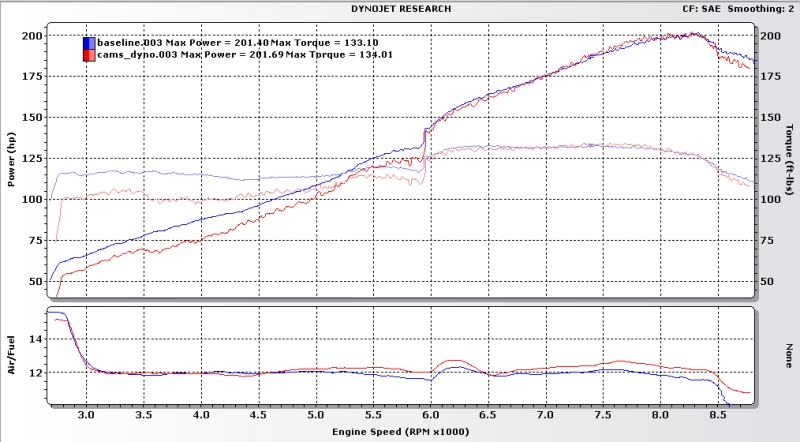
Summary: Note that the red graph is the "after" graph. This indicates huge losses in torque down low, and a break-even for the most part on the high cam. I can offer no explanation as to why there were no gains up high, even though it appears that the fuel mixture was leaned out a little. Nor can I offer any insight as to why the losses were so astronomical on the low cam.
While I am definitely disappointed in these results, I will concede that the "relatively restrictive" airflow of the stock components may be preventing these cams (and the better flowing head) from performing optimally. I will continue on the NA path with the hopes that each mod will multiply the gains of the former, and that I will still be able to reach my power goal.
Next to come is fuel tuning w/ a VAFC, then I'll start opening up the airways.
http://forums.s2ki.com/forums/showthread.p...threadid=168603
The following thread includes some troubleshooting info for an issue we had when installing the cams.
Warning: I'd like to first advise everyone that they should purchase Toda products from an authorized retailer. Toda does not offer technical support or warranties if you do not purchase their parts from an authorized retailer. You can check Toda's web page for a list of authorized retailers. Don't assume that a person selling Toda parts is an authorized retailer... I made that mistake, and now I am suffering for it.
Well, anyway... here it is folks, a dyno from a 2003 S2000 w/ Toda Spec A v2 cams. The cams (and Toda valvesprings) were installed by Marcucci Motorsports in Mansfield, TX. At the same time, Marcucci Motorsports performed a mild Port & Polish, and installed a Hondata intake manifold insulator.
Keep in mind that all other components remain unchanged (stock). I still have the stock intake, header, exhaust and ECU.
Summary: Note that the red graph is the "after" graph. This indicates huge losses in torque down low, and a break-even for the most part on the high cam. I can offer no explanation as to why there were no gains up high, even though it appears that the fuel mixture was leaned out a little. Nor can I offer any insight as to why the losses were so astronomical on the low cam.
While I am definitely disappointed in these results, I will concede that the "relatively restrictive" airflow of the stock components may be preventing these cams (and the better flowing head) from performing optimally. I will continue on the NA path with the hopes that each mod will multiply the gains of the former, and that I will still be able to reach my power goal.
Next to come is fuel tuning w/ a VAFC, then I'll start opening up the airways.

Registered User
Joined: Jun 2002
Posts: 4,170
Likes: 0
From: Brookfield
Wow, thats not good. I realize the dynos show losses, but what does your butt dyno say? Noticeable loss, or still feel the same to you?
I agree that changing out all the breathing items on the car will help out a lot (intake, header and exhaust)
I agree that changing out all the breathing items on the car will help out a lot (intake, header and exhaust)

Registered User
Joined: Oct 2003
Posts: 272
Likes: 0
From: Santa Clarita
damn not bad at all-i say this because i feel that the air flow through the motor is being restricted as u say. considering that ur set up is still stock(external) i believe this will get u more power in the end-for example an i/h/e will prove to be a much more powerful addition as ever before. good luck and thanks for the post and as far as the port did they do a bench flow on the head?-
Registered User
Joined: Apr 2001
Posts: 2,898
Likes: 1
From: Fort Worth
I'll be the first to say that I do not think the i/h/e is a factor here. Gains may be minimal but there should in no way be a loss.
The head was not flowbenched before and after. The work was very minor with only a few cc's removed from the CC and even less from the ports. Each cylinder was cc'd and the average value used to determine the proper mill to restore the CR to stock. Once reassembled and run for several miles and about 1 hour a compression test was done warm- resulting in stock numbers.
I am most concerned with the dyno right now. The shop has a good reputation as does Dynojet. I did find the following article, though:
http://www.sportcompactcarweb.com/editors/...c_technobabble/
specifically:
I don't think this applies to us much as the only difference should have been in the ambient temp.
This may be a factor, though:
At any rate, I am suspicious that the CF might be "overcorrecting" or there is some other error. We may test another vehicle (otherwise stock) and will probably test mxt's car again with the stock cams to verify the dyno results. I will say, though, that at the roughly 20 degree F differential between the baseline and "Toda" run that with 1% change in power for every 5 degrees... that would be right at a 4% increase in power which is what we've seen.
The head was not flowbenched before and after. The work was very minor with only a few cc's removed from the CC and even less from the ports. Each cylinder was cc'd and the average value used to determine the proper mill to restore the CR to stock. Once reassembled and run for several miles and about 1 hour a compression test was done warm- resulting in stock numbers.
I am most concerned with the dyno right now. The shop has a good reputation as does Dynojet. I did find the following article, though:
http://www.sportcompactcarweb.com/editors/...c_technobabble/
specifically:
The SAE correction factor used by Dynojet assumes that lower air pressure at the sensor box means lower air pressure in the intake manifold, though, so at 5,000 feet the dyno is applying a 20-percent correction factor to compensate for a loss of air density that the engine never sees. This is fine if you are doing all your tests in Denver, but if you do one test in Denver and one test in New Orleans (the highest mountain in New Orleans is 12 feet above sea level) uncorrected numbers will be more accurate.
The SAE correction factors are only accurate over a relatively limited range, and the Dynojet software is smart enough to warn you when two runs with wildly different correction factors are being compared. The software in New Orleans can't check your glovebox for that last dyno printout from Denver, though, so you'll have to warn yourself.
The SAE correction factors are only accurate over a relatively limited range, and the Dynojet software is smart enough to warn you when two runs with wildly different correction factors are being compared. The software in New Orleans can't check your glovebox for that last dyno printout from Denver, though, so you'll have to warn yourself.
This may be a factor, though:
This is where the dyno operator has to be extremely devious. If you mess with the readings that the computer uses to calculate the correction factor, you can alter the corrected output significantly. The one reading that the built-in sensors do not take automatically is humidity. The dyno operator has to enter the humidity correction themselves. Since the humidity is manually entered into the computer it is the easiest to alter. While humidity numbers are obviously suspect, the temperature can be faked pretty easily as well. We actually decided to try this one, just to see how easily it could be done.
Jackson Racing's Dynojet is set up with the weather data box mounted on a perpetually-shady portion of the dyno room wall. The temperature probe hangs under the box in the open air about two feet off the ground--right where most air intakes pull their air supply. Oscar Jackson pointed out that he has seen these boxes mounted where they were more easily accessed, and has even seen the temperature sensor hanging on a divider wall next to the computer, or in a drawer on the dyno bench. In the drawer, an unscrupulous dyno operator could put his or her hand around the sensor before doing a run, bumping the ambient temperature reading up into the 90-degree range. With it hanging on a well-placed wall, the sensor could be flipped from the shade into direct sunlight, where it could slowly bake up to a nice, warm temperature.
The wire on Jackson's sensor was only about two feet long, so we couldn't get it into the sun, and a shield prevented holding the sensor in a warm hand from having much effect. Instead, I cupped my hands around the sensor and blew on it. Within 30 seconds the dyno was reading 95 degree ambient temperatures even though our baseline run made a few minutes earlier had been in 66-degree air. We made another run with the engine breathing 66-degree air, but the dyno correcting for 95-degree air. Our corrected power jumped from 136 hp to 143 hp.
Jackson Racing's Dynojet is set up with the weather data box mounted on a perpetually-shady portion of the dyno room wall. The temperature probe hangs under the box in the open air about two feet off the ground--right where most air intakes pull their air supply. Oscar Jackson pointed out that he has seen these boxes mounted where they were more easily accessed, and has even seen the temperature sensor hanging on a divider wall next to the computer, or in a drawer on the dyno bench. In the drawer, an unscrupulous dyno operator could put his or her hand around the sensor before doing a run, bumping the ambient temperature reading up into the 90-degree range. With it hanging on a well-placed wall, the sensor could be flipped from the shade into direct sunlight, where it could slowly bake up to a nice, warm temperature.
The wire on Jackson's sensor was only about two feet long, so we couldn't get it into the sun, and a shield prevented holding the sensor in a warm hand from having much effect. Instead, I cupped my hands around the sensor and blew on it. Within 30 seconds the dyno was reading 95 degree ambient temperatures even though our baseline run made a few minutes earlier had been in 66-degree air. We made another run with the engine breathing 66-degree air, but the dyno correcting for 95-degree air. Our corrected power jumped from 136 hp to 143 hp.
Thread Starter
Registered User
Joined: Jan 2003
Posts: 8,482
Likes: 3
From: Wylie, TX
If anyone has dyno charts from their Todas, I'd really like to see them. From the threads that I've read, almost everyone with these cams state that they should make strong gains below VTEC. However, I have found one person with a dyno chart that is suspiciously similar to mine. I'd just like to see other charts for these cams, so I should know whether or not my results are typical.
Thanks!
-Marcus.
Thanks!
-Marcus.
Trending Topics

Thread Starter
Registered User
Joined: Jan 2003
Posts: 8,482
Likes: 3
From: Wylie, TX
Originally posted by vapors2k
Marcus, check your PM. You are the rare and basically only person I've seen to post yourc charts from the toda cams.
Marcus, check your PM. You are the rare and basically only person I've seen to post yourc charts from the toda cams.
I'm definitely hoping for 2. Maybe there is something simple that is missing that is causing these cams to lose power. Maybe there is just something that needs to be re-adjusted, and then I'll get the gains that I expected.
Of the few people that have posted in other threads stating that they got gains on the low end, I haven't seen any of them post dyno charts. That concerns me.