


Dating is hard these days





Thread Starter
Registered User
Joined: Jul 2008
Posts: 2,450
Likes: 0

Originally Posted by Mark355,Aug 8 2010, 03:20 PM

i need my truck to go back and forth to work and to haul around my boys
my s is my s and i'm never getting rid of it EVER, i have an agreement with my best friend he's going to "buy" my hatch
she can have the vibe, i don't want it, as far as the jet ski, it was my idea to buy it with her settlement from the accident but it's in her name so it's hers, but she needs the ridgeline to launch it
 or it could go the other way
the house is totally out of the question, it's not in my name so therefore it is not community property, she can have the furniture and shit i'd be happy watching tv sitting on a bucket
we did come to an agreement on one thing though i get my boys when i'm in and she has them when i'm out but thats the only thing we can agree on with one of us wanting to kill the other
i have a feeling this is going to get ugly before it's all said and done
i just need to stay sober untill everything is done with so she can't use my alcoholism against me





Registered User
Joined: Aug 2008
Posts: 293
Likes: 0
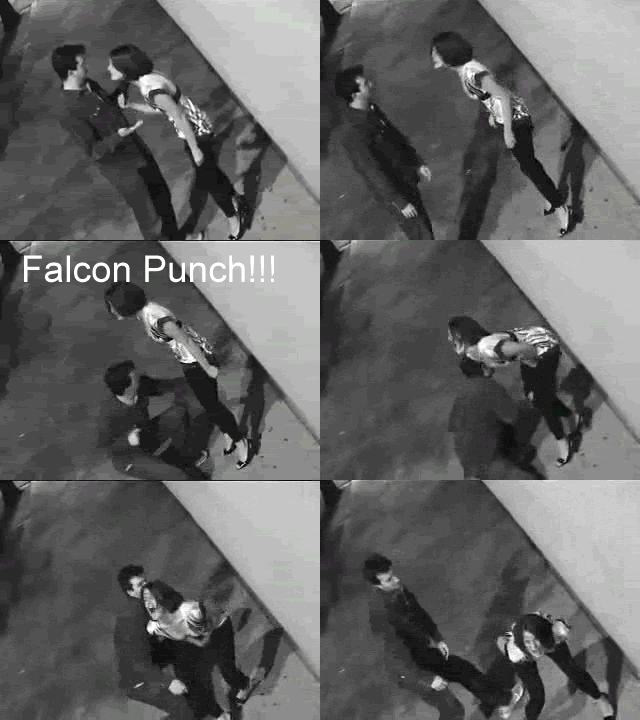
^ lol what HK movie is that from?
also:
http://www.nydailynews.com/news/world/2010...k_arrested.html
Damn, I prolly woulda hit the before pic. Psychooooooooooo
also:
http://www.nydailynews.com/news/world/2010...k_arrested.html
Damn, I prolly woulda hit the before pic. Psychooooooooooo

Banned
Joined: Mar 2005
Posts: 1,893
Likes: 44
From: Northern Vergina
Originally Posted by The Gasman,Aug 8 2010, 08:18 PM
Sorry to say, but reading this makes me love my life.
FYI, the tape is not admissible in court.
FYI, the tape is not admissible in court.
"
FEDERAL RULE OF EVIDENCE 901 (A) PROVIDES in general terms that the requirement of authentication or identification as a condition precedent to the admissibility of evidence is satisfied by proffered proof sufficient to support a finding that the matter in question is what its proponent claims it to be. A foundation for authentication of sound recordings was established in the federal courts in United States v. McKeever,*1* and upheld in cases such as United States v. McMillan.*2* In McMillan the court ruled that where a government agent testified that he heard the voice .of an informant at all times when he was making a recording of a telephone conversation, that this part of the conversation was accurate, and that immediately after the telephone calls were completed, a tape was replayed by the agent in the informant's presence to verify that the conversation had in fact been recorded and that the instruments were operating correctly, it was sufficiently established that the recordings were true and accurate as a basis for their admission in evidence.
In United States v. Kandiel,*3* the court ruled that any question concerning the credibility of a witness who identifies voices on a tape recording admitted into evidence simply goes to the weight which the jury accords the evidence, not its admissibility. Referring to McMillan the court said:
Applying [the McMillan case], we conclude that the government laid a proper foundation for introduction of the two cassette tapes into evidence. The tapes were found at appellant's home. Ahmed Kandiel [defendant's brother] testified that the tapes were made in Egypt and sent to appellant by their mother and father while Ahmed was living with appellant. The contents of the tape recordings have numerous references to people, places and activities that were corroborative of other testimony in the record. We believe the government has offered sufficient circumstantial evidence to establish the prima facie authenticity and correctness of the tapes. Furthermore we find that the government sufficiently established the identity of the speakers through the testimony of Ahmed Kandiel. Appellant's argument that Ahmed's credibility was suspect, and that therefore his testimony was insufficient to establish foundation for the admission of the tapes is with out merit. Identification of a voice, whether heard firsthand or through mechanical or electronic transmission or recording, may be made "by opinion based upon hearing the voice at any time under circumstances connecting it with the alleged speaker." Fed. R. Evid. 901(b)(5). Any question concerning the credibility of the identifying witness simply goes to the weight the jury accords this evidence, not to its admissibility. United States v. Kirk, 534 E2d 1262, 1277 (8th Cir. 1976), cert. denied, 433 U.S. 907, 97 S. Ct. 2971, 53 L. Ed. 2d 1091 (1977). Our review of the record convinces us that the district court did not abuse its discretion in finding that proper foundation was laid for admitting the tapes. See United States v. Johnson, 767 E2d 1259, 1271 (8th Cir. 1985).*4*The cases are, therefore, now in general agreement as to what constitutes a proper foundation for the admission of a sound recording and indicate a reasonably strict adherence to the rules prescribed for testing admissibility of recordings, as set forth in McMillan.*5*
These rules can be summarized as follows:
The recording device must have been capable of taking the conversation now offered in evidence
The operator of the device must be competent to operate the device
The recording must be authentic and correct
Changes, additions or deletions have not been made in the recording
The recording must have been preserved in a manner that is shown to the court
The speakers must be identified
The conversation elicited was made voluntarily and in good faith, without any kind of inducement.*6*
"

Thread
Thread Starter
Forum
Replies
Last Post
magician
Off-topic Talk
12
Mar 10, 2003 03:27 AM
DR. JEKYLL
Off-topic Talk
21
Aug 10, 2002 10:20 PM

