


Image of a single molecule


Thread Starter


Joined: Mar 2004
Posts: 17,163
Likes: 4


Registered User
Joined: Jul 2001
Posts: 6,592
Likes: 0
From: Yorba Linda, CA

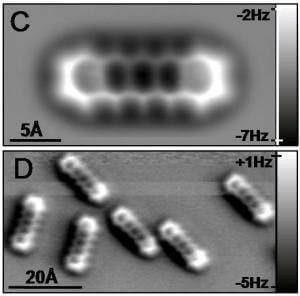
Pentacene.
That's so cool! It looks like a bunch of fuzzy caterpillars.
I was wondering if they were using tunneling electron microscopy for the image, but it seems I'm about a generation behind: it's an Atomic Force Microscope.
Wow!
That's so cool! It looks like a bunch of fuzzy caterpillars.
I was wondering if they were using tunneling electron microscopy for the image, but it seems I'm about a generation behind: it's an Atomic Force Microscope.
Wow!



Registered User
Joined: Jul 2001
Posts: 6,592
Likes: 0
From: Yorba Linda, CA
One interesting feature to note about the picture is that the carbon-carbon bonds are all the same size (length).
The wikipedia article I quoted uses the old notation for a benzene ring, depicting alternating single and double carbon-carbon bonds. The newer notation for a benzene ring - a hexagon with a circle inside it - arose when chemists or physicists discovered that the bonds in a benzene molecule are all the same length: about half-way between the length of a single carbon-carbon bond and a double carbon-carbon bond.
The wikipedia article I quoted uses the old notation for a benzene ring, depicting alternating single and double carbon-carbon bonds. The newer notation for a benzene ring - a hexagon with a circle inside it - arose when chemists or physicists discovered that the bonds in a benzene molecule are all the same length: about half-way between the length of a single carbon-carbon bond and a double carbon-carbon bond.
Trending Topics

Registered User
Joined: May 2009
Posts: 26,916
Likes: 1
From: Houston, Texas
Originally Posted by magician,Sep 14 2009, 07:38 PM
One interesting feature to note about the picture is that the carbon-carbon bonds are all the same size (length).
The wikipedia article I quoted uses the old notation for a benzene ring, depictingalternating single and double carbon-carbon bonds. The newer notation for a benzene ring - a hexagon with a circle inside it - arose when chemists or physicists discovered that the bonds in a benzene molecule are all the same length: about half-way between the length of a single carbon-carbon bond and a double carbon-carbon bond.
The wikipedia article I quoted uses the old notation for a benzene ring, depictingalternating single and double carbon-carbon bonds. The newer notation for a benzene ring - a hexagon with a circle inside it - arose when chemists or physicists discovered that the bonds in a benzene molecule are all the same length: about half-way between the length of a single carbon-carbon bond and a double carbon-carbon bond.



Thread Starter
Joined: Mar 2004
Posts: 17,163
Likes: 4
Originally Posted by magician,Sep 14 2009, 10:38 PM
One interesting feature to note about the picture is that the carbon-carbon bonds are all the same size (length).
The wikipedia article I quoted uses the old notation for a benzene ring, depicting alternating single and double carbon-carbon bonds. The newer notation for a benzene ring - a hexagon with a circle inside it - arose when chemists or physicists discovered that the bonds in a benzene molecule are all the same length: about half-way between the length of a single carbon-carbon bond and a double carbon-carbon bond.
The wikipedia article I quoted uses the old notation for a benzene ring, depicting alternating single and double carbon-carbon bonds. The newer notation for a benzene ring - a hexagon with a circle inside it - arose when chemists or physicists discovered that the bonds in a benzene molecule are all the same length: about half-way between the length of a single carbon-carbon bond and a double carbon-carbon bond.