


OHLINS dfv question


Joined: Apr 2009
Posts: 2,629
Likes: 42
From: Windsor, CA

The purpose of preload is to change the allocation of total travel between bump travel and droop travel. Most sources will point to allocating 1/2 to 2/3 of available travel to bump and the remaining to droop. The goal is to avoid bump-stop engagement and its corresponding spike in effective spring rate. OEMs often choose to utilize the bump-stop as part of the overall tuning package, choosing spring rates that cause the car to corner on the bump stop intentionally, which is how they can make a car feel "neutral" until you reach the limit, and then have it understeer safely (harder front bump stop than rear bump stop). I suspect Ohlins took this approach with the DFV as well, knowing that they were travel-limited and knowing people would be into the bump stops all the time. You'll notice the bump stop on the DFV is relatively large, has progressive rate, and is relatively soft at the start of engagement. Personally, I want my car to handle the same whether I'm at the limit or not, so I prefer to avoid bump stop contact when cornering. Hence my desire to run the shock with a more even split of bump/rebound travel.
As Urge relays from Gernby, you can't split travel evenly on the rear DFV without compromising on ride height. Sounds like Gernby ultimately chose to accept compromised bump travel in exchange for keeping a low ride height, so he went with 15mm preload and it's working for him. I chose a higher ride height (pending RCA install). Different strokes for different folks.
With my 12K rear springs and associated preload settings I currently have roughly 2/3 of my available travel in bump, with the remaining 1/3 as droop. I haven't had issues with rear-wheel lift on track yet, however I'm not running a rear sway bar so that helps to remove inside wheel jacking forces. If I do eventually run into rear wheel lift, I will obviously need to reduce preload as the S2000's diff needs both wheels on the ground at all times.
As Urge relays from Gernby, you can't split travel evenly on the rear DFV without compromising on ride height. Sounds like Gernby ultimately chose to accept compromised bump travel in exchange for keeping a low ride height, so he went with 15mm preload and it's working for him. I chose a higher ride height (pending RCA install). Different strokes for different folks.
With my 12K rear springs and associated preload settings I currently have roughly 2/3 of my available travel in bump, with the remaining 1/3 as droop. I haven't had issues with rear-wheel lift on track yet, however I'm not running a rear sway bar so that helps to remove inside wheel jacking forces. If I do eventually run into rear wheel lift, I will obviously need to reduce preload as the S2000's diff needs both wheels on the ground at all times.


Joined: Mar 2005
Posts: 322
Likes: 3
Originally Posted by steven88' timestamp='1423483809' post='23498949
[quote name='andrewhake' timestamp='1423255175' post='23496403']
It's a good question, that still really hasn't been answered in my opinion.
It's a good question, that still really hasn't been answered in my opinion.
So what's the verdict here? I know Urge is a well known dealer who sells Ohlins kits, and is very educated on Ohlins products. He says preload should not be that high, and recommends the 2mm preload. Andrew and Steve both say they run Ohlins recommended preload with no issues. I've also read others running recommended settings with no problem.
Urge, do you happen to have any further comment as to why thomsbrain and Gernby recommends 30mm of preload? Thanks.
He uses 0.08" or 2mm Preload on the Front and 0.6" or 15mm Preload on the rear. His rationale for the 15mm preload is to put the piston in the middle of the shock. He wanted to go more but was limited by ride height. IMO, I think 15mm is a little much, but Gerby has numerous FTD against much more modified cars running 2X higher cost shocks.
Your milage may vary.
[/quote]
And this is all relative to the stock 8kg Ohlins rear springs right? Would any of this change if someone went with 10kg Swift or Hypercoil rear springs?

Joined: Jul 2003
Posts: 13,471
Likes: 35
From: Upstate NY
Similarly, how does a beefy front sway bar play into this? I have set mine to 2mm and run a Gendron 1.25" solid front bar. I don't have any funky handling issues. I don't spend any time on the track, but have done close to 20 autocross events with this set up.

Thread Starter


Joined: Dec 2002
Posts: 514
Likes: 40
From: Seneca Falls
I ended up going with the 15mm pre-load for the rears, which I set with the shock in the car. All other set-up was per OHLINS manual. I have not measured yet but I can tell by eye that the front is lowered, but the rear does not seem any lower??? I was under the assumption the pre-load wouldn't effect ride-height at all. I'll take measurements tonight.

Thread Starter
Joined: Dec 2002
Posts: 514
Likes: 40
From: Seneca Falls
I thought adding pre-load would just compress the spring, not extend the shock, in turn changing ride height. Is this what happened? So, if I want to keep the 15mm pre-load I will need to adjust ride-height? How about if I just reset pre-load back to 2mm, will that give me the 25mm drop?

Registered User
Joined: Dec 2010
Posts: 431
Likes: 4
Im running 2mm pre load all the way around. I didnt notice i was hitting bumpstops At a local auto X nor at homestead. This is coming into turn ten flat and noticed no riding of the bumpstops. Anyone who was driven there knows that there is a pretty rough dip and elevation change. 8 clicks all the around and higher tire pressure than desired. I only ran a couple of sessions so i still haven't been able to dial in the
When I was on my old spoon showa coilovers inm y old car i would litteraly hit the bumpstop so hard on turn 10 that it would unsettle the car to what i can best describe to being a pop and rear shift. Not fun.
I havent had much of any seat time in the new car due to work, funds and building it.
When I was on my old spoon showa coilovers inm y old car i would litteraly hit the bumpstop so hard on turn 10 that it would unsettle the car to what i can best describe to being a pop and rear shift. Not fun.
I havent had much of any seat time in the new car due to work, funds and building it.
Thread Starter
Joined: Dec 2002
Posts: 514
Likes: 40
From: Seneca Falls
I finally got these installed and went for a couple of test drives this weekend. I'm posting some installation pics of aspects of the install that I have not seen in other DFV review posts.
One of my original questions in this post was concerning the adjuster knobs. They are attached to the nut below them and the whole assembly is removed by turning them off the shaft they are threaded onto. I found this little tid-bit in someone else’s post, after I had them off. He suggested tightening the adjuster knob to full stiff and then turning the nut off, which is what I did also.

For the rear boots, I just cut out a section so I could keep both ends, retaining the nice seal to the shock body. Also making it easy to check and see where your bump stop is.

After you remove the spare tire and plastic trim panels from the trunk, you’ll find this:

As others have mentioned it’s a tight fit to get to that adjuster knob.

As stated previously, I had a blond moment thinking that the 15mm pre-load would not change ride-height. After initial install and lowering the car back to the ground, the rear height had not changed from stock. My next step after learning of my mistake was to simply use the shock to get the lowered height I was after. Simple, right? I did some calculating and started turning the shock into the bracket. I figured I’d need to turn the shock approx.16.5 turns to get to where I needed to be. After about 13 turns I could no longer turn the spanner wrench by hand. At that point I decided to just go with 2mm of pre-load. I imagine the 15mm would be possible by setting pre-load with the shock mounted on the car (like I did) and then removing the shock and getting your ride-height by turning the bracket. Trying to do this on the car proved quite difficult as the spring tension seemed to be working against me. I still had to remove the side I was working on to put everything back to its initial settings because I had everything out of whack at that point. Luckily I could just discern my original paint mark on the shock, to know where to re-set the lower lock ring. Here is a picture as of my first bolt in:

And of course the obligatory……
Before: F 14.25 R 14.75

After: F 13.25 R 13.75

I finally took it for a drive. I could feel the difference in the spring, and it was quiet, no squeaks or rattles. I think my biggest impression from my new mod is just how good the stock suspension was. I do like the looks of the car with the 1” drop. Now I just need to re-learn the handling aspects of the new suspension, considering I have been enjoying the stock ride all these years.
I’ve put about 100 miles on the shocks and evened out the ride height side-to-side. Tomorrow I’m getting an alignment and then this weekend is the Spring Enduro at my local auto-x track.
One of my original questions in this post was concerning the adjuster knobs. They are attached to the nut below them and the whole assembly is removed by turning them off the shaft they are threaded onto. I found this little tid-bit in someone else’s post, after I had them off. He suggested tightening the adjuster knob to full stiff and then turning the nut off, which is what I did also.
For the rear boots, I just cut out a section so I could keep both ends, retaining the nice seal to the shock body. Also making it easy to check and see where your bump stop is.
After you remove the spare tire and plastic trim panels from the trunk, you’ll find this:
As others have mentioned it’s a tight fit to get to that adjuster knob.
As stated previously, I had a blond moment thinking that the 15mm pre-load would not change ride-height. After initial install and lowering the car back to the ground, the rear height had not changed from stock. My next step after learning of my mistake was to simply use the shock to get the lowered height I was after. Simple, right? I did some calculating and started turning the shock into the bracket. I figured I’d need to turn the shock approx.16.5 turns to get to where I needed to be. After about 13 turns I could no longer turn the spanner wrench by hand. At that point I decided to just go with 2mm of pre-load. I imagine the 15mm would be possible by setting pre-load with the shock mounted on the car (like I did) and then removing the shock and getting your ride-height by turning the bracket. Trying to do this on the car proved quite difficult as the spring tension seemed to be working against me. I still had to remove the side I was working on to put everything back to its initial settings because I had everything out of whack at that point. Luckily I could just discern my original paint mark on the shock, to know where to re-set the lower lock ring. Here is a picture as of my first bolt in:
And of course the obligatory……
Before: F 14.25 R 14.75
After: F 13.25 R 13.75
I finally took it for a drive. I could feel the difference in the spring, and it was quiet, no squeaks or rattles. I think my biggest impression from my new mod is just how good the stock suspension was. I do like the looks of the car with the 1” drop. Now I just need to re-learn the handling aspects of the new suspension, considering I have been enjoying the stock ride all these years.
I’ve put about 100 miles on the shocks and evened out the ride height side-to-side. Tomorrow I’m getting an alignment and then this weekend is the Spring Enduro at my local auto-x track.


Joined: Sep 2012
Posts: 3,303
Likes: 214
From: Greenwood, AR
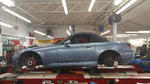
The rear looks annoying high to me. I've noticed with these coilovers that getting lower in the rear is difficult, but you could slam the front if you wanted to. Tomorrow, I am going back out into the garage to see if I can even up the rear as one seems to go a little lower than the other side. The low side is acceptable to me (13"), but the higher side is not. I haven't been able to drive on these yet due to winter, so I haven't been in a hurry to get the coilovers setup, especially since a buddy will be corner balancing them for me when I tow it out to Colorado next month.

Joined: Sep 2003
Posts: 543
Likes: 1
From: Carnation
I ran mine at the Ohlins recommended settings for a while. Then I decided that while Ohlins probably knows more about damping than Honda, they don't know more about suspension geometry, and I raised it back up to stock height. "Looks" have nothing to do with why these shocks are on my car.