


500HP to 600 ?


Thread Starter

Joined: Sep 2012
Posts: 172
Likes: 7

Thanks guys for replying. I'd PREFER to keep my existing GTX3076 and go to E85 to achieve 600 HP. Would be happy with that.
I'm even considering the upgraded AEM2 w/ 93/E85 mixed % vs straight E85 but wonder if I'd need to keep the meth or could ditch it....
I'm even considering the upgraded AEM2 w/ 93/E85 mixed % vs straight E85 but wonder if I'd need to keep the meth or could ditch it....
Thread Starter
Joined: Sep 2012
Posts: 172
Likes: 7
If 100% E85 tune, dropping meth for sure
If mixing on the 93/E85 with the updated AEM2 software.....I'd think I'd still be OK to drop the meth but what if I'm running straight 93 and no meth available (not a lot available near me) ? Just have to be careful and hope a ZR1 doesn't roll up on me ?!??!
If mixing on the 93/E85 with the updated AEM2 software.....I'd think I'd still be OK to drop the meth but what if I'm running straight 93 and no meth available (not a lot available near me) ? Just have to be careful and hope a ZR1 doesn't roll up on me ?!??!


Joined: Mar 2007
Posts: 5,997
Likes: 0
From: chino hills
You'll loose a tiny bit of spool but youll gain more top end which will help you get to 600whp a little easier.
Straight from garretts website
http://www.turbobygarrett.com/turbob...housing_sizing
Small A/R
Turbine performance is greatly affected by changing the A/R of the housing, as it is used to adjust the flow capacity of the turbine. Using a smaller A/R will increase the exhaust gas velocity into the turbine wheel. This provides increased turbine power at lower engine speeds, resulting in a quicker boost rise. However, a small A/R also causes the flow to enter the wheel more tangentially, which reduces the ultimate flow capacity of the turbine wheel. This will tend to increase exhaust backpressure and hence reduce the engine's ability to "breathe" effectively at high RPM, adversely affecting peak engine power.
Large A/R
Conversely, using a larger A/R will lower exhaust gas velocity, and delay boost rise. The flow in a larger A/R housing enters the wheel in a more radial fashion, increasing the wheel's effective flow capacity, resulting in lower backpressure and better power at higher engine speeds.
We have HIGH revving motors, with awesome heads so it's best to get a big A/R so our motors don't choke in the upper rpms

Straight from garretts website
http://www.turbobygarrett.com/turbob...housing_sizing
Small A/R
Turbine performance is greatly affected by changing the A/R of the housing, as it is used to adjust the flow capacity of the turbine. Using a smaller A/R will increase the exhaust gas velocity into the turbine wheel. This provides increased turbine power at lower engine speeds, resulting in a quicker boost rise. However, a small A/R also causes the flow to enter the wheel more tangentially, which reduces the ultimate flow capacity of the turbine wheel. This will tend to increase exhaust backpressure and hence reduce the engine's ability to "breathe" effectively at high RPM, adversely affecting peak engine power.
Large A/R
Conversely, using a larger A/R will lower exhaust gas velocity, and delay boost rise. The flow in a larger A/R housing enters the wheel in a more radial fashion, increasing the wheel's effective flow capacity, resulting in lower backpressure and better power at higher engine speeds.
We have HIGH revving motors, with awesome heads so it's best to get a big A/R so our motors don't choke in the upper rpms
Thread Starter
Joined: Sep 2012
Posts: 172
Likes: 7
You'll loose a tiny bit of spool but youll gain more top end which will help you get to 600whp a little easier.
Straight from garretts website
http://www.turbobygarrett.com/turbob...housing_sizing
Small A/R
Turbine performance is greatly affected by changing the A/R of the housing, as it is used to adjust the flow capacity of the turbine. Using a smaller A/R will increase the exhaust gas velocity into the turbine wheel. This provides increased turbine power at lower engine speeds, resulting in a quicker boost rise. However, a small A/R also causes the flow to enter the wheel more tangentially, which reduces the ultimate flow capacity of the turbine wheel. This will tend to increase exhaust backpressure and hence reduce the engine's ability to "breathe" effectively at high RPM, adversely affecting peak engine power.
Large A/R
Conversely, using a larger A/R will lower exhaust gas velocity, and delay boost rise. The flow in a larger A/R housing enters the wheel in a more radial fashion, increasing the wheel's effective flow capacity, resulting in lower backpressure and better power at higher engine speeds.
We have HIGH revving motors, with awesome heads so it's best to get a big A/R so our motors don't choke in the upper rpms
Straight from garretts website
http://www.turbobygarrett.com/turbob...housing_sizing
Small A/R
Turbine performance is greatly affected by changing the A/R of the housing, as it is used to adjust the flow capacity of the turbine. Using a smaller A/R will increase the exhaust gas velocity into the turbine wheel. This provides increased turbine power at lower engine speeds, resulting in a quicker boost rise. However, a small A/R also causes the flow to enter the wheel more tangentially, which reduces the ultimate flow capacity of the turbine wheel. This will tend to increase exhaust backpressure and hence reduce the engine's ability to "breathe" effectively at high RPM, adversely affecting peak engine power.
Large A/R
Conversely, using a larger A/R will lower exhaust gas velocity, and delay boost rise. The flow in a larger A/R housing enters the wheel in a more radial fashion, increasing the wheel's effective flow capacity, resulting in lower backpressure and better power at higher engine speeds.
We have HIGH revving motors, with awesome heads so it's best to get a big A/R so our motors don't choke in the upper rpms
Great info and thanks for the input, appreciated.
I only went w/ the .63 since that what builder/tuner suggested as I asked for the "quickest" possible set up.
I'm surely not opposed to changing to .82 but I'm really wondering at what overall cost and can I really tell the diff....IE is it really worth it ? Theoretically it sounds like it but I'm surely not disappointed in the way the .63 performs but I don't have any reference either.
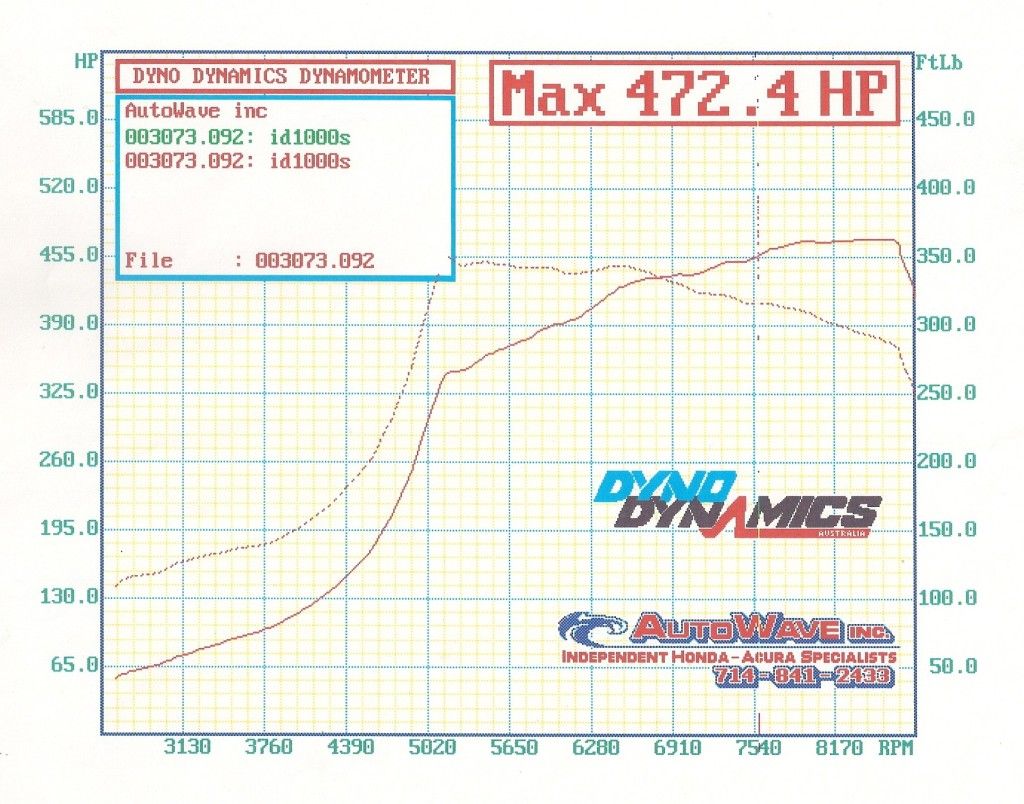
* If you care, attached is my dyno based on .63 so not sure what .82 or 1.06 would look like. Any comments there ?
Will surely consider if it comes to that point so thanks again !

Joined: Mar 2007
Posts: 5,997
Likes: 0
From: chino hills
I dunno your setup but I'm running full race tubular manifold gtx3076/0.82 and I hit full boost at 5000rpm 16psi so it wont be much off from yours. For what you told your tuner what you wanted, I would've selected the .63 for you also. Honestly I'd just keep what you have and make the switch to e85. Crank it to 23-25 psi and see what happens. Your lowered compression so the motor will be fine.


Registered User
Joined: Dec 2005
Posts: 5,651
Likes: 0
From: huntington long island
I dunno your setup but I'm running full race tubular manifold gtx3076/0.82 and I hit full boost at 5000rpm 16psi so it wont be much off from yours. For what you told your tuner what you wanted, I would've selected the .63 for you also. Honestly I'd just keep what you have and make the switch to e85. Crank it to 23-25 psi and see what happens. Your lowered compression so the motor will be fine.
Thread Starter
Joined: Sep 2012
Posts: 172
Likes: 7
I dunno your setup but I'm running full race tubular manifold gtx3076/0.82 and I hit full boost at 5000rpm 16psi so it wont be much off from yours. For what you told your tuner what you wanted, I would've selected the .63 for you also. Honestly I'd just keep what you have and make the switch to e85. Crank it to 23-25 psi and see what happens. Your lowered compression so the motor will be fine.
