


Turbo Oil Catch Can Setup Options


Thread Starter


Joined: Mar 2010
Posts: 1,685
Likes: 79
From: Los Angeles
 Boosted Oil Catch Can Setup Options
Hey guys, I wanted to create a thread discussing oil catch can setups for boosted applications. There are probably more ways out there, but i drew up 5 different oil catch can setups that I am considering running. Im a visual learner so i have pictures. There are a lot of conflicting opinions on pcv valves and running open loop vs closed loop catch can setups. Here is what I learned. Ill try to keep it short.
The 2 main benefits of maintaining vacuum in the crankcase seems to be the idea of sealing the rings and pulling fuel-tainted fumes (blowby gases) out in order to prevent contaminating the engine oil. Catch cans are useful in that it will collect any oil and the oil/fuel particles in the gases to allow cleaner air to re-enter the intake system. Also, for us boosted guys, the increased pressure in the crankcase from the turbo setup could pop up the oil dipstick, or worse, cause ring/seal damage to various parts on the engine.
Below are 5 diagrams I am considering running on my turbo f22. Please review and discuss +'s and -'s to each.

Oem pcv to closed loop catch can, to supra pcv, to IM.
Crankcase vent to vented catch can, to intake arm on turbo.

Oem pcv to closed loop catch can, to supra pcv, to IM.
Crankcase vent to vented catch can, to intake arm just before IM.

Both removed oem pcv and crankcase vent to vented catch can. Plug IM valve.

Both removed oem pcv and crankcase vent to vented catch can, to intake arm on turbo. Plug IM valve.
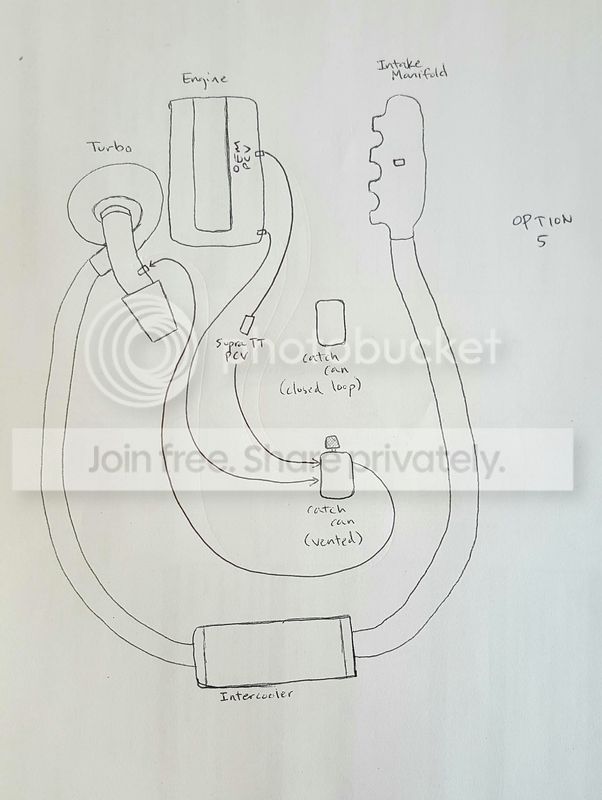
Both (oem pcv to supra pcv) and crankcase vent to vented catch can, to intake arm on turbo. Plug IM valve.
The 2 main benefits of maintaining vacuum in the crankcase seems to be the idea of sealing the rings and pulling fuel-tainted fumes (blowby gases) out in order to prevent contaminating the engine oil. Catch cans are useful in that it will collect any oil and the oil/fuel particles in the gases to allow cleaner air to re-enter the intake system. Also, for us boosted guys, the increased pressure in the crankcase from the turbo setup could pop up the oil dipstick, or worse, cause ring/seal damage to various parts on the engine.
Below are 5 diagrams I am considering running on my turbo f22. Please review and discuss +'s and -'s to each.

Oem pcv to closed loop catch can, to supra pcv, to IM.
Crankcase vent to vented catch can, to intake arm on turbo.

Oem pcv to closed loop catch can, to supra pcv, to IM.
Crankcase vent to vented catch can, to intake arm just before IM.

Both removed oem pcv and crankcase vent to vented catch can. Plug IM valve.

Both removed oem pcv and crankcase vent to vented catch can, to intake arm on turbo. Plug IM valve.

Both (oem pcv to supra pcv) and crankcase vent to vented catch can, to intake arm on turbo. Plug IM valve.

Registered User
Joined: Jul 2014
Posts: 2,629
Likes: 53
From: Fort Walton Beach, FL
Dual lines to a vented catch can is the way you are going to find the majority of S2000 owners turbo or not that run their cars on track. This is my old setup:
http://rio.ridedomain.com/engine.jpg
http://rio.ridedomain.com/engine.jpg

Thread Starter
Joined: Mar 2010
Posts: 1,685
Likes: 79
From: Los Angeles
Thats good to know. So a big NO to option 2. I should take that image down not to confuse others. I was leaning towards options 1, 4 or 5 for vacuum cc setup. Between 4 and 5, not sure if utilizing the pcv would be effective being that its plumbed to a vented catch can. Itll probably pull very little vacuum given that its vented and hooked up to the turbo intake piping.

Joined: May 2003
Posts: 1,785
Likes: 57
From: DFW
If you run #4 or #5 then the PCV portion would basically act as if you had capped the PCV line. Reason is that you wouldn't get any vaccum from the line on a vented catch can, so running a line will do little for this setup. Really I think your two options are #1 (if you want to keep vacuum/OEM setup) or #3 if you are comfortable with a completely vented setup.

Trending Topics


Joined: Mar 2003
Posts: 6,507
Likes: 51
From: Sellersburg, IN
In option 1, you're vacuum will only be beneficial out of boost and minimal at that and the only vent able to breathe would be the front one under boost, which is actually worse off for a boosted application. In a perfect world you would have a constant vacuum but that's not practical, so the next best option is to just let both vents breathe to atmosphere without any PCV. No need in over thinking and complicating things.

Registered User
Joined: May 2013
Posts: 301
Likes: 2
Besides oil consumption, you will also have a dirty intake manifold, more carbon residu on the intake valves, dirty sparkplugs etc... Better let the valve cover vent to atmosphere
Try option #3. This will work
Joined: Mar 2003
Posts: 6,507
Likes: 51
From: Sellersburg, IN
And cause detonation.