When you click on links to various merchants on this site and make a purchase, this can result in this site earning a commission. Affiliate programs and affiliations include, but are not limited to, the eBay Partner Network.
The more brethren we inspire/help get up to speed and boosting, the better for the community. IMO an S2000 needs forced induction to get up to speed with today's daily drivers. I keep seeing basic questions about fuel systems and what to buy, there's so much information one could spend weeks researching and still be confused. To help other S2K owners thinking about pulling the trigger and modifying their fuel systems this will serve as a cheat sheet. Something I've read over and over and what has worked for me. You can research all you want but this is the cheat sheet so listen up and take advantage noobs! The following are recommendations for 600WHP and under set up. If your making more than 600WHP you know what your doing and this thread is not for you. I tried to make this as simple and to the point as possible. Also we'll be looking at the most popular/best quality/easiest to assemble products. If you want to know how to drill your stock fuel rail to install a fuel pressure sensor, and how to solder fuel injector connections to the oem harness to save a few bucks this thread is not for you. If you want products that are plug and play, have installation instructions with colored pictures, and detailed reviews on the internet then keep reading.
What fuel pump should i use? What injectors? Do i need an aftermarket fuel rail? Do i need a fuel pressure regulator? What ECU is best? Do i need a fuel pressure sensor? What about E85? What about a flex fuel sensor? These are questions a person looking to turbo their s2k should be asking themselves.
I'll start with the most important:
1.Fuel injectors-
You have 1 Choice. Injector Dynamics 1300X E85-compatible.
These injectors come with plug and play connections, their injector data is easy accessible on their website(most ecus even have wizards with a drop down menu that already has all their calibration data)
These injectors will idle great on a stock S2K running gas or E85 with an aftermarket ecu, or put out 600WHP worth of fuel with gas or E85(with Walbro450 fuel pump). Their that good.
Due to them having such a broad usable spectrum, gas or e85, and stock to 600whp, this is what one should buy. They are a bit pricey but they are a quality product and you'll save money because they are a breeze to tune. Also because of their broad spectrum they are easy to sell if you ever need to these are a great great investment! Also these will idle like stock they are that good. So really no drawbacks and their price is worth saving yourself headaches. Get you some ID1300X and join the club. Again, these are the right injectors whether you are running E85 or gas, or 200whp 300whp 400whp 500whp 600whp, they cover all of this.
2. Fuel Pump- Walbro 450 E85-compatible
This fuel pump comes with a detailed plug and play and wiring kit from Science of Speed. This fuel pump can be used on a stock S2000 all the way to a 600whp S2K and it is near OEM quiet. Forget about the Walbro 255 or any other pump that might be $10 $20 cheaper, do it right, get a quality one, get a quiet one, be set incase you ever want more power. Again, this will work on your set up whether you are running E85 or gas, or 200whp 300whp 400whp 500whp 600whp, they cover all of this.
3. Fuel Rail- Radium Fuel Rail
The only reason to upgrade a fuel rail really is because the oem one does not have an npt port in order to install a fuel pressure sensor. Get the Radium Fuel rail, it is the biggest one and costs near the same as any other fuel rail.
4. Fuel pressure regulator- Aeromotive Fuel pressure regulator
If your boosted yes you do need a fuel pressure regulator. AEM fuel pressure regulator is very popular but splurge and get an Aeromotive S2K fuel pressure regulator. They actually make one just for the S2K and best of all, it has a built in fuel pressure sensor port! Even though its more expensive than any other fuel pressure regulator it is damn good quality and now that i think about it, if you buy this, you can just keep using your oem fuel rail because this has an npt port for a fuel pressure sensor!
5.Fuel Pressure sensor- AEM 100PSI pressure sensor
This is industry standard, get it it works.
6.Flex fuel sensor- Science of Speed Flex fuel sensor kit
This kit has everything needed and detailed instructions with quality hardware, get this.
7. E85 compatibility issues- Doesn't matter
Everything recommended should be purchased as if running E85 even if you don't plan to. Even if your running gas running E85 compatible fuel pump and injectors your still technically running atleast 10% E85 content so there's some food for thought E85 parts wont hurt anything in fact they are built more robust! Win win win.
This is as bare bones and to the point, one size fits all level of quality and refinement item list so noobs put this on your black Friday shopping cart, get to boosting, and let's share and grow the street car S2K's.
Also this applies only to S200 Model year 2000-2005 because they are return style. If your running 2006 im sure someone else can comment but basically just get a fuel return style kit from Science of speed and follow the recipe above.
Last edited by F1TwoThousand; Nov 8, 2019 at 09:23 PM.
One overlooked thing about boosting is, you don't have to put on a turbo kit before tuning a car. You can install your entire fuel system and ECU first and get the car to start, idle, and drive before installing a turbo, this way you know that you've installed everything correctly instead of adding even more variables with a turbo kit.
You can run 1300s to 600whp, but you will likely be above 90% duty cycle.
I'm at 17psi and 82% injector duty with 571whp (dynojet) or 517whp (Mustang) on ID1300x, SOS walbro 450 267 pump,, SOS wiring kit, and base pressure set to 65psi.
To hit 600whp and keep injector duty cycle down, you need 1700 injectors.
I recommend ID1700 and Walbro 450 267/274 pump.
I use to like the SOS wiring kit, but it has proven to be an issue. Wiring gets HOT and relay fails. I would do 10 gauge wiring to the trunk area, use a larger amp rated relay with wider spaces, and use 14 gauge from relay to the pump in the tank with stock pins when using a 450 pump
If you want to run a bigger pump like the walbro 525 285 or dw400 pump, you'll need 10 gauge from battery to the pump, only way to do that is to drill a hole in the fuel tank hanger with using a fuel safe sealant or bulkhead connector that is fuel compliant.
My opinion is based on amperage requirements of the walbro 450 267/274, dw400, and walbro 525 285 pump.
If I was a moderator, i'd sticky this. Also to add stock fuel pressure regulator base pressure is 47-54PSI I believe. If you have a quality aftermarket fuel pressure regulator go ahead and set it at 55 PSI and you'll be all set.
OEM base fuel pressure should be the standard 3-bar and "base pressure" does not vary. The regulator is a 1:1, so the relative pressure between the manifold and fuel rail will maintain the 3-bar separation.
Once you start tuning and changing the fuel system, you just need to insure the fuel pump can provide required flow at base+boost pressure as flow will drop, and that the injectors can also handle said fuel pressure (generally not an issue for most people).
One overlooked thing about boosting is, you don't have to put on a turbo kit before tuning a car. You can install your entire fuel system and ECU first and get the car to start, idle, and drive before installing a turbo, this way you know that you've installed everything correctly instead of adding even more variables with a turbo kit.
That's exactly what I did in 2004 or 2005 with my AEM Series 1. I bought everything at the same time, but first I installed all of the electronics, tested and tuned and got familiar with the software, and then installed the turbo. This is SO much easier than doing tons of changes at once and hoping for the best. It also means you aren't starting your turbo setup for the first time on an unknown basemap.
This is a good thread and essentially the perfect setup for MOST people who go boost and will eventually want more. This brings you to the horsepower levels that I believe most people will not want to really go beyond, atleast in my case anyway. I ended up doing almost exactly everything in this thread except I ended up using an AEM fuel rail & AEM FPR since I already had them, plus I like the pre-tapped rail for my fuel pressure sensor, but the Radium/Aeromotive would've accomplished the same thing; I just don't like the red anodized FPR.
I don't even live in a state that has E85 readily available, but the ability to go Flex is just so easy that if you're completely doing a fuel system I'd definitely spend a little extra to incorporate the sensor & the 1300x over the 1050x's, which I did. This setup/thread really should be a sticky.



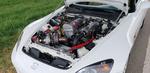
 Turbo S2000 fuel system(for dummies)