


DIY: Installing Siemens Deka 630 cc injectors


Thread Starter
Former Sponsor
Joined: Mar 2002
Posts: 15,526
Likes: 19
 DIY: Installing Siemens Deka 630 cc injectors
Even though I just have basic bolt-ons, and have no plans to go FI or do any internal mods to my motor, I needed bigger injectors. My stock injectors were running past 90% duty, and I didn't feel comfortable with that. I probably just needed an injector a bit over 400cc, but I found a set of used Siemens Deka 630 cc injectors here on S2KI, so I got them.
Inline Pro seems to be selling these injectors as 675cc for $350 ($87.50 each). However, when I got the Deka Model number from another member who bought them from IP, they are really rated at 630cc by Siemens Deka, and are available from other vendors for MUCH less. I'd like to know how IP can justify this...
The part number is Siemens FI114961 or 107-961 ( 107961 ).
I expected the install and retune to be a serious PITA, since I hadn't seen a DIY on it, and I didn't even know how they compared in size to OEM. However, it wound up being much easier than I expected, and the results were great too.
Here is a picture of the Siemens Deka injectors (Left) compared to my OEM injectors (Right).
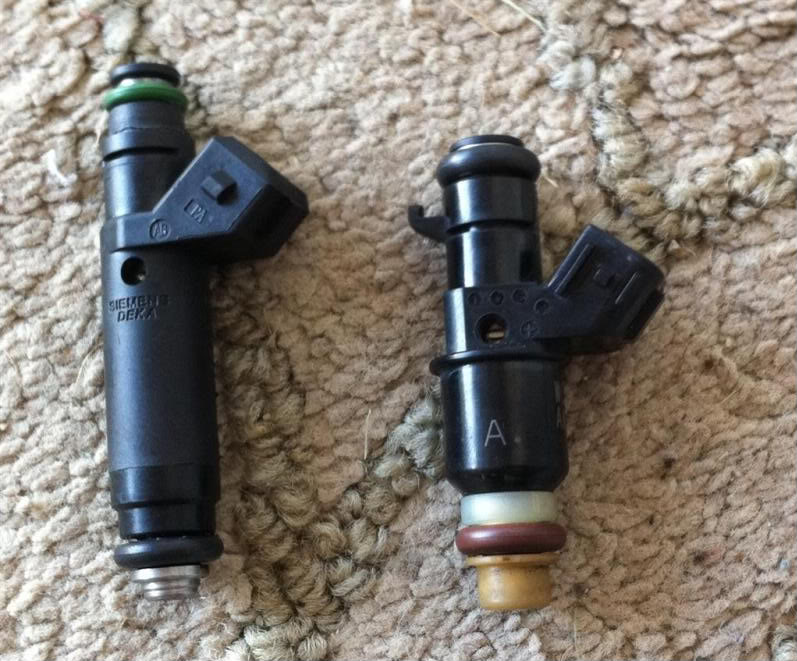
I thought the first challenge was going to be finding the right sized O-rings to be compatable with the fuel rail. The bottom end of the injector seems to fit the intake manifold well, but the top was totally loose in the fuel rail. I went to the auto part store hoping to find an assortment of O-rings that were okay for fuel systems, but they didn't have any. However, I noticed that the O-ring on the stock injectors looked like it might work, since the top of the OEM injector looks about the same size as the Dekas. I swapped them over, and checked how well they fit into the fuel rail. It was a snug fit, but not quite as snug as they were on the stock injectors. I decided to go ahead with them, and hope for the best.
The next challenge was making the longer Deka's fit between the fuel rail and manifold. I forget how much longer the Deka's were, but I think it was about 1/2". Obviously, this wasn't going to be a direct drop-in swap. I needed to extend the fuel rail further away from the intake manifold to make room. Luckily, I happen to have some OEM Honda studs in my tool chest that I believe are used to hold down the valve cover on one of my previous Hondas. It was an almost perfect replacement for the OEM stud.

All it really needed to be long enough was a couple washers on the intake manifold end to make it just the right length. The only drawback to this stud is that the top end really needs a slightly longer threaded section, since the fuel rail is pretty thick. The nut probably has at least a full thread more that it could use. I just made sure to use plenty of Loctite blue on both ends of the stud.

On the other side of the fuel rail, I just stacked up a bunch of washers, and used a longer bolt. It was kind of tricky to get the washers on the bolt without dropping them down in the engine comparment, so make sure you have plenty of extras. Make sure to get the fuel rail as level as possible with the opposite side. If one side is higher than the other, the bolts may not have good contact.

The connectors on the Dekas aren't quite compatible with the OEM Honda plugs. You have a choice of either cutting off the OEM plugs, and wiring on new plugs, or getting plug and play adapters. I did NOT want to cut off the OEM plugs, so I MADE plug and play adapters. It was a PITA to make them, and actually cost more money. I found a vendor that sells pre-made adapters for about $40, IIRC, so I wish I would have done that. Just do a search for "Honda OBD2 EV1 Adapter" on Google, and you'll find a bunch of inexpensive options. If you decide to cut them off or make your own adapters, note that polarity does NOT matter. This seemed weird to me, but others on this forum have confirmed this.
Now to test them out! I turned the key to the ON position, and heard spraying, so I took a quick glance to see what was spraying then turned it back OFF. Fuel was spraying out from 1 of the injectors very fast, so I thought I was hosed. I figured the O-rings just weren't tight enough. However, I just loosened the fuel rail, moved the injector around (up / down / twist left / twist right), then tightened it back up. When I tried it again, everything sealed fine. I think the O-ring just needed to be lubricated to seat well.
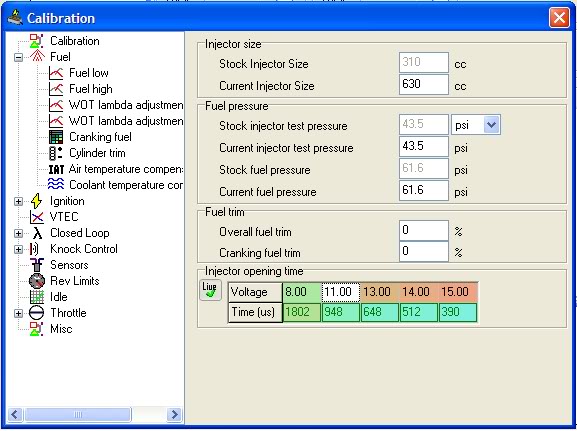
Now that everything is installed, and there are no fuel leaks, I needed to update my FlashPro calibration for the new injector size and lag times. Thankfully, Hondata makes this easy. I just entered in 630 cc in the fuel screen, and looked up the lag times in Deka's spec sheet. After applying the multiplier for my AP2's fuel pressure (1.25), here is what I had.
After uploading the new FlashPro calibration, I started the car right up. It ran just like normal while cold, but the idle got pretty rough as it warmed up. I noticed that my S Trim value was at +5%, and didn't budge even though my AFR was pretty lean. Then I realized that I forgot to remove the restriction I put on my S Trim value. I had it set to a min / max S Trim of -5% / +5%, since that seemed to give me better throttle response. I increased this to -40% / +40%, and started it again. It ran fine, so I drove to a local undeveloped neighborhood to freshen up the tune.
I used my part throttle tuning method to determine how far off my fuel maps were. I could see that there was a clear pattern that the higher loads / RPMs were not as lean as the lower load / RPMs (like idle), so that implied that my lag times weren't large enough. I started increasing my lag times (across the board) by 5% at a time until my S Trim values at idle became small. Once I did this, my whole low cam fuel map was good again.
The only place where I really needed to retune my fuel map was at the high RPMs. I had expected a need to REDUCE my fuel maps at high RPMs where the OEM injectors were going past 80% duty, but it turns out that I needed to INCREASE fuel up there! My only theory about this is that maybe the OEM injectors were not really closing all the way at that high of a duty cycle, and were delivering more fuel that the ECU thought.
After getting my tune worked out again, I was pleased to see that my injector duty cycle dropped from over 90% to about 45%. My AFR's are smooth again, and my idle is almost as good as stock. I don't think anyone would notice a difference unless I mentioned it. However, on top of all this, it seems that I actually GAINED power. My datalogs show a steady increase in torque across the whole RPM range, but the gains are biggest in the high RPMs. I don't know if this is because the Deka injectors have a better spray pattern, or if it's just a benefit of having smaller injector pulse widths. Or maybe the fuel has more time to atomize in the cylinder before combustion...

After driving around with the injectors for about a week, and doing more datalogs to confirm the "soft dyno" results from above, I decided to try out E85. The stock injectors aren't anywhere close to large enough for E85, but these 630's are more than enough. I did a little research about what kind of tuning changes would be required, then waited for my tank to be empty again. Once I had no more bars left on my fuel gauge, I went to the grocery store near my home to fill up with E85.
The FlashPro's live tuning feature made the swap super easy. I just started the car up, and let it idle for a while. As the E85 made its way through the fuel system, the S Trim value slowly climbed to +10%, +20%, +30%, etc. I don't remember where it stopped, but when it did, I selected the whole fuel map, and applied a +3X% adjustment (low and high cam). This brought the fuel trims back down near 0.
Then I went for a casual drive to make sure S Trim was staying low, and I wasn't getting any knock counts. When I felt comfortable, I started doing heavier loads and eventually full throttle. My fuel maps just needed slight tweaks at full throttle to get a flat AFR. I also richened it up a bit more than I would with E10 to get AF (not AF Corr) close to 12:1. The car seemed more powerful, and idle was super smooth (maybe better than stock injectors with E10).
Over the next week, I tweaked on my timing and fuel maps, and did LOTS of full throttle datalogs for soft dyno comparisons. It's clear that E85 makes gains, but they may not be much more than a few ft-lbs. I really need to do more datalogs with E10 to confirm it, since I didn't do enough datalogs with E10 on the Deka injectors. What I can confirm is that the bigger injectors combined with E85 makes a very significant gain. I've done tons of datalogs that confirm this.
Below is a typical run with OEM injectors and E10 fuel compared to a typical run with Deka injectors and E85. Temperatures were about 13 degrees apart, but the graphs are SAE corrected. I have tons of graphs that show this same difference.

Inline Pro seems to be selling these injectors as 675cc for $350 ($87.50 each). However, when I got the Deka Model number from another member who bought them from IP, they are really rated at 630cc by Siemens Deka, and are available from other vendors for MUCH less. I'd like to know how IP can justify this...
The part number is Siemens FI114961 or 107-961 ( 107961 ).
I expected the install and retune to be a serious PITA, since I hadn't seen a DIY on it, and I didn't even know how they compared in size to OEM. However, it wound up being much easier than I expected, and the results were great too.
Here is a picture of the Siemens Deka injectors (Left) compared to my OEM injectors (Right).
I thought the first challenge was going to be finding the right sized O-rings to be compatable with the fuel rail. The bottom end of the injector seems to fit the intake manifold well, but the top was totally loose in the fuel rail. I went to the auto part store hoping to find an assortment of O-rings that were okay for fuel systems, but they didn't have any. However, I noticed that the O-ring on the stock injectors looked like it might work, since the top of the OEM injector looks about the same size as the Dekas. I swapped them over, and checked how well they fit into the fuel rail. It was a snug fit, but not quite as snug as they were on the stock injectors. I decided to go ahead with them, and hope for the best.
The next challenge was making the longer Deka's fit between the fuel rail and manifold. I forget how much longer the Deka's were, but I think it was about 1/2". Obviously, this wasn't going to be a direct drop-in swap. I needed to extend the fuel rail further away from the intake manifold to make room. Luckily, I happen to have some OEM Honda studs in my tool chest that I believe are used to hold down the valve cover on one of my previous Hondas. It was an almost perfect replacement for the OEM stud.
All it really needed to be long enough was a couple washers on the intake manifold end to make it just the right length. The only drawback to this stud is that the top end really needs a slightly longer threaded section, since the fuel rail is pretty thick. The nut probably has at least a full thread more that it could use. I just made sure to use plenty of Loctite blue on both ends of the stud.
On the other side of the fuel rail, I just stacked up a bunch of washers, and used a longer bolt. It was kind of tricky to get the washers on the bolt without dropping them down in the engine comparment, so make sure you have plenty of extras. Make sure to get the fuel rail as level as possible with the opposite side. If one side is higher than the other, the bolts may not have good contact.
The connectors on the Dekas aren't quite compatible with the OEM Honda plugs. You have a choice of either cutting off the OEM plugs, and wiring on new plugs, or getting plug and play adapters. I did NOT want to cut off the OEM plugs, so I MADE plug and play adapters. It was a PITA to make them, and actually cost more money. I found a vendor that sells pre-made adapters for about $40, IIRC, so I wish I would have done that. Just do a search for "Honda OBD2 EV1 Adapter" on Google, and you'll find a bunch of inexpensive options. If you decide to cut them off or make your own adapters, note that polarity does NOT matter. This seemed weird to me, but others on this forum have confirmed this.
Now to test them out! I turned the key to the ON position, and heard spraying, so I took a quick glance to see what was spraying then turned it back OFF. Fuel was spraying out from 1 of the injectors very fast, so I thought I was hosed. I figured the O-rings just weren't tight enough. However, I just loosened the fuel rail, moved the injector around (up / down / twist left / twist right), then tightened it back up. When I tried it again, everything sealed fine. I think the O-ring just needed to be lubricated to seat well.
Now that everything is installed, and there are no fuel leaks, I needed to update my FlashPro calibration for the new injector size and lag times. Thankfully, Hondata makes this easy. I just entered in 630 cc in the fuel screen, and looked up the lag times in Deka's spec sheet. After applying the multiplier for my AP2's fuel pressure (1.25), here is what I had.
After uploading the new FlashPro calibration, I started the car right up. It ran just like normal while cold, but the idle got pretty rough as it warmed up. I noticed that my S Trim value was at +5%, and didn't budge even though my AFR was pretty lean. Then I realized that I forgot to remove the restriction I put on my S Trim value. I had it set to a min / max S Trim of -5% / +5%, since that seemed to give me better throttle response. I increased this to -40% / +40%, and started it again. It ran fine, so I drove to a local undeveloped neighborhood to freshen up the tune.
I used my part throttle tuning method to determine how far off my fuel maps were. I could see that there was a clear pattern that the higher loads / RPMs were not as lean as the lower load / RPMs (like idle), so that implied that my lag times weren't large enough. I started increasing my lag times (across the board) by 5% at a time until my S Trim values at idle became small. Once I did this, my whole low cam fuel map was good again.
The only place where I really needed to retune my fuel map was at the high RPMs. I had expected a need to REDUCE my fuel maps at high RPMs where the OEM injectors were going past 80% duty, but it turns out that I needed to INCREASE fuel up there! My only theory about this is that maybe the OEM injectors were not really closing all the way at that high of a duty cycle, and were delivering more fuel that the ECU thought.
After getting my tune worked out again, I was pleased to see that my injector duty cycle dropped from over 90% to about 45%. My AFR's are smooth again, and my idle is almost as good as stock. I don't think anyone would notice a difference unless I mentioned it. However, on top of all this, it seems that I actually GAINED power. My datalogs show a steady increase in torque across the whole RPM range, but the gains are biggest in the high RPMs. I don't know if this is because the Deka injectors have a better spray pattern, or if it's just a benefit of having smaller injector pulse widths. Or maybe the fuel has more time to atomize in the cylinder before combustion...
After driving around with the injectors for about a week, and doing more datalogs to confirm the "soft dyno" results from above, I decided to try out E85. The stock injectors aren't anywhere close to large enough for E85, but these 630's are more than enough. I did a little research about what kind of tuning changes would be required, then waited for my tank to be empty again. Once I had no more bars left on my fuel gauge, I went to the grocery store near my home to fill up with E85.
The FlashPro's live tuning feature made the swap super easy. I just started the car up, and let it idle for a while. As the E85 made its way through the fuel system, the S Trim value slowly climbed to +10%, +20%, +30%, etc. I don't remember where it stopped, but when it did, I selected the whole fuel map, and applied a +3X% adjustment (low and high cam). This brought the fuel trims back down near 0.
Then I went for a casual drive to make sure S Trim was staying low, and I wasn't getting any knock counts. When I felt comfortable, I started doing heavier loads and eventually full throttle. My fuel maps just needed slight tweaks at full throttle to get a flat AFR. I also richened it up a bit more than I would with E10 to get AF (not AF Corr) close to 12:1. The car seemed more powerful, and idle was super smooth (maybe better than stock injectors with E10).
Over the next week, I tweaked on my timing and fuel maps, and did LOTS of full throttle datalogs for soft dyno comparisons. It's clear that E85 makes gains, but they may not be much more than a few ft-lbs. I really need to do more datalogs with E10 to confirm it, since I didn't do enough datalogs with E10 on the Deka injectors. What I can confirm is that the bigger injectors combined with E85 makes a very significant gain. I've done tons of datalogs that confirm this.
Below is a typical run with OEM injectors and E10 fuel compared to a typical run with Deka injectors and E85. Temperatures were about 13 degrees apart, but the graphs are SAE corrected. I have tons of graphs that show this same difference.
Thread Starter
Former Sponsor
Joined: Mar 2002
Posts: 15,526
Likes: 19
BTW, the thick solid lines on the torque plots represent torque, and the thin dashed lines represent injector pulse width, which I find is helpful to identify how good the tune is. It seems to me that if your AFR is flat, and your torque follows the injector pulse width well, then the tune is probably pretty good.

Registered User
Joined: May 2008
Posts: 5,177
Likes: 1
i am so shocked that there is no reply to this!!! after doing a quick search on your mods this thread popped up. man i am really considering copying your mods. you know what they say imitation is the best form of flattery.  but here in the great sate of arkansas we only have one tuner. and he is the most untruth worthy and incompetent tuner ever. this guy shouldn't even touch cars. so i really dont want to let this near my car.
i was thinking about getting larger injectors and getting a flashpro. how exactly did you change the setting on flashpro to allow you to run these injectors?
but here in the great sate of arkansas we only have one tuner. and he is the most untruth worthy and incompetent tuner ever. this guy shouldn't even touch cars. so i really dont want to let this near my car. i was thinking about getting larger injectors and getting a flashpro. how exactly did you change the setting on flashpro to allow you to run these injectors?
Registered User
Joined: May 2008
Posts: 5,177
Likes: 1
he said that the stock injectors were on 90%+ duty cycle and he didnt like that. i dont think an upgrade fuel pump would help since the stock injectors wouldnt be able to keep up anyways. you could up the pressure but the injectors can only work so hard. i can see using an larger fuel pump when you have large injectors and the stock fuel pump is not supplying the larger injectors fast enough.
of course stock injector could "do" the job fo na and sc up too 300-320. but they are being used to their max. well maybe not on bolt-on na. but i would also see no point of upgrading injectors when you really arent at 100% duty cycle. but i am amazed that they did help pick up a little more power when the injectors are on 40%ish duty cycle.
of course stock injector could "do" the job fo na and sc up too 300-320. but they are being used to their max. well maybe not on bolt-on na. but i would also see no point of upgrading injectors when you really arent at 100% duty cycle. but i am amazed that they did help pick up a little more power when the injectors are on 40%ish duty cycle.
Thread Starter
Former Sponsor
Joined: Mar 2002
Posts: 15,526
Likes: 19
ans2k got it right.
I didn't want to upgrade my fuel pump since it would be a lot more work, and not any cheaper. The fuel system on the DBW AP2 is significantly different than the '00-'05 models, so I don't even know what fuel pump would work with it. The fuel pressure regulator is built into the pump, and there is no fuel return line.
I didn't want to upgrade my fuel pump since it would be a lot more work, and not any cheaper. The fuel system on the DBW AP2 is significantly different than the '00-'05 models, so I don't even know what fuel pump would work with it. The fuel pressure regulator is built into the pump, and there is no fuel return line.
Trending Topics

Former Sponsor
Joined: Oct 2007
Posts: 28,698
Likes: 38
From: Mooresville, NC
Originally Posted by gernby,Feb 7 2011, 12:35 PM
ans2k got it right.
I didn't want to upgrade my fuel pump since it would be a lot more work, and not any cheaper. The fuel system on the DBW AP2 is significantly different than the '00-'05 models, so I don't even know what fuel pump would work with it. The fuel pressure regulator is built into the pump, and there is no fuel return line.
I didn't want to upgrade my fuel pump since it would be a lot more work, and not any cheaper. The fuel system on the DBW AP2 is significantly different than the '00-'05 models, so I don't even know what fuel pump would work with it. The fuel pressure regulator is built into the pump, and there is no fuel return line.
Thread Starter
Former Sponsor
Joined: Mar 2002
Posts: 15,526
Likes: 19
I thought I posted about that ...
I didn't want to go with an injector that was just "big enough". I wanted to have injectors that would be very sufficient for E85, N20, or boost. After the performance results, I'm glad I went with the ones I did, since I think there's a good chance that the very short duty cycles are the source of the gains.
I have 2 theories about the duty cycles. Since my OEM injectors were spraying up to 95% of the time (at high RPMs and full throttle), and the intake valves are only open about 25% of the time, that means most of the fuel is sprayed on closed valves. By shortening the duty cycles with larger injectors, the percentage of time that the injector sprays on closed valves will change (unless the ECU changes the injector phase). So the shorter duty cycles could mean that a larger percentage of fuel is sprayed while the valves are open. Or it could also be opposite from that, and ALL of the fuel would be sprayed on closed valves. I could see how either of those scenarios would change performance in some way.
I didn't want to go with an injector that was just "big enough". I wanted to have injectors that would be very sufficient for E85, N20, or boost. After the performance results, I'm glad I went with the ones I did, since I think there's a good chance that the very short duty cycles are the source of the gains.
I have 2 theories about the duty cycles. Since my OEM injectors were spraying up to 95% of the time (at high RPMs and full throttle), and the intake valves are only open about 25% of the time, that means most of the fuel is sprayed on closed valves. By shortening the duty cycles with larger injectors, the percentage of time that the injector sprays on closed valves will change (unless the ECU changes the injector phase). So the shorter duty cycles could mean that a larger percentage of fuel is sprayed while the valves are open. Or it could also be opposite from that, and ALL of the fuel would be sprayed on closed valves. I could see how either of those scenarios would change performance in some way.