


It looks fast too!


Thread Starter
Former Sponsor
Joined: Mar 2002
Posts: 15,526
Likes: 19

Thanks. It looks like I will be building 9 Dingles for current Gern-Pipe buyers, but I don't know if there will be any built after that. I would need to find a manufacturer to build any additional units, since I'm friggin' tired of doing my own fabrication.
Thread Starter
Former Sponsor
Joined: Mar 2002
Posts: 15,526
Likes: 19
Some stars came into alignment today for me to do a test that I've wanted to do for almost 2 years. When I started testing different exhaust designs, the first one I built was a 3" single without a resonator, very similar to the Berk single. I used that exhaust many many times as my "benchmark" for designs that followed. However, I really wanted to test against a Berk Single, but I didn't want to spend the money on it.
Now that I'm considering my different options for production units, I figured it might be an interesting option for me to sell modified Berk Singles that will bolt onto the Gern-Pipe. Maybe I could even get Berk to offer a Gern-Ready version...
Anyway, I ordered a Berk Single a few weeks ago, and received it yesterday. Since the new Dingle is being welded today, I decided to go ahead and test it. I decided to test the Berk against my 2.5" single. The Berk that I got is the test pipe version, but my Gern-Pipe has an HFC. Even though I have done similar tests with my custom 3" single, I was still a tad nervous that the Berk would somehow prove all my discoveries wrong.
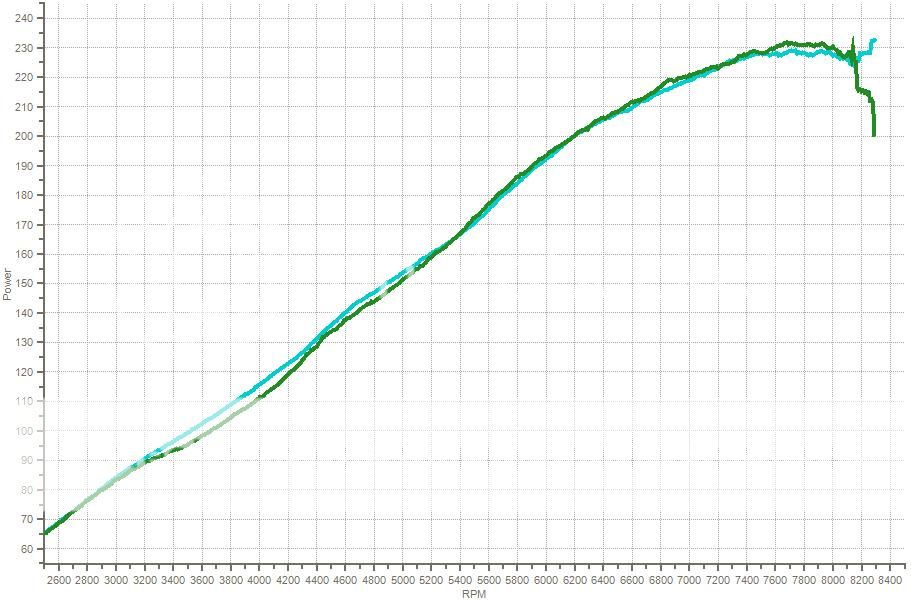
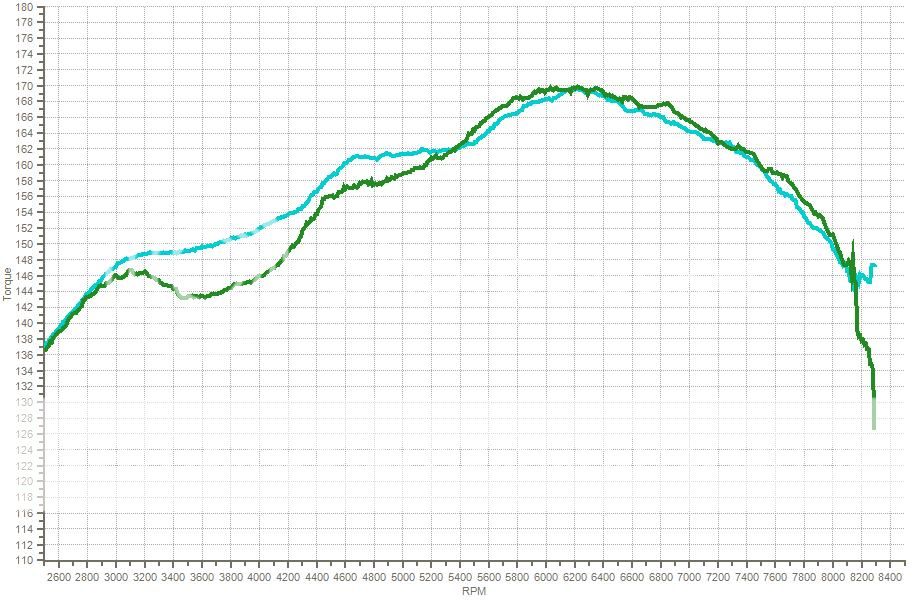
I was able to complete the tests on the Berk, then swap my Gern-Pipe and 2.5" single back on and retest in just a couple hours. Thankfully, the results were the same as what I've seen countless times over the last 2 years. The Berk does create more scavenging in the upper RPMs due to the diameter increase at the header flange, but much of that scavening is wasted. Also, due to the transition being so close to the motor, the scavenging pulses arrive back to the engine too soon to provide benefit below ~5200 RPMs. That's where the Gern-Pipe makes it's gains. The location and shape of the expansion chamber ensures that the scavenging energy is just strong enough to achieve max benefit while also being spread across a very wide RPM range.
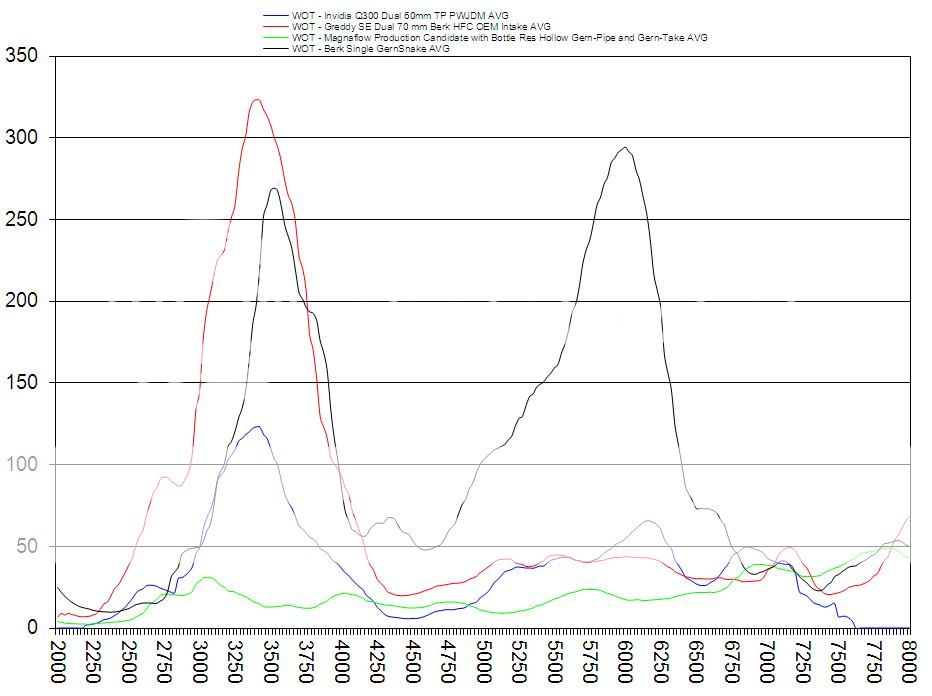
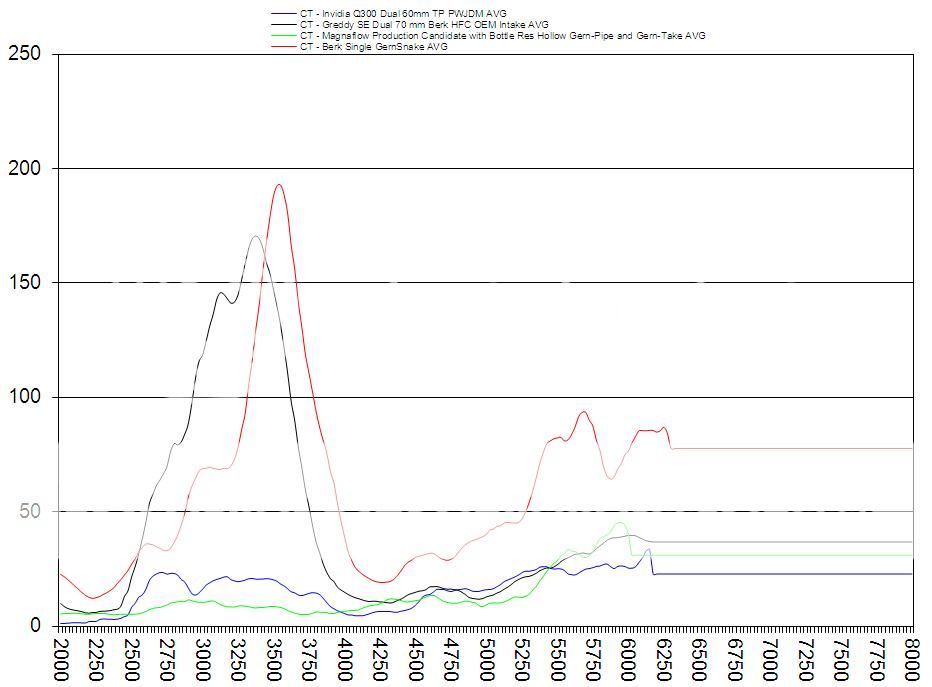
I also tested the Berk's drone levels at full load and also at half load (I call it "cruise throttle"). After reading so many people talk about how bad the Berk drones, I was expecting the drone to be unbearable. However, it really seems much more tolerable than the Greddy SE dual that I tested a few months ago. The Greddy made my bones hurt, even with the top down, and I literally couldn't wait to get out of my car when it was on there. The Berk doesn't irritate me nearly as much. My Drone-O-Meter graphs are below the dyno plots.
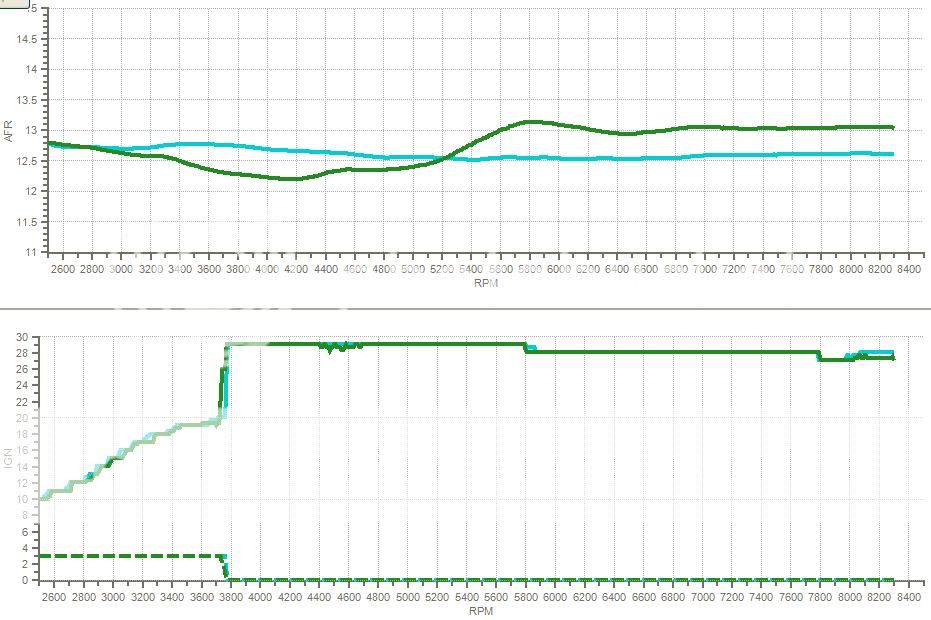
Green is the Berk single (test-pipe version) and Turquoise is my Gern-Pipe (integrated HFC) and 2.5" single.
Now that I'm considering my different options for production units, I figured it might be an interesting option for me to sell modified Berk Singles that will bolt onto the Gern-Pipe. Maybe I could even get Berk to offer a Gern-Ready version...
Anyway, I ordered a Berk Single a few weeks ago, and received it yesterday. Since the new Dingle is being welded today, I decided to go ahead and test it. I decided to test the Berk against my 2.5" single. The Berk that I got is the test pipe version, but my Gern-Pipe has an HFC. Even though I have done similar tests with my custom 3" single, I was still a tad nervous that the Berk would somehow prove all my discoveries wrong.
I was able to complete the tests on the Berk, then swap my Gern-Pipe and 2.5" single back on and retest in just a couple hours. Thankfully, the results were the same as what I've seen countless times over the last 2 years. The Berk does create more scavenging in the upper RPMs due to the diameter increase at the header flange, but much of that scavening is wasted. Also, due to the transition being so close to the motor, the scavenging pulses arrive back to the engine too soon to provide benefit below ~5200 RPMs. That's where the Gern-Pipe makes it's gains. The location and shape of the expansion chamber ensures that the scavenging energy is just strong enough to achieve max benefit while also being spread across a very wide RPM range.
I also tested the Berk's drone levels at full load and also at half load (I call it "cruise throttle"). After reading so many people talk about how bad the Berk drones, I was expecting the drone to be unbearable. However, it really seems much more tolerable than the Greddy SE dual that I tested a few months ago. The Greddy made my bones hurt, even with the top down, and I literally couldn't wait to get out of my car when it was on there. The Berk doesn't irritate me nearly as much. My Drone-O-Meter graphs are below the dyno plots.
Green is the Berk single (test-pipe version) and Turquoise is my Gern-Pipe (integrated HFC) and 2.5" single.
Thread Starter
Former Sponsor
Joined: Mar 2002
Posts: 15,526
Likes: 19
I should have included the individual dyno plots that were averaged to create the plots I posted above. As you can see, there is a margin of error from one pull to the next (similar to a DynoJet).


Joined: Aug 2011
Posts: 4,220
Likes: 81
From: Florida
I am happy you might decide to pair up with existing berk single exhausts. I believe I suggested this a while ago since the Berk already has the vband in a similar location. I'll be interested in more details if you go down this road.
Thread Starter
Former Sponsor
Joined: Mar 2002
Posts: 15,526
Likes: 19
The Berk that I received will need to be cut, since the VBand is way too far forward. If the VBand was behind the rear axles, I could build a bolt-on adapter.







Registered User
Joined: Sep 2008
Posts: 2,380
Likes: 0
From: Arizona
Any decibel readings yet on this exhaust with xxxx mods at 50ft?
Sent from my Galaxy Nexus using Tapatalk 2

