


Alternator and Energy Consumption


Registered User
Joined: Mar 2005
Posts: 303
Likes: 0
From: Sunnyvale

zKing, the answer to your question is hidden within HommedeAil's reply's:
What he's trying to explain to you is that the "resistance" that the alternator experiences varies with the needs of the battery. The varying current requirement is what changes the resistance. When there is no (or practically no) current being required, the magnetive resistance inside the alternator is almost none.
Those more proficient can feel free to correct me, but I believe the "resistance" that the spinning alternator experiences comes from the magnetic field within and that the magnetic field can actually fluxuate (become stronger or weaker) depending on the draw(demand) of the current.
Exactly!
First, to address the other well-intentioned responders, when the alternator is called upon to deliver zero current (i.e., the battery is fully charged and there are no accessories drawing current, the amount of force that it takes to spin the alternator is virtually zero. Try it. Go to a parts shop, take an alternator out of a box and spin it with your fingers. It spins pretty easily and will continue to spin on its own for awhile. Now, how much horsepower do you think you can deliver with two fingertips?
Those more proficient can feel free to correct me, but I believe the "resistance" that the spinning alternator experiences comes from the magnetic field within and that the magnetic field can actually fluxuate (become stronger or weaker) depending on the draw(demand) of the current.
The variable mechanical resistance to spinning the alternator is caused by a variation in the magnetic field generated by the current being drawn from the alternator. As the current demand decreases, the magnetic field changes so that there is less and less mechanical resistance to spinning the alternator.



Joined: Dec 2004
Posts: 10,061
Likes: 324
From: Land of Cincinnati Chili
The difference in voltage between the alternator output (14.4 volts) and the current battery charge accounts for the current draw used to charge the battery. The difference in voltage potential creates an effective resistance load that varies with the voltage difference. Additional current loads are the resistive loads being generated by the various electrical needs of the vehicle at the time.
Check this link:
http://www.alternatorparts.com/under...lternators.htm
Check this link:
http://www.alternatorparts.com/under...lternators.htm
Registered User
Joined: Mar 2005
Posts: 303
Likes: 0
From: Sunnyvale
A Lesson In Alternators
From: Autoshop 101
The "important" parts of the Alternator (what you have been asking about):
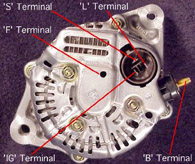
Here is a look at the alernator's terminals.
The terminal marked "S" senses the voltage of the battery. This is key, as that will allow the alternator to determine what currency it must deliver.
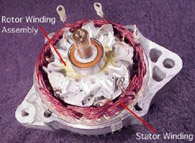
Here's a look of an opened-up alternator.
You can see two things here: The Rotor Winding assembly and the Stator Winding. The rotor section is what is turned by your car.
The Rotor Assembly
This is a close up of the inner moving part - the rotor assembly. Note the different parts.
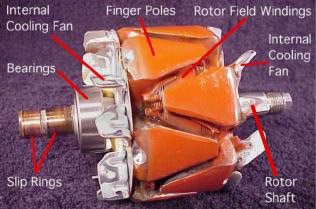
The Rotor is a Magnet!
The inidividual sections of the rotor are polarized! The rotor field winding creates the magnetic field that induces voltage into the stator. The magnetic field saturates the iron finger poles. One finger pole becomes a north pole and the other a south pole. The rotor spins creating an alternating magnetic field, North, South, North, South, etc.

The Stator Winding
We saw this part earlier. This is the outer "case" for the rotor. The rotor fits inside this and together they create electricity!
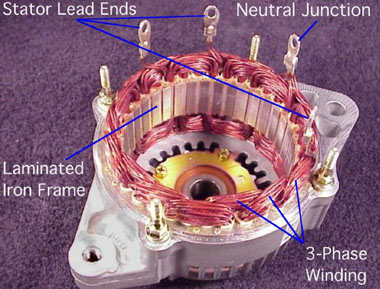
The Pieces Combined
As the rotor assembly rotates within the stator winding, two things happen:
1. The alternating magnetic field from the spinning rotor induces an alternating voltage into the stator winding.
2. The strength of the magnetic field and the speed of the rotor affect the amount of voltage induced into the stator.

Remember the S Sensor? It detects voltage
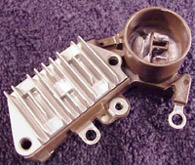
The regulator will attempt to maintain a pre-determined charging system voltage level. When charging system voltage falls below this point, the regulator will increase the field current, thus strengthening the magnetic field, which results in an increase of alternator output. When charging system voltage raises above this point, the regulator will decrease field current , thus weakening the magnetic field, and results in a decrease of alternator output
That's it!
Good luck!
From: Autoshop 101
The "important" parts of the Alternator (what you have been asking about):
Here is a look at the alernator's terminals.
The terminal marked "S" senses the voltage of the battery. This is key, as that will allow the alternator to determine what currency it must deliver.
Here's a look of an opened-up alternator.
You can see two things here: The Rotor Winding assembly and the Stator Winding. The rotor section is what is turned by your car.
The Rotor Assembly
This is a close up of the inner moving part - the rotor assembly. Note the different parts.
The Rotor is a Magnet!
The inidividual sections of the rotor are polarized! The rotor field winding creates the magnetic field that induces voltage into the stator. The magnetic field saturates the iron finger poles. One finger pole becomes a north pole and the other a south pole. The rotor spins creating an alternating magnetic field, North, South, North, South, etc.
The Stator Winding
We saw this part earlier. This is the outer "case" for the rotor. The rotor fits inside this and together they create electricity!
The Pieces Combined
As the rotor assembly rotates within the stator winding, two things happen:
1. The alternating magnetic field from the spinning rotor induces an alternating voltage into the stator winding.
2. The strength of the magnetic field and the speed of the rotor affect the amount of voltage induced into the stator.
Remember the S Sensor? It detects voltage
The regulator will attempt to maintain a pre-determined charging system voltage level. When charging system voltage falls below this point, the regulator will increase the field current, thus strengthening the magnetic field, which results in an increase of alternator output. When charging system voltage raises above this point, the regulator will decrease field current , thus weakening the magnetic field, and results in a decrease of alternator output
That's it!
Good luck!

Registered User
Joined: Nov 2003
Posts: 132
Likes: 0
From: Boston
Originally Posted by HommedeAil,Jun 21 2005, 01:08 PM
Try it. Go to a parts shop, take an alternator out of a box and spin it with your fingers.

Regards
BD

Thread Starter
Registered User
Joined: Jan 2005
Posts: 116
Likes: 0
I'd like to thank all of you for your help! Your explanations were all very useful. I just have a question about one part bposeley mentioned in his tutorial: "the regulator will increase the field current, thus strengthening the magnetic field" What do you mean by this and how is this done?

Thread
Thread Starter
Forum
Replies
Last Post