


Spoon rotors - progress report


Registered User

Joined: Oct 2000
Posts: 266
Likes: 0
From: PVP / San Moritz CA

And I thought I understood how to post images! 
Here are the links to the above pix:
http://albums.photopoint.com/j/ViewPhoto?u...2557&p=27924378
http://albums.photopoint.com/j/ViewPhoto?u...2557&p=27924379
Here are the links to the above pix:
http://albums.photopoint.com/j/ViewPhoto?u...2557&p=27924378
http://albums.photopoint.com/j/ViewPhoto?u...2557&p=27924379

Registered User

Joined: Oct 2000
Posts: 1,046
Likes: 0
From: Anaheim
That's interesting. So, in the picture below it suggests that the rotor draws air from beneath the car, and it looks like they've plumbed air in throught that black flexi-hose, prob. from the "blank-plate" vents in the front bumper.
However, in picture #2 they seem to be identical, so there is only one version left and right, as luis posted.
I guess it's the cheap solution. on the one side, it draws from under the car and spits the air out, and on the other side, it draws from within the rim and spits it in? Which may be possible, if the airflow speed can overcome the centrifugual force. Still, it's going to make one side cool better than the other, I would think.


However, in picture #2 they seem to be identical, so there is only one version left and right, as luis posted.
I guess it's the cheap solution. on the one side, it draws from under the car and spits the air out, and on the other side, it draws from within the rim and spits it in? Which may be possible, if the airflow speed can overcome the centrifugual force. Still, it's going to make one side cool better than the other, I would think.

Moderator

Joined: Oct 2000
Posts: 30,809
Likes: 15
From: Sydney
<BLOCKQUOTE><font size="1" face="Verdana, Arial">quote:</font><HR>Originally posted by fluxen:
on the one side, it draws from under the car and spits the air out, and on the other side, it draws from within the rim and spits it in?[/quote]
One of these rotors will get hotter than the other, and actually hotter than the standard rotor. Great for oval track racing
on the one side, it draws from under the car and spits the air out, and on the other side, it draws from within the rim and spits it in?[/quote]
One of these rotors will get hotter than the other, and actually hotter than the standard rotor. Great for oval track racing

Joined: Oct 2000
Posts: 9,210
Likes: 7
From: WA
<BLOCKQUOTE><font size="1" face="Verdana, Arial">quote:</font><HR>Originally posted by AusS2000:
One of these rotors will get hotter than the other, and actually hotter than the standard rotor. Great for oval track racing
[/quote]
I really don't believe that. I would guess that there is a negligible difference in how they cool. I think the vanes are for radiating heat not scooping air and there would be enough air movement in both sides to result in equal performance.
One of these rotors will get hotter than the other, and actually hotter than the standard rotor. Great for oval track racing
[/quote]
I really don't believe that. I would guess that there is a negligible difference in how they cool. I think the vanes are for radiating heat not scooping air and there would be enough air movement in both sides to result in equal performance.
Registered User
Joined: Oct 2000
Posts: 1,046
Likes: 0
From: Anaheim
I doubt the one get that much hotter than the other either, if only because I don't think Spoon would have gotten where they are producing crap like that.
The fact that they're not directional for the different sides seems disturbingly inelegant from such a premium tuner. It's just one of those things that may not matter, but bothers me.
The fact that they're not directional for the different sides seems disturbingly inelegant from such a premium tuner. It's just one of those things that may not matter, but bothers me.

Thread Starter
Joined: Oct 2000
Posts: 1,921
Likes: 0
From: Lisbon
Thanks guys. Great insights! I will be testing the car and measure rotor temperature to get the proof of the pudding!
Do you have any suggestion for an inexpensive way of measuring rotor temperature? Finger testing won't do. Too inacurate!
Do you have any suggestion for an inexpensive way of measuring rotor temperature? Finger testing won't do. Too inacurate!
Moderator
Joined: Oct 2000
Posts: 30,809
Likes: 15
From: Sydney
<BLOCKQUOTE><font size="1" face="Verdana, Arial">quote:</font><HR>Originally posted by cdelena:
I would guess that there is a negligible difference in how they cool.[/quote]
The difference in temperature will be proportional to the aero/thermo dynamics of the raked design of the fins.
It has been suggested that the fins work two ways. They pump the air, and their surface area radiates heat.
In method one, any cooling benefit as a result the raked design (over a straight radial fin design like standard of DBA rotors) is completely reversed on the other side of the vehicle. It may be marginal, but the difference on the other side is this margin X2.
With regards to method two, increased surface area, this is not really correct. Remember that every extra square mm of fin between the rotors covers approximately the same square mm of area on the inside of each disk.
I'm sure the difference in cooling between the disks is negligable, but isn't this difference (actually half this difference) exactly what you forked over good dollars for.
I would guess that there is a negligible difference in how they cool.[/quote]
The difference in temperature will be proportional to the aero/thermo dynamics of the raked design of the fins.
It has been suggested that the fins work two ways. They pump the air, and their surface area radiates heat.
In method one, any cooling benefit as a result the raked design (over a straight radial fin design like standard of DBA rotors) is completely reversed on the other side of the vehicle. It may be marginal, but the difference on the other side is this margin X2.
With regards to method two, increased surface area, this is not really correct. Remember that every extra square mm of fin between the rotors covers approximately the same square mm of area on the inside of each disk.
I'm sure the difference in cooling between the disks is negligable, but isn't this difference (actually half this difference) exactly what you forked over good dollars for.
Thread Starter
Joined: Oct 2000
Posts: 1,921
Likes: 0
From: Lisbon
<BLOCKQUOTE><font size="1" face="Verdana, Arial">quote:</font><HR>Originally posted by fluxen:
The fact that they're not directional for the different sides seems disturbingly inelegant from such a premium tuner. It's just one of those things that may not matter, but bothers me.
[/quote]
Fluxen, if it doesn't matter then it's a good thing Spoon makes only one version. It's cheaper, and they can pass on the savings to their customers... (or pocket the money, says the cynic in me).
The fact that they're not directional for the different sides seems disturbingly inelegant from such a premium tuner. It's just one of those things that may not matter, but bothers me.
[/quote]
Fluxen, if it doesn't matter then it's a good thing Spoon makes only one version. It's cheaper, and they can pass on the savings to their customers... (or pocket the money, says the cynic in me).
Thread Starter
Joined: Oct 2000
Posts: 1,921
Likes: 0
From: Lisbon
<BLOCKQUOTE><font size="1" face="Verdana, Arial">quote:</font><HR>Originally posted by AusS2000:
With regards to method two, increased surface area, this is not really correct. Remember that every extra square mm of fin between the rotors covers approximately the same square mm of area on the inside of each disk.
[/quote]
First let me say that the DBA rotors look great.
Second I'm not sure I follow your line of reasoning. An increase in fin length will increase the surface available for heat dissipation.
The additional area the curved "fin" covers on the rotor when compared to a straight fin is substantially smaller than the additional fin area. Remember that the thickness of the fin is much smaller than its width.
Curved vanes help with air flow regardless of direction. Remember that they are open on both sides and what goes in must come out. The spoon rotors scoop air from the outside on one side and from the inside on the other.
Again, I'll try to measure it later after I break them in.
With regards to method two, increased surface area, this is not really correct. Remember that every extra square mm of fin between the rotors covers approximately the same square mm of area on the inside of each disk.
[/quote]
First let me say that the DBA rotors look great.
Second I'm not sure I follow your line of reasoning. An increase in fin length will increase the surface available for heat dissipation.
The additional area the curved "fin" covers on the rotor when compared to a straight fin is substantially smaller than the additional fin area. Remember that the thickness of the fin is much smaller than its width.
Curved vanes help with air flow regardless of direction. Remember that they are open on both sides and what goes in must come out. The spoon rotors scoop air from the outside on one side and from the inside on the other.
Again, I'll try to measure it later after I break them in.
Moderator
Joined: Oct 2000
Posts: 30,809
Likes: 15
From: Sydney
<BLOCKQUOTE><font size="1" face="Verdana, Arial">quote:</font><HR>Originally posted by Luis:
Remember that the thickness of the fin is much smaller than its width.[/quote]
I stand corrected. I had a look at the close up of the rotors edge and I didn't realise the fins were so wide.
<BLOCKQUOTE><font size="1" face="Verdana, Arial">quote:</font><HR>Curved vanes help with air flow regardless of direction.[/quote]
Yep, but there are two forces in effect here. Direct centrifugal force (A always out from center), and reflected centrifugal force off the vanes (B either inwards or outwards depending on the rotational direction). That's why so much design goes into the design of a turbo's compressor.
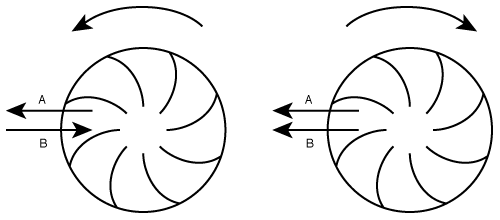
In the left image the force on the airflow would be A-B. On the right the force would be A+B. A difference of 2B (or not 2B - sorry ).
).
No biggy really, but what you are paying for is B (plus some holes).
Don't get me wrong, this is not some commercial push on the DBA rotors, or poo-poo'ing your purchase. I am just disappointed that a company like Spoon would charge top dollar, and then cut corners.
Remember that the thickness of the fin is much smaller than its width.[/quote]
I stand corrected. I had a look at the close up of the rotors edge and I didn't realise the fins were so wide.
<BLOCKQUOTE><font size="1" face="Verdana, Arial">quote:</font><HR>Curved vanes help with air flow regardless of direction.[/quote]
Yep, but there are two forces in effect here. Direct centrifugal force (A always out from center), and reflected centrifugal force off the vanes (B either inwards or outwards depending on the rotational direction). That's why so much design goes into the design of a turbo's compressor.
In the left image the force on the airflow would be A-B. On the right the force would be A+B. A difference of 2B (or not 2B - sorry
).No biggy really, but what you are paying for is B (plus some holes).
Don't get me wrong, this is not some commercial push on the DBA rotors, or poo-poo'ing your purchase. I am just disappointed that a company like Spoon would charge top dollar, and then cut corners.