


Gunk outside fuel injector cap and inside intake


Thread Starter

Joined: Oct 2002
Posts: 113
Likes: 1
From: Austin
 Gunk outside fuel injector cap and inside intake
I've been troubleshooting a cylinder misfire for over a year now and I'm starting to think I may have to take it to a professional. As far as I can tell there are no symptoms except that the CEL comes on when driving at low speeds (under 30 mph). Everytime I try a different fix I reset the CEL and go for a drive. I'm usually out on the highway for about an hour and the CEL never comes on until I get back to my neighborhood. I've replaced the spark plugs and adjusted the valves and today decided to pull the fuel injectors. To my suprise they we very dirty, this black gunk around the cap and rubber seal as well as inside the intake.
Is this normal?
Is this normal?

Thread Starter
Joined: Oct 2002
Posts: 113
Likes: 1
From: Austin
There's about 85,000 miles. No, I've never used any fuel injector/system cleaners. I'm going to have the injectors tested on Monday to rule them out.
What do you think about the gunk on the injectors and in/around the injector openings on the intake manifold?
Thanks Gernby
What do you think about the gunk on the injectors and in/around the injector openings on the intake manifold?
Thanks Gernby

Former Sponsor
Joined: Mar 2002
Posts: 15,526
Likes: 19
I'd have to see pictures of said "gunk" to make any comment on it. IF the car is driveable, I'd try a couple bottles / tanks of Techron before anything else. Get the bigger bottle that says it treats up to 20 gallons, pour it into your tank and fill up with "good" gas. When your tank is almost completely empty, do it again.
Most fuel injector cleaners seem to do nothing, but I was amazed at what it did to a Lincoln that I bought with 60K miles on it about 13 years ago. I bought it in Texas, then immediately drove it to Virginia (~1200 miles). I reset the fuel / trip computer right off the bat. I only got 24 MPG on the first tank of gas (on the interstate), so I dumped a bottle of Techron in there. I did that for 3 tank fulls, and by the time I reached Virginia, I was averaging over 30 MPG.
Most fuel injector cleaners seem to do nothing, but I was amazed at what it did to a Lincoln that I bought with 60K miles on it about 13 years ago. I bought it in Texas, then immediately drove it to Virginia (~1200 miles). I reset the fuel / trip computer right off the bat. I only got 24 MPG on the first tank of gas (on the interstate), so I dumped a bottle of Techron in there. I did that for 3 tank fulls, and by the time I reached Virginia, I was averaging over 30 MPG.



Joined: Oct 2009
Posts: 29,896
Likes: 5,435
From: Ontario Canada
I sent my injectors out for cleaning in past months and there was that black gunk around the injectors and inside the manifold. I've seen it on other Honda manifolds I've had over the years, it is basically unburned fuel deposits, much like you would see on the backside of an intake valve. They have a wet carbon look to them and are kind of gritty to the touch, and will disolve in solvent if you try to clean them. Sometimes it can be exacerbated by a leaky injector or an injector that doesn't spray perfectly, but I think you will always find some form of this in most vehicles if you look hard enough behind the injectors when they are removed.
Trending Topics
Former Sponsor
Joined: Mar 2002
Posts: 15,526
Likes: 19
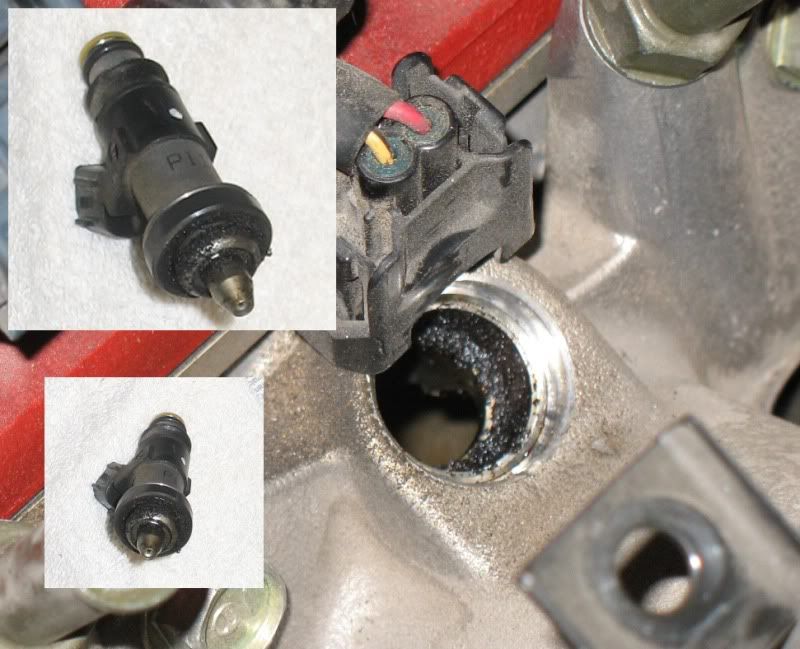
JohnnyAnonymous sent this picture to me via email. It seems to me that this buildup of crap is not coming from the fuel, since the nozzle of the injector looks pretty clean. I would guess it's either from a poor quality air filter, or maybe even from the PCV. I think I'd just clean it up as well as you can, then try a couple bottles of techron.
Joined: Oct 2009
Posts: 29,896
Likes: 5,435
From: Ontario Canada
Gernby, that is exactly what it looks like. To the best of my knowledge it is fuel related, it isn't entirely dirt, although I'm sure some does get mixed up in it. I believe if you were to check 10 cars like this they would all have it to some degree. Mine looked exactly like that, and I've seen it on other Honda engines in past years. My best guess is that it is a mix of unburned fuel, carbon deposits, dirt, oil vapours and oil. Although this stuff is gritty it isn't a strong grit like you find with sand, it will desolve if you rub it in your fingers back and forth, much like a carbon deposit, not too much different than what you find on the back of an intake valve.
Wipe it clean as best as you can, put in new parts such as seals and make sure everything is to spec when you torque down the fuel rail. If you were to re-open it up 20,000 miles down the road chances are you would find the same thing again.
Wipe it clean as best as you can, put in new parts such as seals and make sure everything is to spec when you torque down the fuel rail. If you were to re-open it up 20,000 miles down the road chances are you would find the same thing again.