


Why valves do not float - what cracks retainers


Joined: Jan 2011
Posts: 2,207
Likes: 7
From: Long Island

Btw..
Have anyone of you ever driven on corrugated roads?
I'm sure you have.
What really helps to stop - actually almost eliminate - the rattle and shaking is to speed up.
You surf the peaks of the mounds and the ride becomes smooth.
It takes a certain speed to ge there though.
To illustrate the difference in cam rpm to make valves float: suppose you have to drive on a corrugated road where the mounds are not 1 feet apart but 5 feet.
How fast would you have to drive to still surf the peaks?

Have anyone of you ever driven on corrugated roads?
I'm sure you have.
What really helps to stop - actually almost eliminate - the rattle and shaking is to speed up.
You surf the peaks of the mounds and the ride becomes smooth.
It takes a certain speed to ge there though.
To illustrate the difference in cam rpm to make valves float: suppose you have to drive on a corrugated road where the mounds are not 1 feet apart but 5 feet.
How fast would you have to drive to still surf the peaks?
Also, I'm not sure that your 1/7, 5/7, etc calculations really mean much. I'm no expert, but I'd like to think that I know enough to know that I don't know enough. Anyone who thinks that it's just a matter of whether or not the valve assembly has enough time to return before the lobe approaches is probably ignoring a lot of things.
I don't know why the retainers crack. I'll throw out a suggestion without any data to back it up. I don't think this is necessarily the cause. It could be that the valve is damaging the retainer when it slaps against the seat because it isn't following the cam (or many other things). My point is that there are a lot of things which are going on which people aren't considering.
At 5350 rpm (89.2 Hz), there's a resonance issue. It could be the valve assembly. It could just be part of the valve assembly. It's a damped resonance so the valves don't drop enough to interfere with the piston, but it allows the valve doesn't seat properly so it can buzz around and crack the retainers.
http://www.youtube.com/watch?v=yfmb-tCo2yA
If Billman re-did his head test with a high speed video camera, I'm sure that would tell a lot. 1000 FPS would give about 11 frames per revolution. I'd also be interested in the audio of the buzzing (from one cylinder), but I'm not sure if much could be determined from looking at the spectrum of that.
But even with Billman's test, if it's just the head then he doesn't has accurate cylinder pressure pressing against the valve. Does it affect the results of the test? I don't know. Could it? Absolutely.

Moderator


Joined: Jul 2002
Posts: 22,386
Likes: 1,838
From: Long Island, New York
 but I hear ya.
The blocked feeler gauge scenario is how I found out about the issue, not on s2ki.
I had a customer come in for routine VA in 2003, and could not insert the feeler gauge. That's when all my retainer talk started.

Banned
Joined: Dec 2003
Posts: 7,662
Likes: 1
From: Long Beach, CA
Id be curious to see how the experiment went with some Dual springs on our head. Those videos posted arent an F20 head so im curious as to how different the scenario would be. Since im going with a stiffer dual spring and Ferrea valves, would 9200 or even 9400 redline be safe?
Joined: Jan 2011
Posts: 2,207
Likes: 7
From: Long Island
Id be curious to see how the experiment went with some Dual springs on our head. Those videos posted arent an F20 head so im curious as to how different the scenario would be. Since im going with a stiffer dual spring and Ferrea valves, would 9200 or even 9400 redline be safe?
Connecting rod stresses are a function of engine speed squared.
http://www.400gt.com/articles/Metal/stress.htm
Gases need time to flow through the valves. At higher RPMs you may see decreased volumetric efficiency.
http://en.wikipedia.org/wiki/Volumet...ustion_engines
There are a many considerations when raising redline/fuel cut, although there are some people who push F22Cs and their motors seem to be ok. Having said that, it seems like it takes more than 9400 rpm to cause retainer failure.

Thread Starter

Joined: Jan 2006
Posts: 4,953
Likes: 25
From: 17 ft below sea level.

Hmm... it is kinda small....
Webshots is changing into a paid service - and I'm not going to pay.
For now this is the only size I can link to.
After Dec 1st all my webshots links will be gone

Thank You Webshots!
What the smallest picture shows is the radius of the cam, with and without lobe, per degree of cam rotation.
The top of the lobe is 0 degree.
51 degrees later (1/7th of 360) the valve closing part of the lobe has ended.
5 x 51 degree of no lobe.
And again 51 degree of valve opening lobe.
Now, copy paste this one after eachother and you get the bigger picture

This looks simular to a cross section of a corrugated road, no?
A floating valve is surfing on the top of the mounds... at 10 mph.
Or is it.......

Joined: Jan 2011
Posts: 2,207
Likes: 7
From: Long Island
Hmm... it is kinda small....
Webshots is changing into a paid service - and I'm not going to pay.
For now this is the only size I can link to.
After Dec 1st all my webshots links will be gone
Thank You Webshots!
What the smallest picture shows is the radius of the cam, with and without lobe, per degree of cam rotation.
The top of the lobe is 0 degree.
51 degrees later (1/7th of 360) the valve closing part of the lobe has ended.
5 x 51 degree of no lobe.
And again 51 degree of valve opening lobe.
Now, copy paste this one after eachother and you get the bigger picture
This looks simular to a cross section of a corrugated road, no?
A floating valve is surfing on the top of the mounds... at 10 mph.
Or is it.......
I never said that I didn't understand your analogy. I asked, "is it related to the camshaft?"
First, that's a really harsh cam profile. It isn't even C1 continuous.
Second, as part of your first order analysis, you need to compare the spring rate to the effective mass of the system and the maximum acceleration provided by the cam profile.
Third, didn't you make the point that it probably follows the profile at 9,000 crank rpm and use that to infer that it doesn't strike the lobe? I thought you made the arguement that if the valve can close in 1/7 a revolution at 9000 crank rpm and there's another 5/7
Given: It is safe to run at an 9000 rpm; the cam follows the valve at this speed; cam opening and closing durations are 1/7 revolution each with the remaining 5/7 revolution being a dwell period where it is closed/inactive.
n[sub]0[/sub] == maximum safe engine speed (9000 rpm)
n[sub]strike[/sub] == minimum engine speed needed to strike the lobe without the valve fully closing
n[sub]surf[/sub] == minimum engine speed needed to surf the peaks
n[sub]strike[/sub] = n[sub]0[/sub] * (1/7 cam revolution + 5/7 cam revolution)/(1/7 cam revolution) = 54000 rpm
n[sub]surf[/sub] > n[sub]strike[/sub]
So you were making the point that at less than 12000 rpm it doesn't striking the lobe. Since it isn't striking the lobe, it cannot be surfing the lobe because that requires even higher engine speeds.
If someone really wants to plug in numbers, they can measure everything and they can try this:
http://dairally.net/daihard/chas/Mis...alveSpring.htm
Btw, I'm not sure where you get 1/7th from. It doesn't seem conservative. I'd say it's at least 1/5 cam revolution (72° each).

Thread Starter
Joined: Jan 2006
Posts: 4,953
Likes: 25
From: 17 ft below sea level.
And who's going to change ALL the links to Webshots in my posts on S2ki?
I never said you didn't either. 
Yes I know, the drawing isn't true science here, its a five minute paint job, maybe 7 including using PSe7 to convert it to JPEG.
Cut a cam in half at the lobe, scan the profile with laser, feed data into CAD software and let it plot you the relation between radius and degree.
It was for information purposes only, and IMO the 1/7th and 5/7th explanation stands.
To do what?
What my point is, is that the valve spring is fast enough to close the valve below redline.
Somewhere between redline and piston/valve contact rpm the valve becomes too slow for the cam = valve hits seat uncontrolled.
For the valve to "ride the top of the lobe" a much higher rpm is needed, IMO.
And then we have Billman's experiment.
You lost me there.
All cam rpm, vital.
The cam spins at half the crank, remember?
You've got the 1/7th and 5/7th thing correct if you change "crank" by "cam"
Its the other way around, the valve follows the cam.
During opening it can not do anything else as it is forced by it.
During closing the valve spring has to do the job.
Until it can't keep up.
Yep 
What do you mean here?
I would not call it n[sub]strike[/sub] but n[sub]dwell
[/sub]n[sub]dwell[/sub] == cam rpm at which valve has reached max speed while cam keeps going faster & faster.
Result, valve closing uncontrolled by cam, hitting seat at full speed, ect, ect.
In a four stroke Otto engine, it all has to happen in one piston stroke.
One piston stroke = half a crank rotation.
Cam runs at half the crank speed.
One piston stroke = quarter cam rotation.
So in a quarter cam rotation the valve has to open AND close.
I've been through this.
Since valves do not exactly close at TDC and BDC I've allowd a bit more.
1/4 is less than 2/7.. right?
And 2/7 is more than 1/4.. right?

Would you rather recieve 2/7th of a million, or 1/4th?

In this picture it looks like the valve lift & closing takes 250-110= 140 cam degrees.
That's over a third.
In that time the crank does 2/3 (and a bit more), that's close to a full rotation.
That means the piston almost goes up & down.. or down & up, most likele the last one.
While the valve is still open?

I never said that I didn't understand your analogy. I asked, "is it related to the camshaft?"
First, that's a really harsh cam profile. It isn't even C1 continuous.
Cut a cam in half at the lobe, scan the profile with laser, feed data into CAD software and let it plot you the relation between radius and degree.
It was for information purposes only, and IMO the 1/7th and 5/7th explanation stands.
Second, as part of your first order analysis, you need to compare the spring rate to the effective mass of the system and the maximum acceleration provided by the cam profile.
What my point is, is that the valve spring is fast enough to close the valve below redline.
Somewhere between redline and piston/valve contact rpm the valve becomes too slow for the cam = valve hits seat uncontrolled.
For the valve to "ride the top of the lobe" a much higher rpm is needed, IMO.
And then we have Billman's experiment.
Third, didn't you make the point that it probably follows the profile at 9,000 crank rpm and use that to infer that it doesn't strike the lobe?
I thought you made the arguement that if the valve can close in 1/7 a revolution at 9000 crank rpm and there's another 5/7 crank revolution of dwell afterwards before the next rising section, you'd need to be spinning way way faster.
The cam spins at half the crank, remember?
You've got the 1/7th and 5/7th thing correct if you change "crank" by "cam"
So following your logic we get,
Given: It is safe to run at an 9000 rpm; the cam follows the valve at this speed;
Given: It is safe to run at an 9000 rpm; the cam follows the valve at this speed;
During opening it can not do anything else as it is forced by it.
During closing the valve spring has to do the job.
Until it can't keep up.
cam opening and closing durations are 1/7 revolution each with the remaining 5/7 revolution being a dwell period where it is closed/inactive.
n[sub]0[/sub] == maximum safe engine speed (9000 rpm)
n[sub]strike[/sub] == minimum engine speed needed to strike the lobe without the valve fully closing
n[sub]strike[/sub] == minimum engine speed needed to strike the lobe without the valve fully closing
I would not call it n[sub]strike[/sub] but n[sub]dwell
[/sub]n[sub]dwell[/sub] == cam rpm at which valve has reached max speed while cam keeps going faster & faster.
Result, valve closing uncontrolled by cam, hitting seat at full speed, ect, ect.
Btw, I'm not sure where you get 1/7th from. It doesn't seem conservative. I'd say it's at least 1/5 cam revolution (72° each).
One piston stroke = half a crank rotation.
Cam runs at half the crank speed.
One piston stroke = quarter cam rotation.
So in a quarter cam rotation the valve has to open AND close.
I've been through this.
Since valves do not exactly close at TDC and BDC I've allowd a bit more.
1/4 is less than 2/7.. right?
And 2/7 is more than 1/4.. right?
Would you rather recieve 2/7th of a million, or 1/4th?
In this picture it looks like the valve lift & closing takes 250-110= 140 cam degrees.
That's over a third.
In that time the crank does 2/3 (and a bit more), that's close to a full rotation.
That means the piston almost goes up & down.. or down & up, most likele the last one.
While the valve is still open?
Joined: Jan 2011
Posts: 2,207
Likes: 7
From: Long Island
I didn't want to quote this, but there are lots of points to address. I'll be deleting parts that I'm not addressing. This will be a couple of posts.
And who's going to change ALL the links to Webshots in my posts on S2ki?
My suggestion was intended for future posts. I.E. you could have picked a new host for your cam profile image.
JPEG is file for photographs but you shouldn't convert drawn images to JPEG. PNG is a much better format. It's lossless compression so it doesn't introduce artifacts.
If you wanted to get the cam profile, you could use a dial indicator to to measure the deflection from the base circle. You don't need that many points to be able to fit it to a spline. In addition, you don't Need CAD software either because you're not making a 3D image of the cam. You're displaying the cam profile data on to a Cartesian plot. You can use whatever spreadsheet where you're recording your data to generate a plot.
Have you considered another image hosting solution?
Yes I know, the drawing isn't true science here, its a five minute paint job, maybe 7 including using PSe7 to convert it to JPEG.
Cut a cam in half at the lobe, scan the profile with laser, feed data into CAD software and let it plot you the relation between radius and degree.
It was for information purposes only, and IMO the 1/7th and 5/7th explanation stands.
Cut a cam in half at the lobe, scan the profile with laser, feed data into CAD software and let it plot you the relation between radius and degree.
It was for information purposes only, and IMO the 1/7th and 5/7th explanation stands.
If you wanted to get the cam profile, you could use a dial indicator to to measure the deflection from the base circle. You don't need that many points to be able to fit it to a spline. In addition, you don't Need CAD software either because you're not making a 3D image of the cam. You're displaying the cam profile data on to a Cartesian plot. You can use whatever spreadsheet where you're recording your data to generate a plot.
Joined: Jan 2011
Posts: 2,207
Likes: 7
From: Long Island
Second, as part of your first order analysis, you need to compare the spring rate to the effective mass of the system and the maximum acceleration provided by the cam profile.
What my point is, is that the valve spring is fast enough to close the valve below redline.
Somewhere between redline and piston/valve contact rpm the valve becomes too slow for the cam = valve hits seat uncontrolled.
For the valve to "ride the top of the lobe" a much higher rpm is needed, IMO.
And then we have Billman's experiment.
Third, didn't you make the point that it probably follows the profile at 9,000 crank rpm and use that to infer that it doesn't strike the lobe?
I thought you made the arguement that if the valve can close in 1/7 a revolution at 9000 crank rpm and there's another 5/7 crank revolution of dwell afterwards before the next rising section, you'd need to be spinning way way faster.
The cam spins at half the crank, remember?
You've got the 1/7th and 5/7th thing correct if you change "crank" by "cam"
So following your logic we get,
Given: It is safe to run at an 9000 rpm; the cam follows the valve at this speed;
Given: It is safe to run at an 9000 rpm; the cam follows the valve at this speed;
During opening it can not do anything else as it is forced by it.
During closing the valve spring has to do the job.
Until it can't keep up.
cam opening and closing durations are 1/7 revolution each with the remaining 5/7 revolution being a dwell period where it is closed/inactive.
n[sub]0[/sub] == maximum safe engine speed (9000 rpm)
n[sub]strike[/sub] == minimum engine speed needed to strike the lobe without the valve fully closing
n[sub]strike[/sub] == minimum engine speed needed to strike the lobe without the valve fully closing
I would not call it n[sub]strike[/sub] but n[sub]dwell
[/sub]n[sub]dwell[/sub] == cam rpm at which valve has reached max speed while cam keeps going faster & faster.
Result, valve closing uncontrolled by cam, hitting seat at full speed, ect, ect.
Joined: Jan 2011
Posts: 2,207
Likes: 7
From: Long Island
Btw, I'm not sure where you get 1/7th from. It doesn't seem conservative. I'd say it's at least 1/5 cam revolution (72° each).
One piston stroke = half a crank rotation.
Cam runs at half the crank speed.
One piston stroke = quarter cam rotation.
So in a quarter cam rotation the valve has to open AND close.
I've been through this.
Since valves do not exactly close at TDC and BDC I've allowd a bit more.
1/4 is less than 2/7.. right?
And 2/7 is more than 1/4.. right?
Would you rather recieve 2/7th of a million, or 1/4th?
In this picture it looks like the valve lift & closing takes 250-110= 140 cam degrees.
That's over a third.
In that time the crank does 2/3 (and a bit more), that's close to a full rotation.
That means the piston almost goes up & down.. or down & up, most likele the last one.
While the valve is still open?
Your claimed value = 2/7 = 0.286
Image cam lobe = 140° = 140/360 = 0.389
My conservative value = 2/5 = 0.400
I understand that you're saying there are four strokes, but it doesn't mean that the intake valve is only active during the intake stroke. Valve overlap is common. The valves may be active during the power and compression strokes as well.
It can be seen if you look a plot of cam profiles.
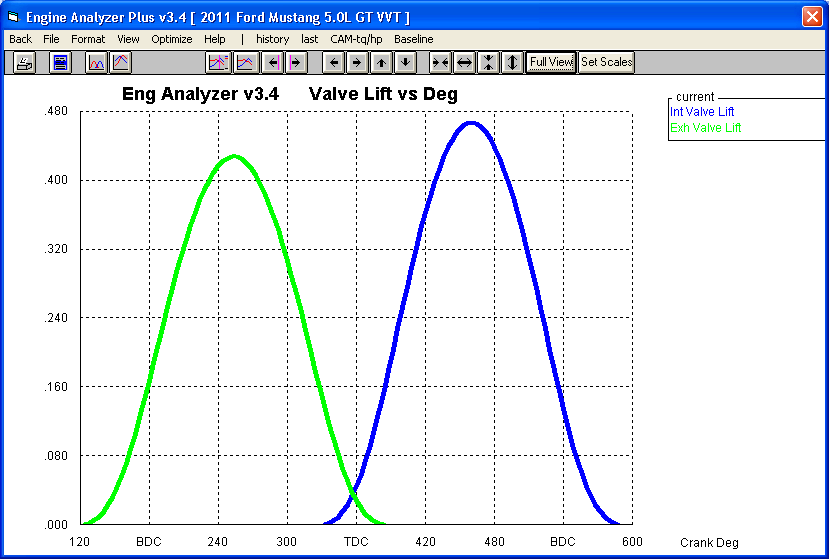
Or if you look at the cam with the images superimposed.
