


Memorial Day


Joined: Apr 2007
Posts: 16,419
Likes: 2,639
From: Long Beach, MS

Ukrainians may need an entire month to honor all those lost in the war there. So depressing.
Anyone who died in action during any U.S. military operation, from the War of Independence to Afghanistan deserves our gratitude and respect.
Anyone who died in action during any U.S. military operation, from the War of Independence to Afghanistan deserves our gratitude and respect.


Joined: Jul 2002
Posts: 37,581
Likes: 6,377
From: bolton
I'll expand that a little Mike, while I'm not a flag waver,
I think that anyone who put on the uniform deserves our respect.
My father had served during the Korean conflict but was fortunate that he stayed stateside.
At any moment however, the orders can come down that place a service member in harm's way.
I think that anyone who put on the uniform deserves our respect.
My father had served during the Korean conflict but was fortunate that he stayed stateside.
At any moment however, the orders can come down that place a service member in harm's way.






Joined: Apr 2003
Posts: 12,935
Likes: 773
From: Clifton, VA
As a Vietnam Era Army veteran that served from 1970-72. I was a "chair borne ranger" that severed most of my time at the Pentagon (based on my test scores). Quite frankly, I have some "survivors guilt". When I was stationed at Fort Dix, NJ I was attached to a company that trained radio operators (MOS 05B). Every eight weeks we would have about 225 trainees come through the cycle. After eight weeks about 175 would get orders for Vietnam. Where having a radio strapped on one's back was akin to having a target on one's back. As the Viet Cong knew that it was the radio operator that called in the air or artillery strikes.
I salute those that served in country (like Gene, Jet Sitter, and others) that came home. But more importantly to all of those did not return home from all of the wars that we fought.


Joined: Jun 2006
Posts: 30,756
Likes: 4,767
From: Medina, OH
This is one of the best quotes that I have seen for Memorial Day.
On May 25, 1998 President Bill Clinton said “My fellow Americans, on this memorial day, let us commit ourselves to a future worthy of their sacrifice. “
On May 25, 1998 President Bill Clinton said “My fellow Americans, on this memorial day, let us commit ourselves to a future worthy of their sacrifice. “


Joined: Aug 2012
Posts: 7,925
Likes: 3,447
From: Foothills East of Sacramento

“It is well that war is so terrible, otherwise we should grow too fond of it.”
General Robert Lee
Come Up From The Fields Father
WALT WHITMAN
Come up from the fields father, here’s a letter from our Pete,
And come to the front door mother, here’s a letter from thy dear son.
Lo, ’tis autumn,
Lo, where the trees, deeper green, yellower and redder,
Cool and sweeten Ohio’s villages with leaves fluttering in the moderate wind,
Where apples ripe in the orchards hang and grapes on the trellis’d vines,
(Smell you the smell of the grapes on the vines?
Smell you the buckwheat where the bees were lately buzzing?)
Above all, lo, the sky so calm, so transparent after the rain, and with wondrous clouds,
Below too, all calm, all vital and beautiful, and the farm prospers well.
Down in the fields all prospers well,
But now from the fields come father, come at the daughter’s call,
And come to the entry mother, to the front door come right away.
Fast as she can she hurries, something ominous, her steps trembling,
She does not tarry to smooth her hair nor adjust her cap.
Open the envelope quickly,
O this is not our son’s writing, yet his name is sign’d,
O a strange hand writes for our dear son, O stricken mother’s soul!
All swims before her eyes, flashes with black, she catches the main words only,
Sentences broken, gunshot wound in the breast, cavalry skirmish, taken to hospital,
At present low, but will soon be better.
Ah now the single figure to me,
Amid all teeming and wealthy Ohio with all its cities and farms,
Sickly white in the face and dull in the head, very faint,
By the jamb of a door leans.
Grieve not so, dear mother, (the just-grown daughter speaks through her sobs,
The little sisters huddle around speechless and dismay’d,)
See, dearest mother, the letter says Pete will soon be better.
Alas poor boy, he will never be better, (nor may-be needs to be better, that brave and simple soul,)
While they stand at home at the door he is dead already,
The only son is dead.
But the mother needs to be better,
She with thin form presently drest in black,
By day her meals untouch’d, then at night fitfully sleeping, often waking,
In the midnight waking, weeping, longing with one deep longing,
O that she might withdraw unnoticed, silent from life escape and withdraw,
To follow, to seek, to be with her dear dead son.
Last edited by cosmomiller; May 26, 2025 at 07:07 AM.
Joined: Aug 2012
Posts: 7,925
Likes: 3,447
From: Foothills East of Sacramento
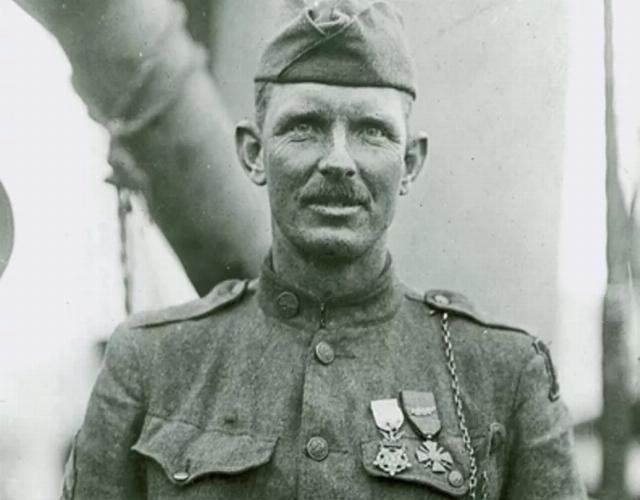
Sgt. York’s Memorial Day Message Still Inspires
By John PerryOn Memorial Day, 1941, Sgt. Alvin York spoke at the Tomb of the Unknown Soldier.
This humble farmer from the backwoods of Tennessee began his military career as a pacifist. While he was serving with the U.S. Army during WW I, a Bible study with his commanding officer persuaded a reluctant York that it was right to help defenseless civilians even if it meant killing their attackers. In 1919 he was awarded the Congressional Medal of Honor after singlehandedly dispatching more than twenty enemy soldiers and capturing 132 on October 8 of the previous year. He saw first-hand the price of liberty through the smoke and carnage of a French battlefield.
Like many who lived through the horrors of the Great War, York hoped death and loss on such a scale would never happen again. “No one can possibly hate war as much as a soldier,” he said. “I don’t approve of taking human life unless it is necessary, but I considered it necessary.” As he saw it, “We had to go into it to give our boys and young ladies a chance for peace in the days to come.”
York risked his life to win that peace abroad (a canteen beside him during the firefight had eighteen bullet holes in it), expecting to secure a lasting peace at home. When Hitler’s rise to power in 1933 again threatened Germany’s neighbors, York insisted the battle was theirs alone and that America “should fight a defensive war only” this time around.
But as the new conflict in Europe entered its second year, Americans became divided over whether to join forces with Britain and her struggling allies against the Nazis. Powerful voices argued that it wasn’t America’s fight and there was no reason to get involved. One leader of the noninterventionist camp was legendary flyer Charles Lindbergh, who believed the only people interested in going to war were “the British, the Jews, and the Roosevelt Administration.”
The sergeant was one of many who had a change of heart as Nazi armies occupied one nation after another and began the systematic murder of Jewish citizens. York condemned Lindbergh and other isolationists, taking heavy criticism in the press from the aviator’s supporters, who called York a “skunk,” “ignoramus,” and worse. With Japan in the east and Germany in the west flexing their military muscle, York encouraged American leaders to answer with “millions of soldiers being armed with the very latest and best equipment.” The peace that seemed so secure in 1918 had vanished in a cloud of destruction even more horrible than before. America must be prepared to fight.
In 1941 York was fifty-three years old and nearly a hundred pounds over his fighting weight. His legendary sharpshooter eyes looked out at the crowd through wire-framed reading glasses. The old soldier declared that the fight for freedom was a never-ending responsibility.
“By our victory in the last war, we won a lease on liberty, not a deed to it,” he said. “Now, after twenty-three years, Adolf Hitler tells us that the lease is expiring, and after the manner of all leases, we have the privilege of renewing it, or letting it go by default.”
France, he continued, fell to the Germans because French elites failed to act. European nations had collapsed “like a house of cards.” If America was willing to stand by while her allies were overrun, he told his listeners -- including President Roosevelt and a nationwide radio audience -- America should “surrender to Hitler right now, while we can still do so on our own terms.”
 But, he added, “The boy whose remains are in this unknown soldier’s grave wouldn’t recognize that kind of American.” Furthermore, such shameful inaction would mean the nation owed George Washington an apology because “he wasted his time at Valley Forge.”
The capitals of the world would soon be either Berlin and Moscow or Washington and London, Sgt. York concluded, and he preferred to be ruled by Parliament and Congress rather than the Reichstag and the Kremlin. “And because we were, for a time, side by side, I know this unknown soldier does, too.
“We owe it to him to renew the lease on liberty he helped us to get.
“May God help us to be equal to the task.”
Isolationist support evaporated overnight after the attack on Pearl Harbor the following December. America and the world were at war again, determined to renew the lease on liberty won at so great a cost only a generation before.
Alvin York knew from personal experience what everyone who understands American history also knows: freedom is not a steady state. The world’s natural order is conflict and chaos. America is an exceptional country whose freedom and prosperity are not the norm. They were gained and are preserved only by sacrifice and diligent defense. Too many Americans have no idea that this is the case. They live in the freest, wealthiest, safest country in the history of the world and have no clue how it got that way or even that it is an outlier unique in history.
Ignorant of the lessons of the past and the responsibilities of the present, can we come up with the price of a new lease on liberty when the next payment comes due?
May God help us to be equal to the task.
John Perry is a ghostwriter and collaborator, as well as the author of more than a dozen books including Sgt. York: His Life, Legend, and Legacy (Fidelis, 2021)