The "Official" EPOXY Garage Floor DIY


Thread Starter
Joined: Jan 2008
Posts: 9,570
Likes: 3
From: New Jersey
 The "Official" EPOXY Garage Floor DIY
Well, It's been about 6 months since I layed down the EPOXY floor in my house and it has been holding up great. I think it's probably the best thing a fellow car enthusiast can do when buying a new house. I had wanted to do this for a while, so I started to get to work within the first week of moving into the new house, lol. The House I moved into was 15 years old, and like most garages was used to just park cars and collect dust/garbage. It was pretty much neglected and I could spend another three pages telling you how long it took me to re-Spackle, re-tape and paint the bare sheetrock. It took me 2 coats of primer and 3 coats of paint to get it pure white (the old sheetrock was so dry it soaked up everything, and I used shitty BEHR paint).
This is a pretty Quick & dirty as each manufacturer may have a step by step that is slightly different, this is just to give you an idea! I will probbaly add to this thread as I remember things, lol It is nice to hang out in my garage, wearing slippers, sipping coffee, surfing S2ki in a showroom-like garage
Here is the final, finished project, well worth the hours of prep work and sub $500 bill
This is after the whole garage was painted white, cement fully cleaned/etched/washed etc Also shows the color flakes and two epoxy kits
http://www.flickr.com/photos/joeycostanza/6576080541/http://www.flickr.com/photos/joeycostanza/6576080541/ by http://www.flickr.com/people/joeycostanza/, on Flickr
This was after the 24hr drying period. *It takes about 10 days to fully cure before you can park your car!
http://www.flickr.com/photos/joeycostanza/6576083173/http://www.flickr.com/photos/joeycostanza/6576083173/ by http://www.flickr.com/people/joeycostanza/, on Flickr
http://www.flickr.com/photos/joeycostanza/6576084329/http://www.flickr.com/photos/joeycostanza/6576084329/ by http://www.flickr.com/people/joeycostanza/, on Flickr
As it sits now

http://www.flickr.com/photos/joeycostanza/6576077967/http://www.flickr.com/photos/joeycostanza/6576077967/ by http://www.flickr.com/people/joeycostanza/, on Flickr
I really like the Black/Gray/White Flakes, gives it a nice clean look
http://www.flickr.com/photos/joeycostanza/6221609511/http://www.flickr.com/photos/joeycostanza/6221609511/ by http://www.flickr.com/people/joeycostanza/, on Flickr
http://www.flickr.com/photos/joeycostanza/6221607391/http://www.flickr.com/photos/joeycostanza/6221607391/ by http://www.flickr.com/people/joeycostanza/, on Flickr


Also, for those who do a lot of work on their car, I have dropped jack stands, hammers etc and not a dent Oil, fluids wipe right up as well
First things first. WHAT YOU NEED
As far as what is needed to do the job correctly
Broom
A $35 ventilator mask! The fumes of the EPOXY are STRONG, and the fumes of MURIATIC ACID are VERY HARMFUL, so spend the money on a good respirator!
Power washer ( To remove ALL PAINT/oil stains ETC). I would recommend a good concrete degreaser as well.
Shop Vac or Squeegee to remove all water after power washing
Plastic Watering can (to be thrown out when job is done)
Baking Soda
RUSTOLEUM EPOXY SHIELD Industrial strength garage floor coating (You will need TWO of these for a two car garage, one coat will not be enough PERIOD ($110 for one kit, you will need two)
RUSROLEUM EPOXY SHEILD Clear coat One will be fine About $100
BEHR Flakes. They sell these at HD or Lowes, I chose the Black/Gray/White Flakes, the Blue that came with the kit was not appealing to me. The flakes are like $12.00, 2 would be enough, really depends on what look you want
Power drill as well as cement mixer tool. You WILL need this to mix the two part epoxy correctly
Many Paint rollers, I would spend the money on good quality ones, otherwise the little fibers will come off and annoy you FOREVER as they settle underneath the hardened EPOXY
Cement crack fill. tiny hairline cracks are ok, but for the larger cracks, this is a must!
Taken from the Webpage I referenced, The Garage Journal is also an excellent resource!
http://www.familyhandyman.com/DIY-Pr...e/Step-By-Step
http://www.garagejournal.com/
Evaluate your garage floor
Epoxy is a tough, long-lasting coating that you paint onto the concrete. It resists grease, oil and many other substances that would ruin ordinary paint. It cleans easily and can be found in a variety of colors (if you look hard enough), so you can keep your garage floor sparkling clean and attractive for years.
However, the reality of this challenging project is, one, not all concrete floors will hold a coating, and two, preparing concrete can be labor intensive and tedious. That said, this story will help you assess your concrete’s condition, show you how to clean and etch it, and demonstrate how to apply an epoxy surface that will handle car traffic, chemicals, oils, salt and scraping better than any other paint or stain.
As with any other paint job, success lies in the prep work. Plan to spend the first day removing oil spots, cleaning/degreasing the floor, etching it with a mild acid, and scrubbing, vacuuming and rinsing (a lot!). Day two is for filling cracks and applying the first coat of epoxy, which is followed by a second coat on day three. This job doesn't require many special tools. But to do the best job (and save your back), we recommend that you rent a walk-behind power floor scrubber (Photo 2) with a stiff brush attachment. Brushes work better than scrubbing pads on concrete, but buy two pads if a brush isn't available. Also, rent a wet vacuum if you don't own or have access to one.
Check for trapped moisture
Check for trapped moisture
Test Your Concrete for Moisture
Lift the corner of a plastic bag that's been taped to the garage floor for 24 hours. If it's dry underneath, you can proceed with an epoxy coating. If you see moisture under the plastic, don't coat the floor with epoxy; water pressure will break the bond.
Analyze the floor and weather
Before you even consider epoxy paint for your floor, test to determine if dampness is coming up through the concrete from the ground. If moisture is evident, your floor isn't suitable for epoxy. Also, forgo the project if a concrete sealer was previously used (you'll know a sealer has been used if water beads up when applied to the surface). If you're dealing with a new slab, you must wait a minimum of 28 days, preferably two months, for the floor to cure and dry thoroughly before applying a garage floor coating. And if you're dealing with a previously painted floor, the best advice is to remove the paint, especially when you're applying a solvent-based epoxy that could soften any that remains.
If your concrete passed these tests, make sure the weekend weather passes too. The temperature of the concrete must be a minimum of 55 degrees F, with an air temperature between 60 and 90 degrees for optimum epoxy curing/drying.
Floor cleaning
Photo1: Scrub oil stains
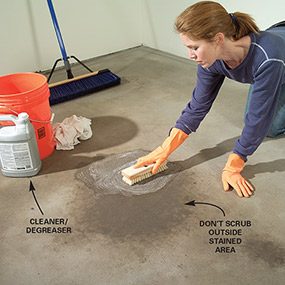
Photo1: Scrub oil stains
Dip a stiff-bristle brush into a cleaner/degreaser and scrub oil stains aggressively. Wipe up with cotton rags or paper shop towels. Repeat the procedure until the greasy feel is gone and water droplets no longer bead up on the surface.
« Previous Photo
Next Photo »
To begin, use a flat-edged shovel or scraper to loosen hardened surface debris, then sweep it out with a stiff-bristle garage broom.
Next, mix up a 5-gallon batch of water and concrete cleaner/degreaser according to label directions (found at home centers and hardware stores).
Once spots are cleaned, power-scrub the entire floor (Photo 2). To clean a two-car garage floor, plan on scrubbing for 20 to 30 minutes (keep the floor wet at all times). Make sure you scrub with a stiff-bristle hand brush along the walls and in the corners where the machine cannot reach. Once you're satisfied with dirt removal, vacuum up the cleaner for proper disposal (Photo 3). Don't just wash the product down the drive into the storm sewer. The environmental effects of cleaning products can vary widely. Check the product label or call the manufacturer for the proper waste disposal method. We looked up the Material Safety Data Sheet for the product we used (made by Behr) on the Web site www.msdssearch.com and learned we could pour the waste into the “sanitary sewer” (toilet). Also check the label or call the manufacturer for instructions on safe disposal of all leftover product and containers. When in doubt, call your city or county environmental office.
Etch the concrete with muriatic acid
Photo 4: Sprinkle the floor with acid/water solution
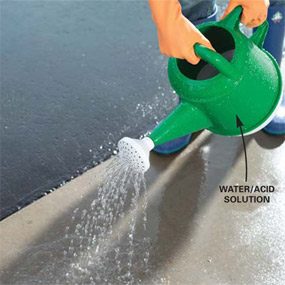
Photo 4: Sprinkle the floor with acid/water solution
Pour 12 ozs. from a bottle of 32 percent muriatic acid (common formulation) into a gallon of water (1 part acid to 10 parts water) in a plastic sprinkler can, then sprinkle evenly over a 10 x 10-ft. area.
« Previous Photo
Next Photo »
Before etching concrete with the acid solution (Photo 4), hose down your entire driveway and several feet beyond the sides of the drive. This aids in the final rinse out of the garage so the material will flow more easily down the driveway. Now sprinkle the 10:1 ratio of water to muriatic acid mixture and power-scrub the floor (with a rinsed brush attachment or new pad; Photos 4 and 5).
When you're finished, take your hose and nozzle end and flood the floor with water, spraying the material out of the garage for a good 10 minutes (diluted muriatic acid can be rinsed with large volumes of water into a storm sewer, according to the manufacturer). Rinse off the power scrubber brush/pad, then scrub the wet floor one last time for 5 to 10 minutes.
Finally, rinse out the entire floor and driveway two to three more times. The concrete surface should now feel like fine-grit sandpaper. If not, you need to repeat the acid washing. Finally, to speed the drying process, squeegee out any remaining pooled water, and take a rag and dry any remaining spots, cracks or chipped areas. Leave the garage door open overnight to speed drying.
Caution!
Always add acid to water, not water to acid and wear an organic vapor/acid respirator (Photo 7).
Choosing an epoxy
The final critical decision is what type of epoxy to use. Epoxy floor paints are tough resins that come in two separate parts that you mix together just before you apply them. You can divide them roughly into three types: 100 percent solids, solvent based and water based.
The 100 percent solid type is almost pure epoxy; it doesn't contain solvents that evaporate. These products are expensive and difficult to handle because they harden so rapidly. They're best left to the pros.
The solvent-based epoxies typically contain from 40 to 60 percent solids (epoxy). They penetrate and adhere well and are the choice of most pros. And they're often available in a wide range of colors, which is one reason we chose this type for our demonstration. But they do have some drawbacks. The solvents are powerful and potentially hazardous; you MUST use a respirator (a 3M 5000 series respirator with an organic vapor/acid gas filter, or the equivalent in another brand). The respirator must fit tightly to your face so you don't breathe the fumes. In addition, you must ventilate the garage well and keep other people away from the odors.
Solvent-based epoxies also may be harder to find. Some paint specialty stores may carry them (Sherwin- Williams and ICI Dulux, among others), but otherwise you'll have to go to an industrial supply–type store. Check the Yellow Pages under “Paint, Wholesale & Manufacturers” or “Industrial Equipment & Supplies, ” or look online.
The water-based epoxies also have two parts that you mix just before application. And they also typically contain 40 to 60 percent solids. The benefit of this type of epoxy is that there are no hazardous solvent fumes. And at least one brand, Rust-Oleum's EpoxyShield Garage Floor Coating, is widely available at home centers.
Whether you're working with solvent- or water-based epoxy, we recommend that you apply two coats to get enough build for long-term wear and durability. “Build” refers to the thickness of the dried epoxy film. Typically, an epoxy with a higher solid content will give a higher build. And, in general, prices tend to reflect the amount of epoxy in the mix—the more epoxy, the higher the build and the higher the price.
For a two-car garage (450 sq. ft.), you'll need 2 to 3 gallons per coat (depending on the percent of solids in the epoxy you buy—read the container). Check the cans for coverage to make sure you buy enough.
Caution!
Wear appropriate gloves, eye and lung protection, and rubber boots, according to the product labels. Turn off gas to the water heater or any other appliance located in the garage. And take precautions to keep children and pets away from the garage and driveway.
Patch the cracks
First thing in the morning, after the floor has dried overnight, fill 1/4-in. cracks and larger, plus holes or spalled areas, with an epoxy crack filler, available at home centers. Use a plastic putty knife to scrape the surface level and smooth. Let this dry for four hours (check label directions) before you begin painting your first coat of epoxy.
First coat of epoxy
Photo 6: Mix the epoxy
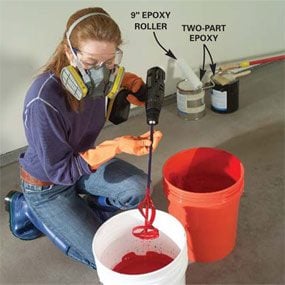
Photo 6: Mix the epoxy
Mix the two epoxy components for five minutes using a drill and stirring bit. Then pour the entire contents into a second bucket and repeat the power mix to ensure complete blending of the entire mixture.
« Previous Photo
Next Photo »
Mix the correct amount of epoxy (Photo 6) to cover the square footage of your garage floor according to label directions. It's critical that you allow the mixed product to stand undisturbed for the specified time on the label before applying it. You also must apply the entire batch you mixed up before the specified time expires. We used a 40 percent solid, solvent-based epoxy from a local industrial supplier/manufacturer that had to sit for 30 minutes, and the batch had to be used up within 24 hours (and it was offered in almost 20 colors).
While waiting for the crack filler to cure, use a high-quality natural-bristle paint brush and cut in the floor edges (Photo 7). Also, tape the area directly underneath the garage door with masking or duct tape, allowing you to shut the door overnight. This is intended to keep out dust, dirt, pets and children until the floor is dry. And put a “Do Not Enter” sign along with tape across the doorway leading to the garage from the house.
Coating the floor
If you move at a steady pace (Photo 9), you should finish your two-car garage floor in less than one hour. (Remember not to paint yourself into a corner!) The solvent odors are powerful. Be sure to wear a respirator (Photo 7) and keep the garage door open at least an hour after coating.
Tips:
Keep a clean cotton rag handy and some Xylol epoxy thinner (for solvent-based epoxy) to clean up epoxy drips and spills.
Consider adding epoxy paint to the bottom 4 in. of drywall, wood or concrete wall along the floor to protect it when you hose the floor clean in the future.
Second coat
Photo 10: Add non-skid granules
1 of 1
Let the first coat dry according to label directions. For the second coat, repeat Steps 7 – 9.
Let the first coat dry overnight, for a minimum of 16 hours (or according to label directions, since epoxy products vary). Add a non-skid product to the epoxy (Photo 10) for the second coat, especially if your vehicles drag snow and moisture into the garage, or you'd feel safer on a less slippery floor. Repeat the “cutting in” and floor painting like the day before (Photos 7 – 9).
Wait another 16 hours (check label directions) after finishing before allowing foot traffic. You can start parking your cars on the floor after approximately three to seven days (depending on the epoxy label directions). A full cure for the floor takes approximately one month.
Tip:
A coat of floor wax applied over the top of a cured epoxy floor will make it easier to clean.
Back to Top
This is a pretty Quick & dirty as each manufacturer may have a step by step that is slightly different, this is just to give you an idea! I will probbaly add to this thread as I remember things, lol It is nice to hang out in my garage, wearing slippers, sipping coffee, surfing S2ki in a showroom-like garage
Here is the final, finished project, well worth the hours of prep work and sub $500 bill
This is after the whole garage was painted white, cement fully cleaned/etched/washed etc Also shows the color flakes and two epoxy kits
http://www.flickr.com/photos/joeycostanza/6576080541/http://www.flickr.com/photos/joeycostanza/6576080541/ by http://www.flickr.com/people/joeycostanza/, on Flickr
This was after the 24hr drying period
. *It takes about 10 days to fully cure before you can park your car!http://www.flickr.com/photos/joeycostanza/6576083173/http://www.flickr.com/photos/joeycostanza/6576083173/ by http://www.flickr.com/people/joeycostanza/, on Flickr
http://www.flickr.com/photos/joeycostanza/6576084329/http://www.flickr.com/photos/joeycostanza/6576084329/ by http://www.flickr.com/people/joeycostanza/, on Flickr
As it sits now
http://www.flickr.com/photos/joeycostanza/6576077967/http://www.flickr.com/photos/joeycostanza/6576077967/ by http://www.flickr.com/people/joeycostanza/, on Flickr
I really like the Black/Gray/White Flakes, gives it a nice clean look
http://www.flickr.com/photos/joeycostanza/6221609511/http://www.flickr.com/photos/joeycostanza/6221609511/ by http://www.flickr.com/people/joeycostanza/, on Flickr
http://www.flickr.com/photos/joeycostanza/6221607391/http://www.flickr.com/photos/joeycostanza/6221607391/ by http://www.flickr.com/people/joeycostanza/, on Flickr
Also, for those who do a lot of work on their car, I have dropped jack stands, hammers etc and not a dent
Oil, fluids wipe right up as wellFirst things first. WHAT YOU NEED
As far as what is needed to do the job correctly
Broom
A $35 ventilator mask! The fumes of the EPOXY are STRONG, and the fumes of MURIATIC ACID are VERY HARMFUL, so spend the money on a good respirator!
Power washer ( To remove ALL PAINT/oil stains ETC). I would recommend a good concrete degreaser as well.
Shop Vac or Squeegee to remove all water after power washing
Plastic Watering can (to be thrown out when job is done)
Baking Soda
RUSTOLEUM EPOXY SHIELD Industrial strength garage floor coating (You will need TWO of these for a two car garage, one coat will not be enough PERIOD ($110 for one kit, you will need two)
RUSROLEUM EPOXY SHEILD Clear coat One will be fine About $100
BEHR Flakes. They sell these at HD or Lowes, I chose the Black/Gray/White Flakes, the Blue that came with the kit was not appealing to me. The flakes are like $12.00, 2 would be enough, really depends on what look you want
Power drill as well as cement mixer tool. You WILL need this to mix the two part epoxy correctly
Many Paint rollers, I would spend the money on good quality ones, otherwise the little fibers will come off and annoy you FOREVER as they settle underneath the hardened EPOXY
Cement crack fill. tiny hairline cracks are ok, but for the larger cracks, this is a must!
Taken from the Webpage I referenced, The Garage Journal is also an excellent resource!
http://www.familyhandyman.com/DIY-Pr...e/Step-By-Step
http://www.garagejournal.com/
Evaluate your garage floor
Epoxy is a tough, long-lasting coating that you paint onto the concrete. It resists grease, oil and many other substances that would ruin ordinary paint. It cleans easily and can be found in a variety of colors (if you look hard enough), so you can keep your garage floor sparkling clean and attractive for years.
However, the reality of this challenging project is, one, not all concrete floors will hold a coating, and two, preparing concrete can be labor intensive and tedious. That said, this story will help you assess your concrete’s condition, show you how to clean and etch it, and demonstrate how to apply an epoxy surface that will handle car traffic, chemicals, oils, salt and scraping better than any other paint or stain.
As with any other paint job, success lies in the prep work. Plan to spend the first day removing oil spots, cleaning/degreasing the floor, etching it with a mild acid, and scrubbing, vacuuming and rinsing (a lot!). Day two is for filling cracks and applying the first coat of epoxy, which is followed by a second coat on day three. This job doesn't require many special tools. But to do the best job (and save your back), we recommend that you rent a walk-behind power floor scrubber (Photo 2) with a stiff brush attachment. Brushes work better than scrubbing pads on concrete, but buy two pads if a brush isn't available. Also, rent a wet vacuum if you don't own or have access to one.
Check for trapped moisture
Check for trapped moisture
Test Your Concrete for Moisture
Lift the corner of a plastic bag that's been taped to the garage floor for 24 hours. If it's dry underneath, you can proceed with an epoxy coating. If you see moisture under the plastic, don't coat the floor with epoxy; water pressure will break the bond.
Analyze the floor and weather
Before you even consider epoxy paint for your floor, test to determine if dampness is coming up through the concrete from the ground. If moisture is evident, your floor isn't suitable for epoxy. Also, forgo the project if a concrete sealer was previously used (you'll know a sealer has been used if water beads up when applied to the surface). If you're dealing with a new slab, you must wait a minimum of 28 days, preferably two months, for the floor to cure and dry thoroughly before applying a garage floor coating. And if you're dealing with a previously painted floor, the best advice is to remove the paint, especially when you're applying a solvent-based epoxy that could soften any that remains.
If your concrete passed these tests, make sure the weekend weather passes too. The temperature of the concrete must be a minimum of 55 degrees F, with an air temperature between 60 and 90 degrees for optimum epoxy curing/drying.
Floor cleaning
Photo1: Scrub oil stains
Photo1: Scrub oil stains
Dip a stiff-bristle brush into a cleaner/degreaser and scrub oil stains aggressively. Wipe up with cotton rags or paper shop towels. Repeat the procedure until the greasy feel is gone and water droplets no longer bead up on the surface.
« Previous Photo
Next Photo »
To begin, use a flat-edged shovel or scraper to loosen hardened surface debris, then sweep it out with a stiff-bristle garage broom.
Next, mix up a 5-gallon batch of water and concrete cleaner/degreaser according to label directions (found at home centers and hardware stores).
Once spots are cleaned, power-scrub the entire floor (Photo 2). To clean a two-car garage floor, plan on scrubbing for 20 to 30 minutes (keep the floor wet at all times). Make sure you scrub with a stiff-bristle hand brush along the walls and in the corners where the machine cannot reach. Once you're satisfied with dirt removal, vacuum up the cleaner for proper disposal (Photo 3). Don't just wash the product down the drive into the storm sewer. The environmental effects of cleaning products can vary widely. Check the product label or call the manufacturer for the proper waste disposal method. We looked up the Material Safety Data Sheet for the product we used (made by Behr) on the Web site www.msdssearch.com and learned we could pour the waste into the “sanitary sewer” (toilet). Also check the label or call the manufacturer for instructions on safe disposal of all leftover product and containers. When in doubt, call your city or county environmental office.
Etch the concrete with muriatic acid
Photo 4: Sprinkle the floor with acid/water solution
Photo 4: Sprinkle the floor with acid/water solution
Pour 12 ozs. from a bottle of 32 percent muriatic acid (common formulation) into a gallon of water (1 part acid to 10 parts water) in a plastic sprinkler can, then sprinkle evenly over a 10 x 10-ft. area.
« Previous Photo
Next Photo »
Before etching concrete with the acid solution (Photo 4), hose down your entire driveway and several feet beyond the sides of the drive. This aids in the final rinse out of the garage so the material will flow more easily down the driveway. Now sprinkle the 10:1 ratio of water to muriatic acid mixture and power-scrub the floor (with a rinsed brush attachment or new pad; Photos 4 and 5).
When you're finished, take your hose and nozzle end and flood the floor with water, spraying the material out of the garage for a good 10 minutes (diluted muriatic acid can be rinsed with large volumes of water into a storm sewer, according to the manufacturer). Rinse off the power scrubber brush/pad, then scrub the wet floor one last time for 5 to 10 minutes.
Finally, rinse out the entire floor and driveway two to three more times. The concrete surface should now feel like fine-grit sandpaper. If not, you need to repeat the acid washing. Finally, to speed the drying process, squeegee out any remaining pooled water, and take a rag and dry any remaining spots, cracks or chipped areas. Leave the garage door open overnight to speed drying.
Caution!
Always add acid to water, not water to acid and wear an organic vapor/acid respirator (Photo 7).
Choosing an epoxy
The final critical decision is what type of epoxy to use. Epoxy floor paints are tough resins that come in two separate parts that you mix together just before you apply them. You can divide them roughly into three types: 100 percent solids, solvent based and water based.
The 100 percent solid type is almost pure epoxy; it doesn't contain solvents that evaporate. These products are expensive and difficult to handle because they harden so rapidly. They're best left to the pros.
The solvent-based epoxies typically contain from 40 to 60 percent solids (epoxy). They penetrate and adhere well and are the choice of most pros. And they're often available in a wide range of colors, which is one reason we chose this type for our demonstration. But they do have some drawbacks. The solvents are powerful and potentially hazardous; you MUST use a respirator (a 3M 5000 series respirator with an organic vapor/acid gas filter, or the equivalent in another brand). The respirator must fit tightly to your face so you don't breathe the fumes. In addition, you must ventilate the garage well and keep other people away from the odors.
Solvent-based epoxies also may be harder to find. Some paint specialty stores may carry them (Sherwin- Williams and ICI Dulux, among others), but otherwise you'll have to go to an industrial supply–type store. Check the Yellow Pages under “Paint, Wholesale & Manufacturers” or “Industrial Equipment & Supplies, ” or look online.
The water-based epoxies also have two parts that you mix just before application. And they also typically contain 40 to 60 percent solids. The benefit of this type of epoxy is that there are no hazardous solvent fumes. And at least one brand, Rust-Oleum's EpoxyShield Garage Floor Coating, is widely available at home centers.
Whether you're working with solvent- or water-based epoxy, we recommend that you apply two coats to get enough build for long-term wear and durability. “Build” refers to the thickness of the dried epoxy film. Typically, an epoxy with a higher solid content will give a higher build. And, in general, prices tend to reflect the amount of epoxy in the mix—the more epoxy, the higher the build and the higher the price.
For a two-car garage (450 sq. ft.), you'll need 2 to 3 gallons per coat (depending on the percent of solids in the epoxy you buy—read the container). Check the cans for coverage to make sure you buy enough.
Caution!
Wear appropriate gloves, eye and lung protection, and rubber boots, according to the product labels. Turn off gas to the water heater or any other appliance located in the garage. And take precautions to keep children and pets away from the garage and driveway.
Patch the cracks
First thing in the morning, after the floor has dried overnight, fill 1/4-in. cracks and larger, plus holes or spalled areas, with an epoxy crack filler, available at home centers. Use a plastic putty knife to scrape the surface level and smooth. Let this dry for four hours (check label directions) before you begin painting your first coat of epoxy.
First coat of epoxy
Photo 6: Mix the epoxy
Photo 6: Mix the epoxy
Mix the two epoxy components for five minutes using a drill and stirring bit. Then pour the entire contents into a second bucket and repeat the power mix to ensure complete blending of the entire mixture.
« Previous Photo
Next Photo »
Mix the correct amount of epoxy (Photo 6) to cover the square footage of your garage floor according to label directions. It's critical that you allow the mixed product to stand undisturbed for the specified time on the label before applying it. You also must apply the entire batch you mixed up before the specified time expires. We used a 40 percent solid, solvent-based epoxy from a local industrial supplier/manufacturer that had to sit for 30 minutes, and the batch had to be used up within 24 hours (and it was offered in almost 20 colors).
While waiting for the crack filler to cure, use a high-quality natural-bristle paint brush and cut in the floor edges (Photo 7). Also, tape the area directly underneath the garage door with masking or duct tape, allowing you to shut the door overnight. This is intended to keep out dust, dirt, pets and children until the floor is dry. And put a “Do Not Enter” sign along with tape across the doorway leading to the garage from the house.
Coating the floor
If you move at a steady pace (Photo 9), you should finish your two-car garage floor in less than one hour. (Remember not to paint yourself into a corner!) The solvent odors are powerful. Be sure to wear a respirator (Photo 7) and keep the garage door open at least an hour after coating.
Tips:
Keep a clean cotton rag handy and some Xylol epoxy thinner (for solvent-based epoxy) to clean up epoxy drips and spills.
Consider adding epoxy paint to the bottom 4 in. of drywall, wood or concrete wall along the floor to protect it when you hose the floor clean in the future.
Second coat
Photo 10: Add non-skid granules
1 of 1
Let the first coat dry according to label directions. For the second coat, repeat Steps 7 – 9.
Let the first coat dry overnight, for a minimum of 16 hours (or according to label directions, since epoxy products vary). Add a non-skid product to the epoxy (Photo 10) for the second coat, especially if your vehicles drag snow and moisture into the garage, or you'd feel safer on a less slippery floor. Repeat the “cutting in” and floor painting like the day before (Photos 7 – 9).
Wait another 16 hours (check label directions) after finishing before allowing foot traffic. You can start parking your cars on the floor after approximately three to seven days (depending on the epoxy label directions). A full cure for the floor takes approximately one month.
Tip:
A coat of floor wax applied over the top of a cured epoxy floor will make it easier to clean.
Back to Top









 I need to do mine asap.

 Thanks for the write-up!