


How does a LSD


Thread Starter
Registered User
Joined: Feb 2004
Posts: 5,387
Likes: 0
From: Palo Alto
 How does a LSD
I basically wrote this post for another thread but thought it was good and people who didn't dive into the other thread might want to read it.
The limited slip diff is one of those car parts that everyone assumes is a must have. Any car that doesn't have one is because the manufacture was too dumb or to cheap to install it. That just isn't true. It can decrease lap times but it can also upset the handling of a car. The Lotus Elise and Cayman very well might come without LSD's not because the companies were cheap but because the test drivers preferred the cars without.
Just a few things starting with the open diff:
1. Torque is like force, it's how hard you twist something.
2. Power is force times velocity or in this case torque times rotational speed. If you push just as hard but move twice as fast you have twice the power.
3. An open diff always sends equal TORQUE to each wheel. ALWAYS.
4. Since an open diff sends equal torque to both wheels the wheel that spins faster gets more power. So that one wheel on ice gets the same torque as the wheel on dry ground but the ice wheel is the only one getting power since it's the only one spinning.
5. The torque applied to the rear wheels (not the power) determines how hard the tires are pushing the car forward.
So at this point we can figured out that with an open diff each rear wheel pushes just as hard. If one is one ice, neither can push that hard.
Limited slip diffs come in a few basic types. You have the old spring loaded clutch pack type. Those have a fixed locking torque. Locking torque is what makes the output shafts try to spin at the same speed as the diff housing. For a clutch pack diff the locking torque is the torque needed say turn the wheel when the car is on jacks and the transmission is in gear. Next you have speed sensitive diffs. These are ones where the locking torque is related to the difference in speed between the axles and the diff housing. They act like an open diff if both wheels are spinning at about the same speed but act like a LSD when one wheel spins up. Finally we have ramp clutch, torque sensing clutch packs, Torsen, Quaifee (sp?) and other torque sensing diffs. In these diffs the locking torque is proportional to the torque into the diff. So when you are on the gas the diff has a lot of locking torque. When you are off the gas the diff is rather open. Even those all these torque sensing diffs have different guts, as a black box they all work about the same way. Since the clutch pack version is the easiest to see I used it in these pictures.
Now on to the pictures...
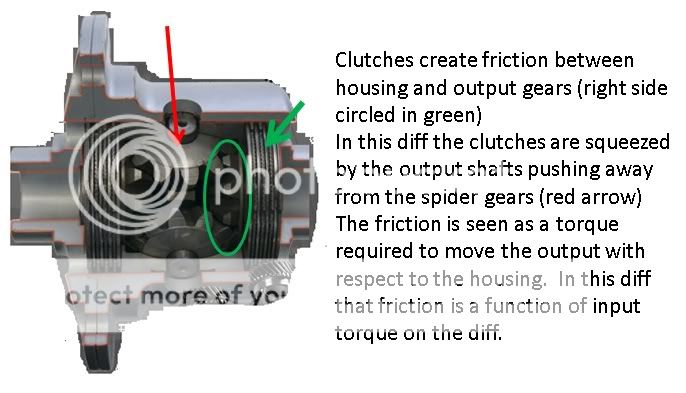
1. A basic clutch pack diff. This diff uses the separation force of the output gears from the spider gears to load up the clutch discs. That means this example is using a torque sensing diff. Note that because the clutches are between the housing and output any time the housing is spinning faster than the output the output will feel a torque in the forward direction. The opposite is true in reverse. There are two ways torque can be applied from the housing to the output; 1. via the spider gears, 2. via the clutch plates. The total torque to the output is ALWAYS the sum of those two torques.
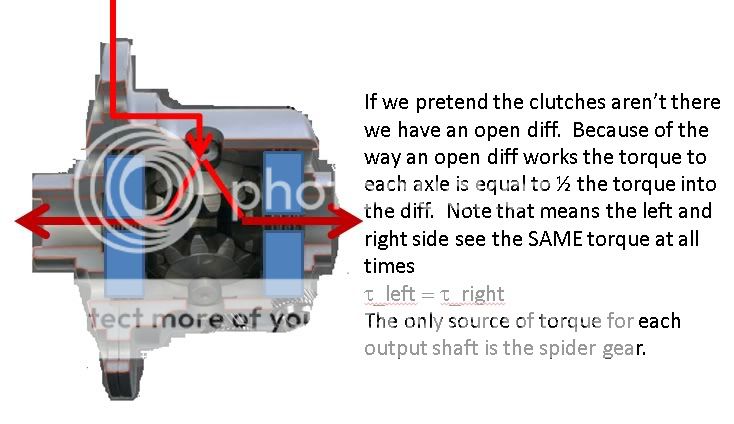
2. The open diff. Without the clutches the torque sent to each wheel is ALWAYS equal. The wheel on ice can't handle any torque so no torque gets sent to the wheel with grip. I stressed this because EVEN when we add clutches the SPIDER GEARS always send equal torque to each wheel. The clutches make up the difference.
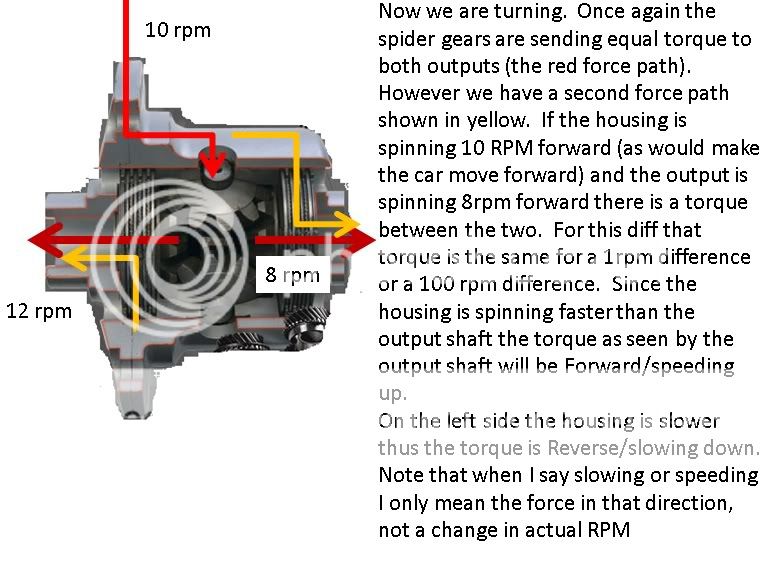
3.Now we turn to the right (imagine we are looking at the back of the car). The right wheel slows, the left wheel speeds up. We have relative motion in the clutches. Since this is a torque sensing, not speed sensing, diff it doesn't mater if the speed difference is 1/2 RPM or 100 RPM, the torque the clutches apply to the output shaft is still just a function of input torque.
The right wheel is spinning slower than the diff. That means the torque on the right output shaft is forward (or trying to make the right wheel spin faster). The torque from the spider gears is also forward. So we have two forward torques added together. Call that T_spider + T_clutches.
The left wheel is going faster so the torque the clutch applies to the output shaft is in the reverse direction. The equation looks like this: T_spider - T_clutches. So in one case we have addition and in the other subtractions. It's pretty clear that the addition case (ie the inside wheel) is going to get more torque. More torque at the wheel means more force on the ground.
Since the inside wheel is pushing harder than the outside wheel the rear axle is creating an understeer moment. If the front wheels were on casters the car would try to straighten out! Of course the front wheels over power this with their own steering moment but this is why a LSD (and of course a spool which is like an LSD with REALLY REALLY high bias!) tend to make a car understeer. Its just most of the time the front wheels can compensate.
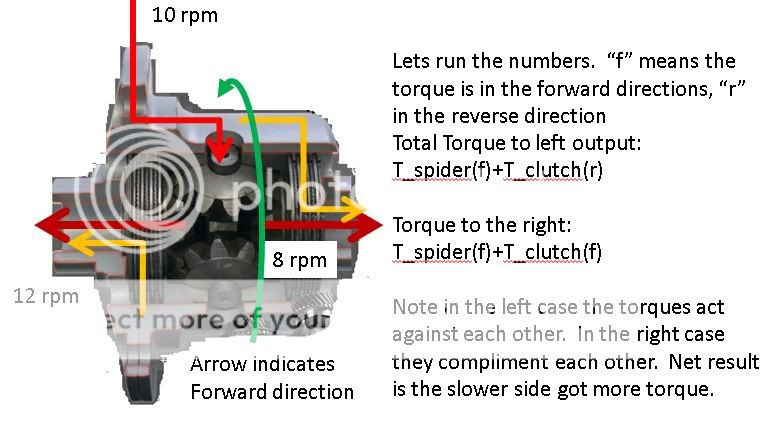
5. The above is true until the inside tire slips. This is the case where everyone says, "See the LSD sends the power to the wheel with grip!" Well yes but that's because it sends more power to the slower wheel. When the inside tire slips it speeds up. Makes sense, it doesn't have the road to slow it down. Of course all the math above holds true. The inside tire is now the fast tire. That means the torque to the inside tire is T_spider - T_clutch. Since the outside tire is now the slow one it's torque equation is: T_spider+T_clutch. So the non-slipping tire gets more torque and everyone is happy.
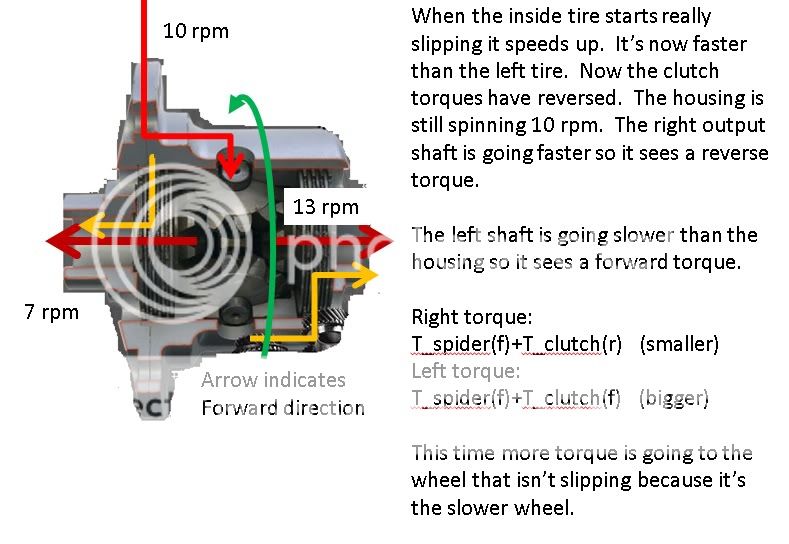
But there is a problem in that last bit. When you are cornering hard the outside tire is doing all it can to keep the rear end of the car from sliding out. When the inside tire loses grip it speeds up which means we get a lot of torque quickly transferring to the outside tire. The poor outside tire had just enough grip to handle pushing the car forward and keeping the tail in line. So now we spin thanks to the quick transfer of torque from the inside tire to the tire with grip! Fortunately this typically happens slowly and progressively enough that we can balance things and drive the car on the edge. Make no mistake, the LSD makes the edge sharper even though it doesn't always make it faster.
The limited slip diff is one of those car parts that everyone assumes is a must have. Any car that doesn't have one is because the manufacture was too dumb or to cheap to install it. That just isn't true. It can decrease lap times but it can also upset the handling of a car. The Lotus Elise and Cayman very well might come without LSD's not because the companies were cheap but because the test drivers preferred the cars without.
Just a few things starting with the open diff:
1. Torque is like force, it's how hard you twist something.
2. Power is force times velocity or in this case torque times rotational speed. If you push just as hard but move twice as fast you have twice the power.
3. An open diff always sends equal TORQUE to each wheel. ALWAYS.
4. Since an open diff sends equal torque to both wheels the wheel that spins faster gets more power. So that one wheel on ice gets the same torque as the wheel on dry ground but the ice wheel is the only one getting power since it's the only one spinning.
5. The torque applied to the rear wheels (not the power) determines how hard the tires are pushing the car forward.
So at this point we can figured out that with an open diff each rear wheel pushes just as hard. If one is one ice, neither can push that hard.
Limited slip diffs come in a few basic types. You have the old spring loaded clutch pack type. Those have a fixed locking torque. Locking torque is what makes the output shafts try to spin at the same speed as the diff housing. For a clutch pack diff the locking torque is the torque needed say turn the wheel when the car is on jacks and the transmission is in gear. Next you have speed sensitive diffs. These are ones where the locking torque is related to the difference in speed between the axles and the diff housing. They act like an open diff if both wheels are spinning at about the same speed but act like a LSD when one wheel spins up. Finally we have ramp clutch, torque sensing clutch packs, Torsen, Quaifee (sp?) and other torque sensing diffs. In these diffs the locking torque is proportional to the torque into the diff. So when you are on the gas the diff has a lot of locking torque. When you are off the gas the diff is rather open. Even those all these torque sensing diffs have different guts, as a black box they all work about the same way. Since the clutch pack version is the easiest to see I used it in these pictures.
Now on to the pictures...
1. A basic clutch pack diff. This diff uses the separation force of the output gears from the spider gears to load up the clutch discs. That means this example is using a torque sensing diff. Note that because the clutches are between the housing and output any time the housing is spinning faster than the output the output will feel a torque in the forward direction. The opposite is true in reverse. There are two ways torque can be applied from the housing to the output; 1. via the spider gears, 2. via the clutch plates. The total torque to the output is ALWAYS the sum of those two torques.
2. The open diff. Without the clutches the torque sent to each wheel is ALWAYS equal. The wheel on ice can't handle any torque so no torque gets sent to the wheel with grip. I stressed this because EVEN when we add clutches the SPIDER GEARS always send equal torque to each wheel. The clutches make up the difference.
3.Now we turn to the right (imagine we are looking at the back of the car). The right wheel slows, the left wheel speeds up. We have relative motion in the clutches. Since this is a torque sensing, not speed sensing, diff it doesn't mater if the speed difference is 1/2 RPM or 100 RPM, the torque the clutches apply to the output shaft is still just a function of input torque.
The right wheel is spinning slower than the diff. That means the torque on the right output shaft is forward (or trying to make the right wheel spin faster). The torque from the spider gears is also forward. So we have two forward torques added together. Call that T_spider + T_clutches.
The left wheel is going faster so the torque the clutch applies to the output shaft is in the reverse direction. The equation looks like this: T_spider - T_clutches. So in one case we have addition and in the other subtractions. It's pretty clear that the addition case (ie the inside wheel) is going to get more torque. More torque at the wheel means more force on the ground.
Since the inside wheel is pushing harder than the outside wheel the rear axle is creating an understeer moment. If the front wheels were on casters the car would try to straighten out! Of course the front wheels over power this with their own steering moment but this is why a LSD (and of course a spool which is like an LSD with REALLY REALLY high bias!) tend to make a car understeer. Its just most of the time the front wheels can compensate.
5. The above is true until the inside tire slips. This is the case where everyone says, "See the LSD sends the power to the wheel with grip!" Well yes but that's because it sends more power to the slower wheel. When the inside tire slips it speeds up. Makes sense, it doesn't have the road to slow it down. Of course all the math above holds true. The inside tire is now the fast tire. That means the torque to the inside tire is T_spider - T_clutch. Since the outside tire is now the slow one it's torque equation is: T_spider+T_clutch. So the non-slipping tire gets more torque and everyone is happy.
But there is a problem in that last bit. When you are cornering hard the outside tire is doing all it can to keep the rear end of the car from sliding out. When the inside tire loses grip it speeds up which means we get a lot of torque quickly transferring to the outside tire. The poor outside tire had just enough grip to handle pushing the car forward and keeping the tail in line. So now we spin thanks to the quick transfer of torque from the inside tire to the tire with grip! Fortunately this typically happens slowly and progressively enough that we can balance things and drive the car on the edge. Make no mistake, the LSD makes the edge sharper even though it doesn't always make it faster.

Registered User
Joined: Aug 2008
Posts: 862
Likes: 0
I don't have time to read all of this now (will do so later), but I thought that you should clarify when talking about torque -> power, you multiply times omega, angular velocity, in rad/s, rpm, etc. It's not a distance per second, it's an amount of rotation per second. Thus, going twelve feet around a 2 foot circumference = 6 rotations and going six feet around a one foot diameter = six rotations. What you said wasn't wrong, it's just not clear to someone without much knowledge on the subject.
The only thing I'd say is that it's not really speed that determines which wheel goes. It's the reaction at the wheels that do. If you create a FBD for the diff where you've got a reaction at one wheel (friction) and none at the other wheel (in air), you have a dynamic rigid body that rotates around the gear connected to the wheel on the ground. The fact that the wheel speeds up is simply a result of having all all that torque applied with no resistance.
Power in this sense is more a result of the torque than a cause of wheel spin.
The only thing I'd say is that it's not really speed that determines which wheel goes. It's the reaction at the wheels that do. If you create a FBD for the diff where you've got a reaction at one wheel (friction) and none at the other wheel (in air), you have a dynamic rigid body that rotates around the gear connected to the wheel on the ground. The fact that the wheel speeds up is simply a result of having all all that torque applied with no resistance.
Power in this sense is more a result of the torque than a cause of wheel spin.
Thread Starter
Registered User
Joined: Feb 2004
Posts: 5,387
Likes: 0
From: Palo Alto
Thanks tarheel91. I was struggling with just how much to say about that. If I started throwing out terms like angular velocity would this confuse people more or less. I also occasionally caught my self saying Force instead of Torque. They are of course similar but not the same. I think just about everyone understand Force but some may not fully get Torque. At the most basic level any unit of torque times any unit of rotational velocity is power but some just don't make sense. I just wanted to get across that some people say a LSD sends all the power to this wheel or an open diff sends the torque to the wheel on ice etc. We need to make sure we are clear that power is torque x speed (implying angular speed).
I don't quite get what you are saying in the second paragraph but I suspect we agree there as well and again I will plead trying to keep the language simple rather than precise.
In your final paragraph you relate power and torque and you are right as well. In system dynamics that's a causal system. You can either define the torque and the speed happens or you can try to control for speed and the load on the wheel in effect tells me how much torque I need. Power of course is just the result of the two. The parallel is current and voltage through a resistor. If I have a resistor I can either define how much voltage to put across it or how much current to put through it. I can't control both. Thus I will conclude with, yes you are right but that also might confuse rather than clarify and I might have already done a lot of confusing
I don't quite get what you are saying in the second paragraph but I suspect we agree there as well and again I will plead trying to keep the language simple rather than precise.
In your final paragraph you relate power and torque and you are right as well. In system dynamics that's a causal system. You can either define the torque and the speed happens or you can try to control for speed and the load on the wheel in effect tells me how much torque I need. Power of course is just the result of the two. The parallel is current and voltage through a resistor. If I have a resistor I can either define how much voltage to put across it or how much current to put through it. I can't control both. Thus I will conclude with, yes you are right but that also might confuse rather than clarify and I might have already done a lot of confusing

Registered User
Joined: Jan 2005
Posts: 7,485
Likes: 21
Good write up. I might add that it really depends on your application as well. Lotus doesn't like LSD on cars for road courses but in my experience it's absolutely vital. My Elise was borderline on needing the LSD when it was n/a especially for autocross but with more power it's absolutely vital. If I had a choice of LSD or open diff I would always pick a LSD.
Thread Starter
Registered User
Joined: Feb 2004
Posts: 5,387
Likes: 0
From: Palo Alto
Yes that is also true. For lower power cars with sticky tires you almost never want a LSD. Something like a Formula Ford is better without. When you have more power than tires it becomes a trade off.

Registered User
Joined: Oct 2009
Posts: 2,220
Likes: 0
I'm glad you put this up in a new thread. I stopped posting in the other thread so I could read and think about what you wrote.
That's a good write-up, taken from a different perspective than I was looking at it. Sometimes trying to express a concept in a way someone else can understand is more difficult than the concept.
When I say "this is how an LSD works," I am not talking about all the ways it is exactly the same as an open differential. You apparently are.
I won't say what you've written is wrong, but it ignores the entire reason people buy them - for the ways it functions when an open diff would result in wheel spin.
"That poor outside tire" is doing what we bought it to do. It is driving the car around the corner, while the inside tire is not spinning wildly.
I'm not saying I know it all, and I'm not saying you know nothing. And I think this discussion is edifying and all that. But how an LSD actually operates when a wheel slips is the part I find interesting and sometimes difficult to grasp without a working cut-away model. I don't find it interesting to say "This is how an LSD works" then ignore the LSD part of the system.
I'm going to make an attempt to describe it, and I would appreciate it if someone else sees some error or detail I am missing.
That's a good write-up, taken from a different perspective than I was looking at it. Sometimes trying to express a concept in a way someone else can understand is more difficult than the concept.
When I say "this is how an LSD works," I am not talking about all the ways it is exactly the same as an open differential. You apparently are.
I won't say what you've written is wrong, but it ignores the entire reason people buy them - for the ways it functions when an open diff would result in wheel spin.
"That poor outside tire" is doing what we bought it to do. It is driving the car around the corner, while the inside tire is not spinning wildly.
I'm not saying I know it all, and I'm not saying you know nothing. And I think this discussion is edifying and all that. But how an LSD actually operates when a wheel slips is the part I find interesting and sometimes difficult to grasp without a working cut-away model. I don't find it interesting to say "This is how an LSD works" then ignore the LSD part of the system.
I'm going to make an attempt to describe it, and I would appreciate it if someone else sees some error or detail I am missing.
Registered User
Joined: Oct 2009
Posts: 2,220
Likes: 0
I am not trying to present a paper to a society of engineers. On the other hand, accuracy is important to me. I just don't want to pad it with academic jargon for the sake of jargon.
***
Both side gears attached to the axle ends have stacks of clutches and plates between the side gear and carrier. The clutches are connected to the carrier and the plates are connected to the axle. The side gears increase the pressure on those stacks as the difference in applied torque between the two sides increases. IOW, if one tire is slipping, the pressure on the clutch and plate stacks on that side goes down, and increases on the other side. The result is an increase in binding on the side with traction, which increases until the axle is locked to the carrier. Of course, if one side is locked to the carrier, the other side is forced to rotate at the same rate by the gears.
The differential simulates an open design when going around a corner when there is equal traction on both sides, because the clutch and plate stacks only bind when there is a change in traction. If there is a change in traction, it progressively transitions to a locked design as pressure in a stack increases. If there is only a small drop in traction of the inside tire, there is only a small drop in pressure on its stack and a small increase on the other side. The result is a relatively small resistance to the differential action. And as the inside wheel has less distance to travel and is unweighted, it's resistance to torque input is also lower, so even without any drop in traction, there is a decrease in stack clamping pressure and a corresponding increase on the outside axle.
There is more than one way to apply pressure to the clutch and plate stacks. It appears in the pictures in the OP's post that the design of the side gear teeth will force the gears into the clutch & plate stacks. This force would be the same on both sides when no wheel is slipping, and would increase as torque is applied by the engine.
When a wheel slips, it's resistance to the engine's torque decreases, and so decreases the clamping of the clutch & plate stacks. The other side gear, since it is now carrying a larger share of pushing the car, will increase the pressure on it's stack, up to the point where the stack locks the carrier and axle together.
When the stacks are compressed together, some of the total torque is passed through the stack. The tighter the stack is compressed, the more torque is transferred.
Obviously if one side is locked, the other side gear has to turn at the same rate. This prevents uncontrolled wheelspin. And the resistance to slipping, or what we see as the behavior of an open diferential when one wheel comes off the ground, increases as traction on one side decreases. Instead of uncontrolled wheelspin we get a progressively locked rear axle.
There is preload on the clutch and plate stacks, measured as the force required to turn one wheel while the other is held stationary. On a street car this is ~60-80 lb.-ft. as near as I can find. Maybe there is wider variation, I don't know.
I'm not saying all of the above is completely accurate and as precise as it can be. It merely is as accurate and precise as I can make it. The amount of information on this subject is scant, and not all of what is available is correct.
***
Both side gears attached to the axle ends have stacks of clutches and plates between the side gear and carrier. The clutches are connected to the carrier and the plates are connected to the axle. The side gears increase the pressure on those stacks as the difference in applied torque between the two sides increases. IOW, if one tire is slipping, the pressure on the clutch and plate stacks on that side goes down, and increases on the other side. The result is an increase in binding on the side with traction, which increases until the axle is locked to the carrier. Of course, if one side is locked to the carrier, the other side is forced to rotate at the same rate by the gears.
The differential simulates an open design when going around a corner when there is equal traction on both sides, because the clutch and plate stacks only bind when there is a change in traction. If there is a change in traction, it progressively transitions to a locked design as pressure in a stack increases. If there is only a small drop in traction of the inside tire, there is only a small drop in pressure on its stack and a small increase on the other side. The result is a relatively small resistance to the differential action. And as the inside wheel has less distance to travel and is unweighted, it's resistance to torque input is also lower, so even without any drop in traction, there is a decrease in stack clamping pressure and a corresponding increase on the outside axle.
There is more than one way to apply pressure to the clutch and plate stacks. It appears in the pictures in the OP's post that the design of the side gear teeth will force the gears into the clutch & plate stacks. This force would be the same on both sides when no wheel is slipping, and would increase as torque is applied by the engine.
When a wheel slips, it's resistance to the engine's torque decreases, and so decreases the clamping of the clutch & plate stacks. The other side gear, since it is now carrying a larger share of pushing the car, will increase the pressure on it's stack, up to the point where the stack locks the carrier and axle together.
When the stacks are compressed together, some of the total torque is passed through the stack. The tighter the stack is compressed, the more torque is transferred.
Obviously if one side is locked, the other side gear has to turn at the same rate. This prevents uncontrolled wheelspin. And the resistance to slipping, or what we see as the behavior of an open diferential when one wheel comes off the ground, increases as traction on one side decreases. Instead of uncontrolled wheelspin we get a progressively locked rear axle.
There is preload on the clutch and plate stacks, measured as the force required to turn one wheel while the other is held stationary. On a street car this is ~60-80 lb.-ft. as near as I can find. Maybe there is wider variation, I don't know.
I'm not saying all of the above is completely accurate and as precise as it can be. It merely is as accurate and precise as I can make it. The amount of information on this subject is scant, and not all of what is available is correct.
Trending Topics


Registered User
Joined: Oct 2009
Posts: 2,220
Likes: 0
To keep things simple, let's not discuss what happens in a corner until we've worked out what happens in a straight line when one tire loses a bit traction.
Consider when driving straight the right wheel experiences:
T_Spider(f) + R_Clutch(f)
and the left sees:
T_Spider(f) + L_Clutch(f)
The value for R_Clutch is the same as L_Clutch.
If the right tire went over a sandy patch, the R_Clutch value would decrease as the internal stack loosened. At the same time the L_Clutch value would increase as the left stack compressed tighter. This is without any change in wheel speed, merely a change in the compression on the stacks.
***
Now something that has me wondering is in some places I read that an open differential always delivers the same torque to each wheel.
And in other places I read that in order for one wheel to rotate faster than the other, the wheel with more resistance to rotation must slow with regards to the transfer case and transfers torque to the other wheel, contributing to it's faster rotation. Such as when one is stuck and presses on the gas, making the wheel in the mud start spinning faster. Or when cornering.
The second version makes sense in that something has to be responsible for the differential action and the total output is the same, just the distribution changes.
I know that a locker or spool makes turning difficult because they always deliver the same amount of torque to each side, even when turning. However, an open rear obviously is easier to turn, therefore cannot be sending the same amount of torque to both sides or it would be identical to the spool and locker.
This leads me to suspect that the outside wheel of an open and an LSD will have more torque than the inside wheel, and the action of the LSD system can change the behavior so that it no longer acts simply as a damped open differential. Obviously the benefits of an LSD of any design is to facilitate the transfer of torque from a slipping wheel to a non-slipping one. This would not show any benefit if it was unable to do anything different than an open diff.
We also know that a viscous differential uses a thick fluid, and when one axle spins faster than the other, the fluid slows it down while feeding that absorbed torque to the other axle. This type clearly transfers torque from side to side, based on speed in this case. So we know the transfer of torque within a differential is a reasonable idea.
IOW, I do not believe it is true that an open differential ALWAYS sends the same amount of torque to each side.
I wrote this:
based on something you wrote in your post and I also read (possibly mis-read) in relation to a specific design, and did not realize it wasn't uniformly true. I now question whether it is ever true as a rule, instead of a special case.
Consider when driving straight the right wheel experiences:
T_Spider(f) + R_Clutch(f)
and the left sees:
T_Spider(f) + L_Clutch(f)
The value for R_Clutch is the same as L_Clutch.
If the right tire went over a sandy patch, the R_Clutch value would decrease as the internal stack loosened. At the same time the L_Clutch value would increase as the left stack compressed tighter. This is without any change in wheel speed, merely a change in the compression on the stacks.
***
Now something that has me wondering is in some places I read that an open differential always delivers the same torque to each wheel.
And in other places I read that in order for one wheel to rotate faster than the other, the wheel with more resistance to rotation must slow with regards to the transfer case and transfers torque to the other wheel, contributing to it's faster rotation. Such as when one is stuck and presses on the gas, making the wheel in the mud start spinning faster. Or when cornering.
The second version makes sense in that something has to be responsible for the differential action and the total output is the same, just the distribution changes.
I know that a locker or spool makes turning difficult because they always deliver the same amount of torque to each side, even when turning. However, an open rear obviously is easier to turn, therefore cannot be sending the same amount of torque to both sides or it would be identical to the spool and locker.
This leads me to suspect that the outside wheel of an open and an LSD will have more torque than the inside wheel, and the action of the LSD system can change the behavior so that it no longer acts simply as a damped open differential. Obviously the benefits of an LSD of any design is to facilitate the transfer of torque from a slipping wheel to a non-slipping one. This would not show any benefit if it was unable to do anything different than an open diff.
We also know that a viscous differential uses a thick fluid, and when one axle spins faster than the other, the fluid slows it down while feeding that absorbed torque to the other axle. This type clearly transfers torque from side to side, based on speed in this case. So we know the transfer of torque within a differential is a reasonable idea.
IOW, I do not believe it is true that an open differential ALWAYS sends the same amount of torque to each side.
I wrote this:
sure, a differential will increase torque to the wheel on the inside of the turn.