


One of the owner's of Tapout dead








Registered User
Joined: Jun 2004
Posts: 16,759
Likes: 1
From: Sun★Works

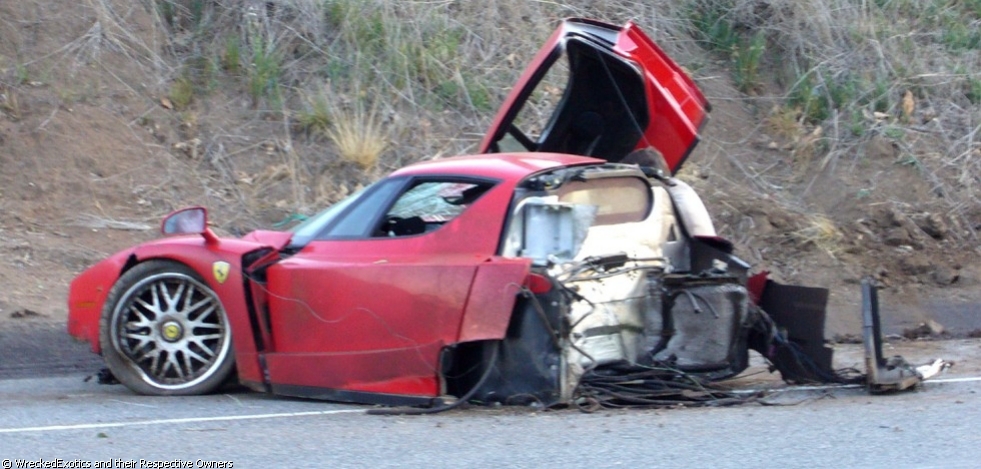
they deisgned the enzo specifically to do just that. it is an attempt to bring some of the race safety elements into their public consumption vehicles.
it is based on the principle of Plastic Vs Elastic damage (no, not the actual substances, rather definitions of types of energy absorbtion and dispertion)
Plastic damage looks like the race cars and dragsters you see wreck on the track where parts fly off all over the place and the car basically disintegrates leavign the cage the driver is in. During this type of damage, potential and actual energy is dipersed away from the driver. the race car team and driver are not concerned with the beauty of the car in this situation, they want to survive
Most of the worlds consumer cars are designed to perform Elastic damage in a crash in an attempt to save as much of the vehicle as possible. The energy is absorbed into the chassis and carried through the car (and often into the driver/passengers etc). we as vain consumers do not want to replace an entire car or side of the car at the event of just about any collision. we dont have the budget to replace entire chassis and panels either. That is why auto producers have to find a way to make the cars as safe as possible while also trying to retain the integrity of the car.
the Enzo is probably the best example of a car designed for the public while retain as much Plastic damage capabilities as possible.
If none of us were concerned with simple bodied cars, road noise, cages and replacing a car that costs say 1100.00 (if we could produce them that cheaply) we could produce much safer cars that more people would survive crashes in. this will most likely never happen in the real world though...we simply want too much out of our cars for that to be a possibility.
it is based on the principle of Plastic Vs Elastic damage (no, not the actual substances, rather definitions of types of energy absorbtion and dispertion)
Plastic damage looks like the race cars and dragsters you see wreck on the track where parts fly off all over the place and the car basically disintegrates leavign the cage the driver is in. During this type of damage, potential and actual energy is dipersed away from the driver. the race car team and driver are not concerned with the beauty of the car in this situation, they want to survive
Most of the worlds consumer cars are designed to perform Elastic damage in a crash in an attempt to save as much of the vehicle as possible. The energy is absorbed into the chassis and carried through the car (and often into the driver/passengers etc). we as vain consumers do not want to replace an entire car or side of the car at the event of just about any collision. we dont have the budget to replace entire chassis and panels either. That is why auto producers have to find a way to make the cars as safe as possible while also trying to retain the integrity of the car.
the Enzo is probably the best example of a car designed for the public while retain as much Plastic damage capabilities as possible.
If none of us were concerned with simple bodied cars, road noise, cages and replacing a car that costs say 1100.00 (if we could produce them that cheaply) we could produce much safer cars that more people would survive crashes in. this will most likely never happen in the real world though...we simply want too much out of our cars for that to be a possibility.


Registered User
Joined: Oct 2005
Posts: 1,198
Likes: 0
From: Drexel Hill, PA
Originally Posted by PrimoGen,Mar 12 2009, 08:49 AM
they deisgned the enzo specifically to do just that. it is an attempt to bring some of the race safety elements into their public consumption vehicles.
it is based on the principle of Plastic Vs Elastic damage (no, not the actual substances, rather definitions of types of energy absorbtion and dispertion)
Plastic damage looks like the race cars and dragsters you see wreck on the track where parts fly off all over the place and the car basically disintegrates leavign the cage the driver is in. During this type of damage, potential and actual energy is dipersed away from the driver. the race car team and driver are not concerned with the beauty of the car in this situation, they want to survive
Most of the worlds consumer cars are designed to perform Elastic damage in a crash in an attempt to save as much of the vehicle as possible. The energy is absorbed into the chassis and carried through the car (and often into the driver/passengers etc). we as vain consumers do not want to replace an entire car or side of the car at the event of just about any collision. we dont have the budget to replace entire chassis and panels either. That is why auto producers have to find a way to make the cars as safe as possible while also trying to retain the integrity of the car.
the Enzo is probably the best example of a car designed for the public while retain as much Plastic damage capabilities as possible.
If none of us were concerned with simple bodied cars, road noise, cages and replacing a car that costs say 1100.00 (if we could produce them that cheaply) we could produce much safer cars that more people would survive crashes in. this will most likely never happen in the real world though...we simply want too much out of our cars for that to be a possibility.
it is based on the principle of Plastic Vs Elastic damage (no, not the actual substances, rather definitions of types of energy absorbtion and dispertion)
Plastic damage looks like the race cars and dragsters you see wreck on the track where parts fly off all over the place and the car basically disintegrates leavign the cage the driver is in. During this type of damage, potential and actual energy is dipersed away from the driver. the race car team and driver are not concerned with the beauty of the car in this situation, they want to survive
Most of the worlds consumer cars are designed to perform Elastic damage in a crash in an attempt to save as much of the vehicle as possible. The energy is absorbed into the chassis and carried through the car (and often into the driver/passengers etc). we as vain consumers do not want to replace an entire car or side of the car at the event of just about any collision. we dont have the budget to replace entire chassis and panels either. That is why auto producers have to find a way to make the cars as safe as possible while also trying to retain the integrity of the car.
the Enzo is probably the best example of a car designed for the public while retain as much Plastic damage capabilities as possible.
If none of us were concerned with simple bodied cars, road noise, cages and replacing a car that costs say 1100.00 (if we could produce them that cheaply) we could produce much safer cars that more people would survive crashes in. this will most likely never happen in the real world though...we simply want too much out of our cars for that to be a possibility.

Joined: Apr 2007
Posts: 1,918
Likes: 0
From: San Diego
i know the passenger, she went to my highschool and her sister was my age and ive known the family since i was in elementary school. she is in critical condition at the moment, with a fair amount of surgery ahead of her if she pulls through.