And now for something completely different....


Thread Starter
Joined: Apr 2004
Posts: 2,571
Likes: 0
From: Redmond, Washington, USA
 And now for something completely different....
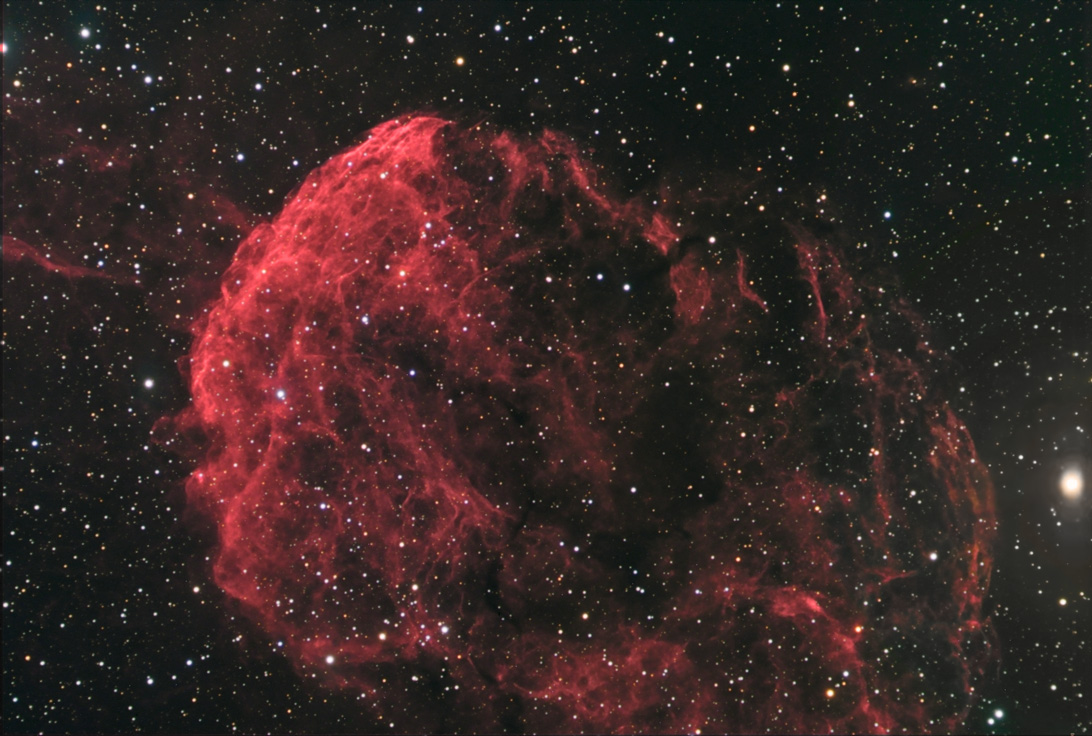
This is a picture I took of the remnant of a supernova explosion from perhaps 30,000 years ago. It's sometimes called the "Jellyfish Nebula" for obvious reasons.


Registered User
Joined: Feb 2002
Posts: 834
Likes: 0
From: Los Angeles
Originally Posted by 124Spider,Jan 26 2007, 04:18 PM
For this picture, an Astrophysics AP130 Starfire f/6. The camera is a dedicated astronomy camera (an SBIG ST-10XME). The picture represents a bit over nine hours of exposure time.

Thread Starter
Joined: Apr 2004
Posts: 2,571
Likes: 0
From: Redmond, Washington, USA
Thanks! The camera is not any bigger than my Canon 10D with a 28-70 f/2.8 lens on it. But there's no question that setting up for astronomical imaging can be quite a task. That scope and camera (as well as another one) are in a dome in the mountains of New Mexico which I share with a guy in Texas; we access it through the internet, which makes things easy (if expensive). I use a similar camera with my telescope at home, but the perpetual Seattle rain necessitated setting up somewhere else, hence the dome in NM.
Here's a picture taken with the other scope in the dome in NM; the brightest star is one of the "seven sisters" in the Pleiades (Subaru in Japanese, hence the Subaru logo), and it's surrounded by this beautiful blue nebulosity.
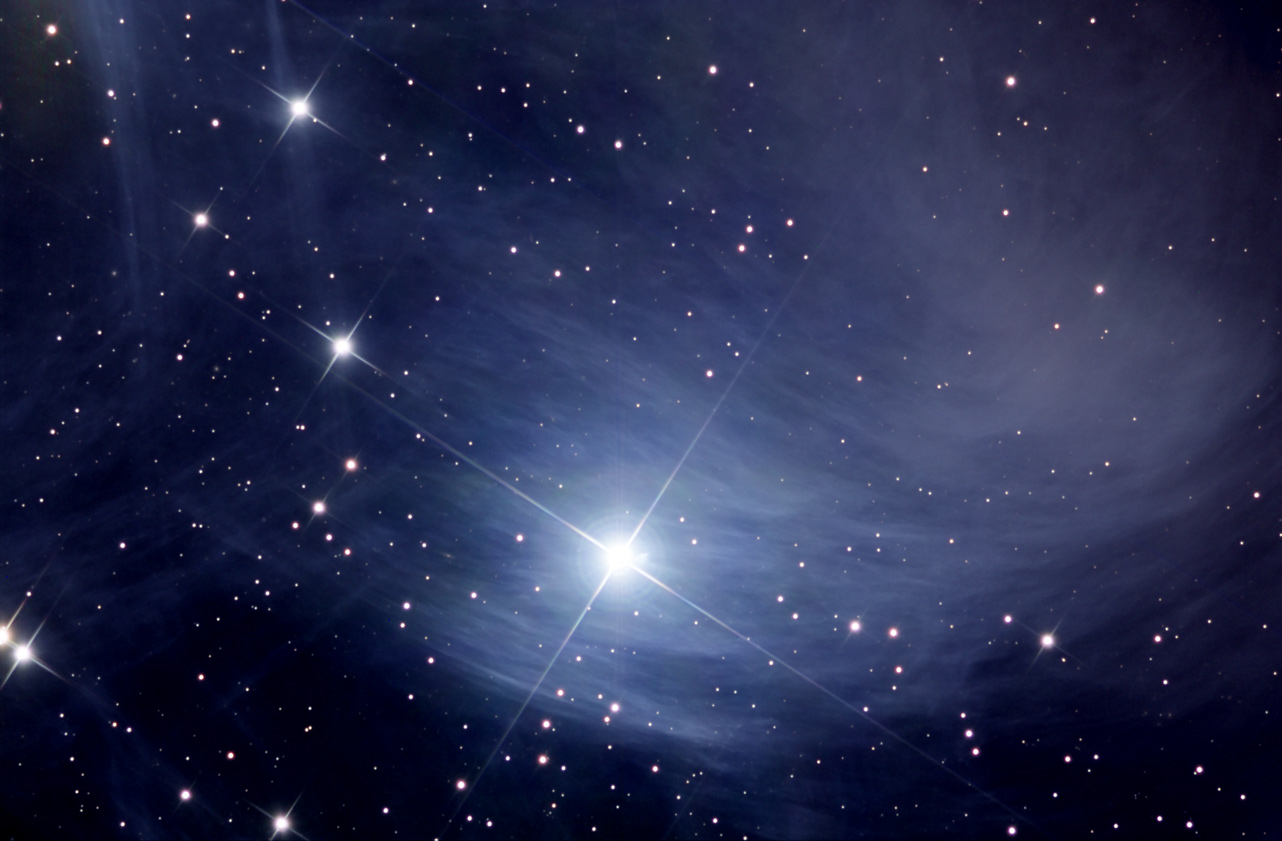
Here's a picture taken with the other scope in the dome in NM; the brightest star is one of the "seven sisters" in the Pleiades (Subaru in Japanese, hence the Subaru logo), and it's surrounded by this beautiful blue nebulosity.

Registered User
Joined: Jan 2005
Posts: 2,778
Likes: 0
From: Kona, HI
Great pictures. Not to completely hijack your thread, but are there attachments (telescope lenses) that you can put onto a 30d or a digital rebel to take decent sky/star pictures? I didn't know anything like that existed (obviously with less spectacular results than what you just posted but still like the idea) and I'm intrigued.
I realize light can be an issue, but in the summer I live in Flagstaff, AZ, the first international dark sky community (major restrictions on streetlights and such for the observatory there), and I'd like to try some of this out, as long as its not too cost prohibative.
I realize light can be an issue, but in the summer I live in Flagstaff, AZ, the first international dark sky community (major restrictions on streetlights and such for the observatory there), and I'd like to try some of this out, as long as its not too cost prohibative.
Trending Topics


Joined: Jul 2002
Posts: 19,257
Likes: 19
From: San Diego, CA
Originally Posted by 124Spider,Jan 26 2007, 04:57 PM
This is a picture I took of the remnant of a supernova explosion from perhaps 30,000 years ago. It's sometimes called the "Jellyfish Nebula" for obvious reasons.