


Why so many Watts?


Registered User
Joined: Mar 2010
Posts: 698
Likes: 0

Originally Posted by cvjoint' timestamp='1307726471' post='20669767
[quote name='lovegroova' timestamp='1307698642' post='20668443']
Wow, was that with the fan switched to maximum and the recirculate button on?
Wow, was that with the fan switched to maximum and the recirculate button on?
Were you holding the sound meter, or was it resting on the centre tunnel or dashboard?
FWIW measured 35dB engine off, then 55dB engine on, and 100dB sound system on high, but not maximum, volume.
[/quote]
I held the mic in my hand, close to ear level. The measurement system is a Dayton Omnimic. It's made by Praxis, basically the Mercedes of measurement systems.
Your phone mic is an awful tool. I tried my Droid with various apps. and if fails badly. The mic clips really easy and has a very irregular response under 100hz. Lastly, it may be A-weighted. If I use A-weights like car magazines do I get very close to their published numbers.
For the purposes of car audio background noise checks you don't want to use weights. This car has loads of noise with the engine on at 30hz. It may be that's where the resonators are tuned from the exhaust or simply a cabin gain effect.


Joined: Sep 2004
Posts: 1,574
Likes: 62
From: NJ USA
I'm the first to admit that I know nothing about sound levels, but everything I've
read lists sounds at 90+ dB as quite loud and very annoying, not how I would
describe my s2000 at idle.
For instance, the chart here gives the following examples (their comments):
read lists sounds at 90+ dB as quite loud and very annoying, not how I would
describe my s2000 at idle.
For instance, the chart here gives the following examples (their comments):
- Jet Flyover (1000 ft.) 103 dB
- Garbage Truck/Cement Mixer 100 dB (No more than 15 minutes of unprotected exposure recommended for sounds between 90–100 dB.)
- Farm Tractor 98 dB
- Newspaper Press 97 dB
- Subway, Motorcycle (25 ft.) 88 dB (Very annoying)
- Lawnmower, Food Blender 85–90 dB (85 dB is the level at which hearing damage (8 hrs.) begins)
- Diesel Truck (40 mph, 50 ft.) 84 dB
Registered User
Joined: Mar 2010
Posts: 698
Likes: 0
I'm the first to admit that I know nothing about sound levels, but everything I've
read lists sounds at 90+ dB as quite loud and very annoying, not how I would
describe my s2000 at idle.
For instance, the chart here gives the following examples (their comments):
read lists sounds at 90+ dB as quite loud and very annoying, not how I would
describe my s2000 at idle.
For instance, the chart here gives the following examples (their comments):
- Jet Flyover (1000 ft.) 103 dB
- Garbage Truck/Cement Mixer 100 dB (No more than 15 minutes of unprotected exposure recommended for sounds between 90–100 dB.)
- Farm Tractor 98 dB
- Newspaper Press 97 dB
- Subway, Motorcycle (25 ft.) 88 dB (Very annoying)
- Lawnmower, Food Blender 85–90 dB (85 dB is the level at which hearing damage (8 hrs.) begins)
- Diesel Truck (40 mph, 50 ft.) 84 dB

Former Moderator


Joined: Jan 2004
Posts: 24,770
Likes: 311
From: Stanmore
Originally Posted by lovegroova' timestamp='1308144328' post='20684381
[quote name='cvjoint' timestamp='1307726471' post='20669767']
[quote name='lovegroova' timestamp='1307698642' post='20668443']
Wow, was that with the fan switched to maximum and the recirculate button on?
[quote name='lovegroova' timestamp='1307698642' post='20668443']
Wow, was that with the fan switched to maximum and the recirculate button on?
Were you holding the sound meter, or was it resting on the centre tunnel or dashboard?
FWIW measured 35dB engine off, then 55dB engine on, and 100dB sound system on high, but not maximum, volume.
[/quote]
I held the mic in my hand, close to ear level. The measurement system is a Dayton Omnimic. It's made by Praxis, basically the Mercedes of measurement systems.
Your phone mic is an awful tool. I tried my Droid with various apps. and if fails badly. The mic clips really easy and has a very irregular response under 100hz. Lastly, it may be A-weighted. If I use A-weights like car magazines do I get very close to their published numbers.
For the purposes of car audio background noise checks you don't want to use weights. This car has loads of noise with the engine on at 30hz. It may be that's where the resonators are tuned from the exhaust or simply a cabin gain effect.
[/quote]
I realise the phone is not great. I wouldn't describe it as "awful", as it gives a pretty good approximation, especially when considered in line with oth's post and the comparatives posted there.
Can you do a C-weighted measurement, as I guess that's probably the best approximation to the human ear (especially my 42 year old examples!) widely available?
Really interesting stuff though

Registered User
Joined: Mar 2010
Posts: 698
Likes: 0
I realise the phone is not great. I wouldn't describe it as "awful", as it gives a pretty good approximation, especially when considered in line with oth's post and the comparatives posted there.
Can you do a C-weighted measurement, as I guess that's probably the best approximation to the human ear (especially my 42 year old examples!) widely available?
Really interesting stuff though
Can you do a C-weighted measurement, as I guess that's probably the best approximation to the human ear (especially my 42 year old examples!) widely available?
Really interesting stuff though
I can post full FFT or RTA graphs of background noise with the engine running. Stick around.

Former Moderator
Joined: Jan 2004
Posts: 24,770
Likes: 311
From: Stanmore
I can do A and C weights. I forgot one thing. I took my rear tray out. Even though I have I layer of Dynamat Extreme on it and 1" of open cell foam, odds are I don't do as good of a job absorbing as the rear tray.
I can post full FFT or RTA graphs of background noise with the engine running. Stick around.
I can post full FFT or RTA graphs of background noise with the engine running. Stick around.
Registered User
Joined: Mar 2010
Posts: 698
Likes: 0
Originally Posted by cvjoint' timestamp='1308591805' post='20701082
I can do A and C weights. I forgot one thing. I took my rear tray out. Even though I have I layer of Dynamat Extreme on it and 1" of open cell foam, odds are I don't do as good of a job absorbing as the rear tray.
I can post full FFT or RTA graphs of background noise with the engine running. Stick around.
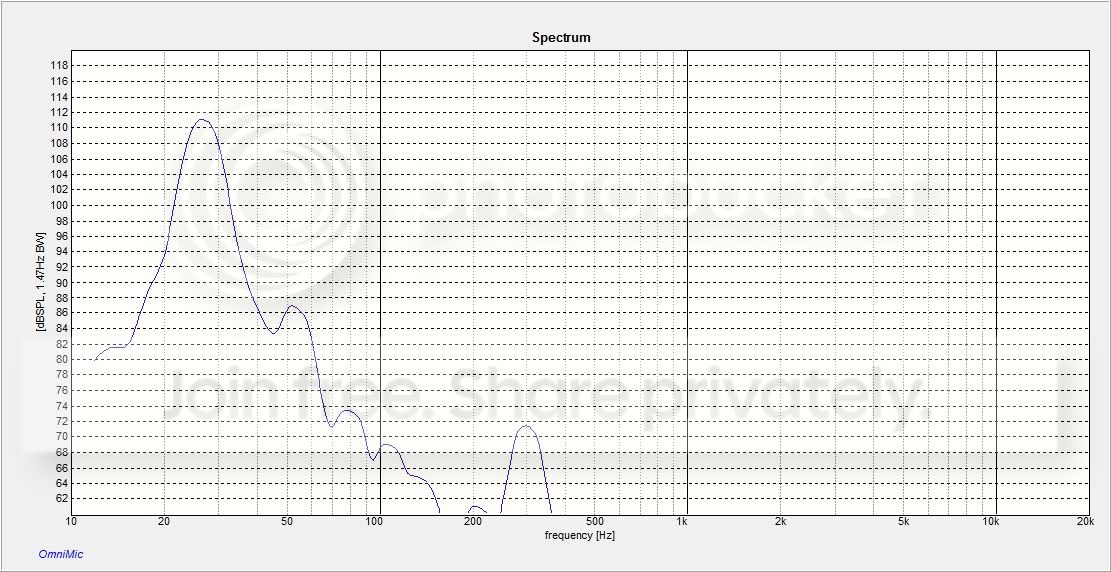
This FFT plot tells the whole story imo. There is lots of engine noise at 27hz or so. That's what's driving the high background noise readings. They were all about 96db this time with the engine warmed up and 90db right when I started. Using the C-weight only brought it down a db or so, same for A-weight.
I now have the air box lid off as well. Add in the rear tray is out my car is a bit louder than stock. However, it's all driven by that bassy peak. That's why it is not annoying. Heck, some old guys probably can't even hear it. Over 100hz where our ear starts gaining some sensitivity the noise levels are well bellow 70db.
Here's what it looks like driving, 1st gear 8,000rpm:

There is a lot more low midrange growl, notice a different higher peak at 280hz. That's quite dangerous if exposed for a long period of time!
Registered User
Joined: Mar 2010
Posts: 698
Likes: 0
Yeah, you'd be correct. In hearing tests they never even test those low frequencies. Check out the equal loudness curve:
http://en.wikipedia.org/wiki/Equal_loudness_curve
Something at 27hz has to be 30db louder, many many times over for it to sound as loud as 1,000hz.
Also, if I were to guess that's what resonators do. They take away noise from a wide bandwidth where it would be annoying and concentrated outside of our hearing range, or close to it. My best guess is the OEM cans concentrate all the exhaust noise around 27hz.
http://en.wikipedia.org/wiki/Equal_loudness_curve
Something at 27hz has to be 30db louder, many many times over for it to sound as loud as 1,000hz.
Also, if I were to guess that's what resonators do. They take away noise from a wide bandwidth where it would be annoying and concentrated outside of our hearing range, or close to it. My best guess is the OEM cans concentrate all the exhaust noise around 27hz.

Thread
Thread Starter
Forum
Replies
Last Post