


Which cams AP1/AP2 for built engine?



Joined: Feb 2008
Posts: 3,964
Likes: 7
From: USA

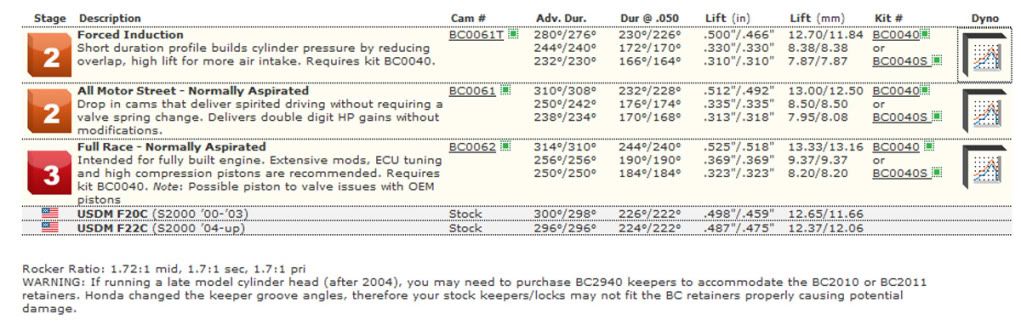
Well you want minimal overlap on a forced induction car as you have no need to draw the intake charge by the use of scavenging from the exhaust. There is one big problem that you can't put a good finger on and that is the ramp of the lobe. The other issue is that Crower measured the factory cams using their techniques so you can only use the standard 0.050" and lift rather than Advertised when comparing with other companies like IP and Skunk II.
To Make It Less Confusing I modified their table
AP1..........................Dur@ 0.050......Lift (in).......Adv Dur
Vtec Int..........................226°............0.49 8"..........300°
Vtec Exh.........................222°............0.459 "..........298°
AP2..........................Dur@ 0.050......Lift (in)........Adv Dur
Vtec Int..........................224°............0.48 7"...........296°
Vtec Exh.........................222°............0.475 "...........296°
Crower FI STG II.......Dur@ 0.050......Lift (in).........Adv Dur
Vtec Int..........................230°............0.50 0"............280°
Vtec Exh.........................226°............0.466 "............276°
BTW: There is still one missing variable, in Crowers data, what is the pre Vtec lobe specs (Though they are less important)
If you notice in Crowers info the ratio between the duration at 0.050" and Advertised is much different between their FI cams and the factory. Now this assumes that they used the same procedure for measuring each, which is what they say. So the difference is made in the ramp of the lobe being different.
Lets not forget about the BTDC and ATDC, as the centerlines also make a difference.
I would suggest using software like Desktop Dyno to illustrate differences as you change certain criteria.
Crower Data
Skunk II Data

To Make It Less Confusing I modified their table
AP1..........................Dur@ 0.050......Lift (in).......Adv Dur
Vtec Int..........................226°............0.49 8"..........300°
Vtec Exh.........................222°............0.459 "..........298°
AP2..........................Dur@ 0.050......Lift (in)........Adv Dur
Vtec Int..........................224°............0.48 7"...........296°
Vtec Exh.........................222°............0.475 "...........296°
Crower FI STG II.......Dur@ 0.050......Lift (in).........Adv Dur
Vtec Int..........................230°............0.50 0"............280°
Vtec Exh.........................226°............0.466 "............276°
BTW: There is still one missing variable, in Crowers data, what is the pre Vtec lobe specs (Though they are less important)
If you notice in Crowers info the ratio between the duration at 0.050" and Advertised is much different between their FI cams and the factory. Now this assumes that they used the same procedure for measuring each, which is what they say. So the difference is made in the ramp of the lobe being different.
Lets not forget about the BTDC and ATDC, as the centerlines also make a difference.
I would suggest using software like Desktop Dyno to illustrate differences as you change certain criteria.
Crower Data
Skunk II Data
Joined: Feb 2008
Posts: 3,964
Likes: 7
From: USA
Oh, and to answer your question by the looks of it based on the data I found the cheapest route is to use an AP1 intake with an AP2 exhaust. However Momentum posed a good point that there good be more differences than we think between years and models.

Registered User
Joined: Feb 2009
Posts: 578
Likes: 0
You don't actually want as little overlap as some people might think, you still need a decent amount of overlap to allow the intake charge time to "push" the burnt exhaust gases out of the cylinder. While that's obviously not fuel efficient it will result in more power for all the guys with nice manifolds. If your running a log manifold you want virtually no overlap (hence VTEC at a ridiculously high RPM). With a good ELTM (especially twin scroll) a decent amount of overlap is actually desirable.
Joined: Feb 2008
Posts: 3,964
Likes: 7
From: USA
Originally Posted by Momentum,Dec 29 2009, 04:26 PM
You don't actually want as little overlap as some people might think, you still need a decent amount of overlap to allow the intake charge time to "push" the burnt exhaust gases out of the cylinder. While that's obviously not fuel efficient it will result in more power for all the guys with nice manifolds. If your running a log manifold you want virtually no overlap (hence VTEC at a ridiculously high RPM). With a good ELTM (especially twin scroll) a decent amount of overlap is actually desirable.

I could write a book on this topic, but I am not getting paid enough to do that.


Registered User
Joined: Jun 2004
Posts: 28,786
Likes: 0
From: Behind you. Yep, I'm there.
i remember readng somewhere OGPacking ended up using AP1 intake and AP2 exhaust.
I remember him trying to use Crowler cams and lost power. Not sure which ones he used.
Search might be able to help you out on this as well.
I remember him trying to use Crowler cams and lost power. Not sure which ones he used.
Search might be able to help you out on this as well.
Joined: Feb 2008
Posts: 3,964
Likes: 7
From: USA
So I switched out my AP2 exhaust cam for my AP1 last night again to test with my new Mase Engineering manifold. If you remember the AP2 cam preformed better on my Inline Pro kit but the thought was that with reduced back pressure the AP1 may do better.
Upside
As with my last kit the first thing I noticed is that I need 30-50% more duty cycle on my boost solenoid. This leads me to believe that the duration difference between the two cams is very different and there is quite a bit of incoming air being blown right through the cylinder thus increasing the CFM through the turbo. So in theory the AP1 cam should lead to a quicker spool and a better chance to evacuate the cylinder.
Downside
Now the second thing I noticed is that the AFR were much richer with the cam. This makes me think that there is less air actually staying in the cylinder meaning less power. In addition the extra CFM that is being put through the turbo is also going through the exhaust increasing the backpressure.
If I ever get a chance I am going to dyno it again and see the difference on paper.
Upside
As with my last kit the first thing I noticed is that I need 30-50% more duty cycle on my boost solenoid. This leads me to believe that the duration difference between the two cams is very different and there is quite a bit of incoming air being blown right through the cylinder thus increasing the CFM through the turbo. So in theory the AP1 cam should lead to a quicker spool and a better chance to evacuate the cylinder.
Downside
Now the second thing I noticed is that the AFR were much richer with the cam. This makes me think that there is less air actually staying in the cylinder meaning less power. In addition the extra CFM that is being put through the turbo is also going through the exhaust increasing the backpressure.
If I ever get a chance I am going to dyno it again and see the difference on paper.

Registered User
Joined: May 2008
Posts: 3,791
Likes: 1
From: Around
This is an interesting thread, although we have still yet to see concrete results.
I'm curious, but wonder if it's worth the hassle for a few more ponies?
Do they make adjustable cam gears for this car? I'd say to get the best gains, it's not going to be a drop in fix, they will need dialed in for best results.
I'm curious, but wonder if it's worth the hassle for a few more ponies?
Do they make adjustable cam gears for this car? I'd say to get the best gains, it's not going to be a drop in fix, they will need dialed in for best results.
Registered User
Joined: Jun 2004
Posts: 28,786
Likes: 0
From: Behind you. Yep, I'm there.
Originally Posted by siadam,Jul 18 2010, 03:36 PM
This is an interesting thread, although we have still yet to see concrete results.
I'm curious, but wonder if it's worth the hassle for a few more ponies?
Do they make adjustable cam gears for this car? I'd say to get the best gains, it's not going to be a drop in fix, they will need dialed in for best results.
I'm curious, but wonder if it's worth the hassle for a few more ponies?
Do they make adjustable cam gears for this car? I'd say to get the best gains, it's not going to be a drop in fix, they will need dialed in for best results.
They mainly do N/A.
Joined: Feb 2008
Posts: 3,964
Likes: 7
From: USA
Another thing that I have noticed is that the engine blow by was DRAMTICLLY reduced? 
The only thing that makes sense to me is that the dynamic compression is lowered with the AP1 cams vs the AP2. This could also explain why there is a difference in the performance.
The only thing that makes sense to me is that the dynamic compression is lowered with the AP1 cams vs the AP2. This could also explain why there is a difference in the performance.
Registered User
Joined: May 2008
Posts: 3,791
Likes: 1
From: Around
Originally Posted by dsddcd,Jul 20 2010, 08:03 AM
Another thing that I have noticed is that the engine blow by was DRAMTICLLY reduced?
The only thing that makes sense to me is that the dynamic compression is lowered with the AP1 cams vs the AP2. This could also explain why there is a difference in the performance.
The only thing that makes sense to me is that the dynamic compression is lowered with the AP1 cams vs the AP2. This could also explain why there is a difference in the performance.