When you click on links to various merchants on this site and make a purchase, this can result in this site earning a commission. Affiliate programs and affiliations include, but are not limited to, the eBay Partner Network.
I've just received the car back. Again with a new (to me) block, CP pistons, inline pro rods, freshly rebuilt. This time they bored to a thousandth over last time to allow for additional piston to wall clearance. Inline pro themselves broke in the motor for a few hundred miles then verified Evans tune on the motor on their own dyno and gave their blessing.
I've driven the car about 150 miles, everything looking great as far as tune/ 0 knocking, etc goes.. except during a 3rd gear pull it pushed the dipstick out and had vapors coming out of the catch can again... so of course I did a leakdown and compression test. I scoped the bores with my camera and they look perfect. Here are the results of the comp/leakdown test:
I've just received the car back. Again with a new (to me) block, CP pistons, inline pro rods, freshly rebuilt. This time they bored to a thousandth over last time to allow for additional piston to wall clearance. Inline pro themselves broke in the motor for a few hundred miles then verified Evans tune on the motor on their own dyno and gave their blessing.
I've driven the car about 150 miles, everything looking great as far as tune/ 0 knocking, etc goes.. except during a 3rd gear pull it pushed the dipstick out and had vapors coming out of the catch can again... so of course I did a leakdown and compression test. I scoped the bores with my camera and they look perfect. Here are the results of the comp/leakdown test:
Are these acceptable numbers for a forged piston/"higher PTW tolerance" fresh motor? Should I allow some more miles for the rings to seat better?
Thanks in advance!
You know what the ptw and ring gaps are? If the O-rings are good on the dipstick and you have a couple -10s to the catchcan, it blowing the dipstick up is not good. 20% is a good bit. for reference I'm running .004" ptw and .021" and .028" ring gaps. My leakdown after a short break-in is less than 10% @ 100psi
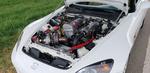
below is my setup. New schmuck catch can with all new -10an lines. I just had this put in by inline pro with this newest motor install.
Admittedly I believe I am on my stock (150k mile) dipstick o rings. Advanced auto had 1 o ring in stock with the other arriving tomorrow. I put on the 1 new ring tonight and the dipstick is significantly tougher to put in than it was before, with only 1 ring on. I bet two will make a difference... but still doesn’t change those leakdown/comp numbers.
It pains me to continue to see you posting about this, esp with a beautiful setup and with a GPW.
Leakdown of over 15% for a fresh build is not my idea of acceptable. Further diagnosis is required. I would listen for where the leak down air leaks are coming from. Intake valve, exhaust valve, piston rings, or coolant (head gasket and likely not your issue). Please report back your findings.
In search of clues and noting the last photo showing the dipstick in backwards caused me to check my engine dipstick orientation again a minute ago to confirm it doesn't matter which way: the dipstick fully seats regardless.
I still think the engine builder is taking shortcuts. When our engines were new it took 7500 miles with whatever engine oil the factory furnished for break-in, not a couple hundred. Owners manual specifies to not change the engine oil before the scheduled interval. I'm convinced full synthetic engine oil is too slick to use during engine wear-in.
It pains me to continue to see you posting about this, esp with a beautiful setup and with a GPW.
Leakdown of over 15% for a fresh build is not my idea of acceptable. Further diagnosis is required. I would listen for where the leak down air leaks are coming from. Intake valve, exhaust valve, piston rings, or coolant (head gasket and likely not your issue). Please report back your findings.
I should've included that with my original post. As usual, air coming out of dipstick hole.
I'm starting to wonder why cyl 2 and 3 are my problem children? They were the worst leakdown on my original 150k mile motor, they were the first to score on the 1st rebuilt motor and now this time they're lower than the others.
In search of clues and noting the last photo showing the dipstick in backwards caused me to check my engine dipstick orientation again a minute ago to confirm it doesn't matter which way: the dipstick fully seats regardless.
I still think the engine builder is taking shortcuts. When our engines were new it took 7500 miles with whatever engine oil the factory furnished for break-in, not a couple hundred. Owners manual specifies to not change the engine oil before the scheduled interval. I'm convinced full synthetic engine oil is too slick to use during engine wear-in.
-- Chuck
I've had the dipstick in backwards as it secured it in there a little better as per posts here on S2ki. This was my attempt to curb the dipstick blowing out while driving.
In all honesty , i would drive it some more on that very green engine . Get the new orings on the dipstick and drive it . I would do the leakdown test after the next oil change . Keep Inlinepro in the loop though . I can attest that those numbers will change once some more miles are put on the clock . I think from the whole mess you have been through has made you extremely paranoid and rightfully so .
Take off throttle body and listen for air leakimg through valves. If leakdown is beimg caused by valves not fully seating you can iliminate any shortblock or piston sealing issues. Thatd be a start. Also try and see if you can hear air escaping through exhaust valves.
You will ALWAY have air coming out of the dip stick, its normal. You need to verify that high leak down % value isn't from any of the valves or a head gasket leak, again the head gasket likely isn't leaking.
My ILP Stage 2.5x head was pretty good. The valves sealed with the springs removed. I do vacuum tested on the intake and exhaust ports to test leakdown before I assemble an engine.



 Inline Pro Engine #3 compression/leakdown results - Finally Updated!