


Full Under Floor/Diffuser



Registered User
Joined: Jul 2004
Posts: 5,645
Likes: 8
From: Los Angeles, CA

Originally Posted by Sebring AP1,Sep 5 2008, 08:52 AM
I'll be at Streets on the 12th! Come join ussss! =D
We can have lunch and talk about diffusers. MmMmMM Rubiosssssss haha
We can have lunch and talk about diffusers. MmMmMM Rubiosssssss haha

who's hosting the event? It's a bit late notice, and on a friday so chances are I'll be working. which reminds me...i have to go to work!
I was planning on going to the speedventures event on the 28 cause I don't work sundays, but a buddy of mine decided to throw his engagement party that night
 .
.


Registered User
Joined: Jul 2004
Posts: 5,645
Likes: 8
From: Los Angeles, CA
No need to apologize at all. I usually have a tendency to keep going on about things even when I should just stop
Hope to possible see you at an event in the future(although I'm not sure if we are locals)
Hope to possible see you at an event in the future(although I'm not sure if we are locals)

Registered User
Joined: Nov 2003
Posts: 2,141
Likes: 1
From: AZ
Originally Posted by HvRRZ,Sep 5 2008, 09:47 AM
It's a show piece to you now, until someone tests it out on the track...and if it happens to just show some improvements and take the time down some then you would be crawling all over it right? yes you would.
What we "R&C guys" want are products that are designed as "go fast parts" that have been tested and proven to work before they are put on the market.
In R&C the data logger/wind tunnel is king, not feelings.
 Actually learned something here!

Registered User
Joined: Apr 2003
Posts: 22,888
Likes: 3
From: Covington WA, USA
Originally Posted by rob.ok,Sep 6 2008, 01:13 AM
How do we pick Jack's brain?
(Notice who has reviewed it on Amazon.com?)

Registered User
Joined: Sep 2004
Posts: 249
Likes: 0
From: Sunny Los Angeles
Exactly. Pick McBeath's brain, not mine. Katz, too.
Anyone can learn more than I know about aero in one good afternoon at the library.
I'm not going to judge you, HvRRZ. I'm the guy who spent a weekend building an underbody kit before I'd done any research on how an underbody kit actually works. It's not at all about flattening the bottom, for example. The angle of the section ahead of the front axle is key, as are the angles of the middle and 'exit' section. The channels also have to change width and depth, and you base it all on a particular car's characteristics. A wind tunnel is kind of a must-have for this kind of thing.
Still, I built it. So if you're interested, I can save you some time and effort. For this to work under braking and in corners, you need much stiffer springs than even fully-track-prepped S2000's run. And once you install the springs that are stiff enough, you're going to need to go through and completely re-do the S2000 chassis -- because 2000# springs are going to tear a stamped unibody apart.
If you don't do that, you're going to have an aero kit that doesn't work under braking and in corners. This means your car will be slower around a track, not faster. Here's the surprise I found: my haphazardly-designed underbody kit actually worked... in a straight line.
I've got data on it. But here's the problem with my 'proven results' -- you don't want extra downforce when you're accelerating in a straight line. It only slows you down. And if that downforce suddenly disappears when you brake or turn the wheel, then you've made your car unpredictable and less-capable just when you need predictability and capability the most.
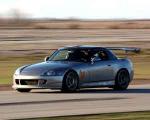
Again, I say this as someone who's been there. Sudden changes in the way a car handles as you go into a corner is not good. Here's a picture from one of my testing days.

I encourage anyone to try just about anything they can come up with to make cars perform better. But the only meaningful improvement that comes from the underbody kits you see attached to performance cars is to smooth out the airflow under the car. This is actually kind of helpful on a car as old as mine (36 years ago, they didn't care much about turbulence under the car). But the S2000 probably isn't all that 'dirty' down there. Some ABS and aluminum might clean things up and actually offer you a small net gain. But anything that claims to be an 'underbody kit' -- with diffuser-type channels and carbon fiber and all of that -- is going to be purely decorative. And like so much purely decorative aftermarket crap, it's easy to get testimonials from guys who 'feel the difference' and it's even relatively easy to get data to back your gizmo up. Remember, my aluminum monstrosity actually lowered ride height in a measurable and repeatable way at 100 mph. But that doesn't mean it made the car faster through a corner or around a track -- it didn't.
Remember, most Lotus/Corvette/etc. drivers don't do anything more than drive to work in their cars. And like most drivers, they're susceptible to the allure of 'racy looking' parts. There's a huge business in manufacturing this kind of stuff. But if you actually use a car to navigate a race track, then you've got to actually do something that works.
Alignment settings, suspension improvements, weight reduction and stickier tires work.
Huge brakes and horsepower mods work, but the bang-for-the-buck is not what most people think.
Driver training works more than just about anything.
Wings work -- most notably at tracks with sustained-high-speed corners like Willow Springs or Thunderhill.
Anyone can learn more than I know about aero in one good afternoon at the library.
I'm not going to judge you, HvRRZ. I'm the guy who spent a weekend building an underbody kit before I'd done any research on how an underbody kit actually works. It's not at all about flattening the bottom, for example. The angle of the section ahead of the front axle is key, as are the angles of the middle and 'exit' section. The channels also have to change width and depth, and you base it all on a particular car's characteristics. A wind tunnel is kind of a must-have for this kind of thing.
Still, I built it. So if you're interested, I can save you some time and effort. For this to work under braking and in corners, you need much stiffer springs than even fully-track-prepped S2000's run. And once you install the springs that are stiff enough, you're going to need to go through and completely re-do the S2000 chassis -- because 2000# springs are going to tear a stamped unibody apart.
If you don't do that, you're going to have an aero kit that doesn't work under braking and in corners. This means your car will be slower around a track, not faster. Here's the surprise I found: my haphazardly-designed underbody kit actually worked... in a straight line.
I've got data on it. But here's the problem with my 'proven results' -- you don't want extra downforce when you're accelerating in a straight line. It only slows you down. And if that downforce suddenly disappears when you brake or turn the wheel, then you've made your car unpredictable and less-capable just when you need predictability and capability the most.
Again, I say this as someone who's been there. Sudden changes in the way a car handles as you go into a corner is not good. Here's a picture from one of my testing days.
I encourage anyone to try just about anything they can come up with to make cars perform better. But the only meaningful improvement that comes from the underbody kits you see attached to performance cars is to smooth out the airflow under the car. This is actually kind of helpful on a car as old as mine (36 years ago, they didn't care much about turbulence under the car). But the S2000 probably isn't all that 'dirty' down there. Some ABS and aluminum might clean things up and actually offer you a small net gain. But anything that claims to be an 'underbody kit' -- with diffuser-type channels and carbon fiber and all of that -- is going to be purely decorative. And like so much purely decorative aftermarket crap, it's easy to get testimonials from guys who 'feel the difference' and it's even relatively easy to get data to back your gizmo up. Remember, my aluminum monstrosity actually lowered ride height in a measurable and repeatable way at 100 mph. But that doesn't mean it made the car faster through a corner or around a track -- it didn't.
Remember, most Lotus/Corvette/etc. drivers don't do anything more than drive to work in their cars. And like most drivers, they're susceptible to the allure of 'racy looking' parts. There's a huge business in manufacturing this kind of stuff. But if you actually use a car to navigate a race track, then you've got to actually do something that works.
Alignment settings, suspension improvements, weight reduction and stickier tires work.
Huge brakes and horsepower mods work, but the bang-for-the-buck is not what most people think.
Driver training works more than just about anything.
Wings work -- most notably at tracks with sustained-high-speed corners like Willow Springs or Thunderhill.