


Interesting Time Attack Diffuser

Joined: Jan 2017
Posts: 861
Likes: 24
From: United States

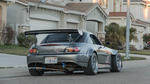
The top fuel s2ks aero is as good as it gets for a s2000. After all they partnered with voltex. U need 1000hp for crazy aero like that subi. From factory the S2k handles better than that subi hence why u don't need massive aero. On a na car u really just need a wing and splitter.

Thread Starter
Joined: Apr 2006
Posts: 1,953
Likes: 51
The article is in the Oct 2014 RaceCar Engineering, by Simon McBeath: https://issuu.com/chelseamagazines/d...ingoctober2014
Downforce works on all cars. The Top Fuel car is years old and it is unclear who is the top aerodynamicist. The goal is high downforce and low drag. A rear diffuser can reduce drag and a good wing has a very high lift/drag ratio, often over 7:1, some approaching 10:1.
Even an F1 car makes lift vs drag decisions. At Spa and Monza, F1 cars give up downforce for low drag. At Monaco and Hungaroring they sacrifice drag for high downforce. The equation is easier in a time attack car because passing isn't an issue. Higher drag can sometimes yield quicker lap times at the cost being unable to pass a slower car in the few effective passing zones.
Diffusers are also important in the front. They can increase the effectiveness of the splitter and move its center of pressure forward, allowing more rear wing. Designing effective front diffusers is tricky because of the cooling and tires. Many prototypes and some formula cars route that airflow over a flat bottom and out behind the front wheels. Production cars can be more problematic.
Most rear diffusers end the diffuser behind the rear axle. That puts its downforce at best over the rear wheels and often behind the rear wheels where it allows less rear wing. Some are so poorly designed they probably do little. What made this one interesting is that on a current, competitive WTAC car the objective was a huge, tall diffuser and it left the suspension and axles in the diffuser...often designs place them above the diffuser. The S2000 is well suited to this because the trunk floor can be modified to allow room and the design of its rear subframe leaves space on the sides. Even more so if the track is widened as apparently allowed under NASA rules (although TT4 and TT5 apparently don't allow diffusers).
With a fixed wt/hp ratio, faster tracks will favor heavier cars with less drag and frontal area while slower tracks will favor lighter cars with more downforce and more mechanical grip, such as from a wider track. There are probably very few TT events where a wider track or more downforce wouldn't be an advantage. In their best case, these production cars produce much less downforce than a modern prototype.
Some prototypes have their rear wing vertically flush with the rear bodywork, interacting with the diffuser to enhance the diffuser and reduce drag by reducing turbulence.
Downforce works on all cars. The Top Fuel car is years old and it is unclear who is the top aerodynamicist. The goal is high downforce and low drag. A rear diffuser can reduce drag and a good wing has a very high lift/drag ratio, often over 7:1, some approaching 10:1.
Even an F1 car makes lift vs drag decisions. At Spa and Monza, F1 cars give up downforce for low drag. At Monaco and Hungaroring they sacrifice drag for high downforce. The equation is easier in a time attack car because passing isn't an issue. Higher drag can sometimes yield quicker lap times at the cost being unable to pass a slower car in the few effective passing zones.
Diffusers are also important in the front. They can increase the effectiveness of the splitter and move its center of pressure forward, allowing more rear wing. Designing effective front diffusers is tricky because of the cooling and tires. Many prototypes and some formula cars route that airflow over a flat bottom and out behind the front wheels. Production cars can be more problematic.
Most rear diffusers end the diffuser behind the rear axle. That puts its downforce at best over the rear wheels and often behind the rear wheels where it allows less rear wing. Some are so poorly designed they probably do little. What made this one interesting is that on a current, competitive WTAC car the objective was a huge, tall diffuser and it left the suspension and axles in the diffuser...often designs place them above the diffuser. The S2000 is well suited to this because the trunk floor can be modified to allow room and the design of its rear subframe leaves space on the sides. Even more so if the track is widened as apparently allowed under NASA rules (although TT4 and TT5 apparently don't allow diffusers).
With a fixed wt/hp ratio, faster tracks will favor heavier cars with less drag and frontal area while slower tracks will favor lighter cars with more downforce and more mechanical grip, such as from a wider track. There are probably very few TT events where a wider track or more downforce wouldn't be an advantage. In their best case, these production cars produce much less downforce than a modern prototype.
Some prototypes have their rear wing vertically flush with the rear bodywork, interacting with the diffuser to enhance the diffuser and reduce drag by reducing turbulence.

Thread
Thread Starter
Forum
Replies
Last Post