


Any recommendations for an air intake system?


Registered User
Joined: May 2004
Posts: 43
Likes: 0
From: Humble

Actually it may be better to measure the pressure drops in inches of water rather than in Hg - much more sensitive. I did an extensive Pd study of my old Dodge Intrepid's intake ( no commercial ones were available ), tapping in the Dwyer manometer immediately in front of the TB, just after the first resonator, just after the air filter box, and right before and after the filter. I discovered that there was very little pressure drop through the filter - most of it was either in the first resonator or at the 90* ebow immediately upstream of the TB. The total drop of the intake system A WOT and 6000 rpm was 28" of water, the first resonator contributing 7" and elbow taking away a wopping 10". By replacing the entire intake with a 3.5" ABS piping, a large 90* elbow and a 9" cone filter, the drop was then just 10". How much horsepower was saved? Who knows for certain - it's just a guess as to the pumping losses recovered, but it cannot hurt. Like Rage says, it is far better to use engineering to determine the value of a new intake, since dyno gains of under 5 hp are very difficult to verify. 
One real advantage of tests like these is to verify that the stock paper pannel filter flowed very well and is not a significant restriction in the subject Dodge. There would be no noticeable performance increase with a K&N pannel filter when both the paper and K&N are clean. this changes significantly when the filters are dirty, as the paper filter plugs up badly while the K&N loses little airflow capacity when equally dirty. This is why some drivers swear they see a performance increase when switching to the K&N - their ole paper filter was dirty and gave a major preasure drop.
Actually, the K&N filters better when it's dirty as the dirt closes off the openings a bit. Cleaning it too often means more sand in the engine oil. This is one reason to use a larger area cone filter, to reduce the pressure drop of a dirty filter.
One real advantage of tests like these is to verify that the stock paper pannel filter flowed very well and is not a significant restriction in the subject Dodge. There would be no noticeable performance increase with a K&N pannel filter when both the paper and K&N are clean. this changes significantly when the filters are dirty, as the paper filter plugs up badly while the K&N loses little airflow capacity when equally dirty. This is why some drivers swear they see a performance increase when switching to the K&N - their ole paper filter was dirty and gave a major preasure drop.
Actually, the K&N filters better when it's dirty as the dirt closes off the openings a bit. Cleaning it too often means more sand in the engine oil.
This is one reason to use a larger area cone filter, to reduce the pressure drop of a dirty filter.

Registered User
Joined: Aug 2001
Posts: 529
Likes: 0
From: Atlanta
What is the obsession with pics? A pic of what i posted will show nothing spectacular, and UNDERSTANDING the approach and execution is far more important. Maybe down the road.
Aw, c'mon RR, how are we suppose to copy what you've done without pics?C'mon- just one little 640x480........
Aw, c'mon RR, how are we suppose to copy what you've done without pics?C'mon- just one little 640x480........




Registered User

Joined: Oct 2000
Posts: 15,323
Likes: 28
From: Longmont, CO
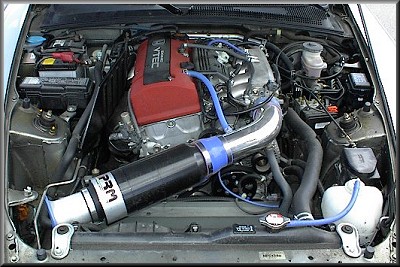
PRM by far has the best sound of any intake I've heard.
As far as performance - it appears to hurt the top end by 2 or 3 hp, and benefit the low end by 5 or so. My dyno wasn't in controlled enough conditions for me to be 100% sure about that, though.
As far as performance - it appears to hurt the top end by 2 or 3 hp, and benefit the low end by 5 or so. My dyno wasn't in controlled enough conditions for me to be 100% sure about that, though.

Registered User
Joined: Sep 2001
Posts: 122
Likes: 0
From: Denver
Originally posted by Road Rage
This mod resulted in a reduction in obstruction of about 30% (engineers measure resistance to flow by the amount of pressure needed in Hg compared to the stock baseline).
This mod resulted in a reduction in obstruction of about 30% (engineers measure resistance to flow by the amount of pressure needed in Hg compared to the stock baseline).
Can you tell us how you measured the flow? I am modifying the stock airbox meself and I'd love to have means to measure the diffrence.
Song