


Atomic Performance Turbo


Registered User
Joined: Feb 2001
Posts: 2,895
Likes: 1
From: You wish

Easy there Rev.
1. I was down talking with John about some business opportunities when your car was in his shop. He told me flat out that they were having serious trouble making power and that everything up to that point had lost power. He felt like the issue was the stock ECU messing with timing and fuel. Given John's results on other cars (i've seen some of his headers pull 20 hp out of 1.8 race engines) and the fact my gas mileage took a dive with the Mugen header (while producing negligible top end gains), I tend to believe him
2. I have no doubt that Atomic has not gotten satisfactory resutls yet. The stock ECU is problematic, as even Comptech has found when trying to run more boost. As to why they haven't addressed it yet, I'm betting the owner hasn't wanted to ante up the dollars yet, and I doubt Atomic will pay for it themselves. As I said, lets wait till real results are out before getting excited.
3. Careful about comparing a NA header system ot a turbo manifold. They serve dramatically different purposes. Both turbos and superchargers take energy to drive, but even with the same compressor section, a turbo will always be more efficient than a supercharger - because the turbo obtains much of its energy from waste heat that has already been, well, wasted. The supercharger must take power off from the crankshaft. You can negate much of the driving losses of a turbo by opening up the exhaust after the turbo, you can't do that with a supercharger. A supercharger's power draw is directly related to the boost level and rpm it must turn. I can tell you that even the paltry M45 eaton on the JR Civic kits draws about 25 hp at 5 psi and a blower speed of 12,000 rpm (according to Eaton). The bigger blowers can consume upwards of 50-60 hp. While these are not the blower used in the Comptech kit, you get an idea of the power required.
4. In terms of charge heating, most heat comes from compressive effects. That's why an Eaton blower can add 150 F of charge heat at a paltry 7 psi. Centri's and turbos are more efficient, but still add a lot of charge heat. A turbo does pick up additional heat from proximity to the exhaust. But, with a proper intercooler, it isn't an issue. Why? Any good intercooler manufacturer will tell you that with a properly sized (and well constructed) intercooler will allow you to bring charge temps down to no more than +30F over ambient with a pressure drop beneath 10% of peak pressure (except at very low boost pressures). That means that you could run a turbo at 8 psi, intercool it, get about 7 psi of manifold pressure and still have charge temps beneath the Comptech blower's current charge temps. Combined with smaller parasitic losses (assuming a proper exhaust) and you can see why a turbo is better from a pure power perspective.
As always, execution is the most important thing and I stand by my statement that I wouldn't buy a FI kit without proper engine management - no matter who makes it. However, properly done a turbo is very attractive. Given that B18Cs with a crappy Drag kit can put down 250+ wheel hp at 7 psi, I don't have any problem believing that a proper kit on the S2000, running similar boost, could put down well over 300 wheel hp (i.e. 400 crank).
UL
-who owns a supercharged car and will probably keep his S2K NA :-)
1. I was down talking with John about some business opportunities when your car was in his shop. He told me flat out that they were having serious trouble making power and that everything up to that point had lost power. He felt like the issue was the stock ECU messing with timing and fuel. Given John's results on other cars (i've seen some of his headers pull 20 hp out of 1.8 race engines) and the fact my gas mileage took a dive with the Mugen header (while producing negligible top end gains), I tend to believe him
2. I have no doubt that Atomic has not gotten satisfactory resutls yet. The stock ECU is problematic, as even Comptech has found when trying to run more boost. As to why they haven't addressed it yet, I'm betting the owner hasn't wanted to ante up the dollars yet, and I doubt Atomic will pay for it themselves. As I said, lets wait till real results are out before getting excited.
3. Careful about comparing a NA header system ot a turbo manifold. They serve dramatically different purposes. Both turbos and superchargers take energy to drive, but even with the same compressor section, a turbo will always be more efficient than a supercharger - because the turbo obtains much of its energy from waste heat that has already been, well, wasted. The supercharger must take power off from the crankshaft. You can negate much of the driving losses of a turbo by opening up the exhaust after the turbo, you can't do that with a supercharger. A supercharger's power draw is directly related to the boost level and rpm it must turn. I can tell you that even the paltry M45 eaton on the JR Civic kits draws about 25 hp at 5 psi and a blower speed of 12,000 rpm (according to Eaton). The bigger blowers can consume upwards of 50-60 hp. While these are not the blower used in the Comptech kit, you get an idea of the power required.
4. In terms of charge heating, most heat comes from compressive effects. That's why an Eaton blower can add 150 F of charge heat at a paltry 7 psi. Centri's and turbos are more efficient, but still add a lot of charge heat. A turbo does pick up additional heat from proximity to the exhaust. But, with a proper intercooler, it isn't an issue. Why? Any good intercooler manufacturer will tell you that with a properly sized (and well constructed) intercooler will allow you to bring charge temps down to no more than +30F over ambient with a pressure drop beneath 10% of peak pressure (except at very low boost pressures). That means that you could run a turbo at 8 psi, intercool it, get about 7 psi of manifold pressure and still have charge temps beneath the Comptech blower's current charge temps. Combined with smaller parasitic losses (assuming a proper exhaust) and you can see why a turbo is better from a pure power perspective.
As always, execution is the most important thing and I stand by my statement that I wouldn't buy a FI kit without proper engine management - no matter who makes it. However, properly done a turbo is very attractive. Given that B18Cs with a crappy Drag kit can put down 250+ wheel hp at 7 psi, I don't have any problem believing that a proper kit on the S2000, running similar boost, could put down well over 300 wheel hp (i.e. 400 crank).
UL
-who owns a supercharged car and will probably keep his S2K NA :-)


Joined: Feb 2001
Posts: 7,414
Likes: 0
From: Toronto
I just don't see the point of turboing or SC'ing an S2k. If you want an FI car, go buy an FI car from the start. The philosophy behind the F20C was to be a really sweet revving motor with great sound and driving characteristics that could spin to 9k.
One should tune the car with that philosophy in mind.
The other thing to remember is that Honda tried to save weight everywhere they could on this car, including the drivetrain. The specced a safety margin on the gearbox, diff, clutch, etc., that probably was lower than what they would spec for a run-of-the-mill Civic. When you double the torque exerted on these pieces, it won't take them long at all to fail.
I say a few good laps around Laguna Seca and that turbo S2k would be broken.
One should tune the car with that philosophy in mind.
The other thing to remember is that Honda tried to save weight everywhere they could on this car, including the drivetrain. The specced a safety margin on the gearbox, diff, clutch, etc., that probably was lower than what they would spec for a run-of-the-mill Civic. When you double the torque exerted on these pieces, it won't take them long at all to fail.
I say a few good laps around Laguna Seca and that turbo S2k would be broken.

Registered User
Joined: Jan 2001
Posts: 1,023
Likes: 0
From: Phoenix
My supercharged S2000 spent a very busy weekend at Firebird international raceway in Phoenix at the end of February. I had no problems other than minimal hesitation under very hard acceleration. By the way there was hardly a car out there that could out accelerate me on the main straight. Including 911s, ZR-1s, NSXs and others. My clutch and differential remain in perfect working condition. All stock.

Registered User

Joined: Nov 2000
Posts: 688
Likes: 1
From: Sellersburg
And that is the point to supercharging, s2krob... its a good fun car without it, but after the first few times you see a 300ZX fly by you or a RX7 leave you or a Supra's tail pipe go by, you'll wish you had that supercharger so you could compete with their Turbo aspirated engines.
I for one, would love to have a SC, but I am hoping a few competitors will release other options to the one available and maybe at a slightly lower price. Not sure how long that will take.
-B
[QUOTE]Originally posted by SCS2k
[B]My supercharged S2000 spent a very busy weekend at Firebird international raceway in Phoenix at the end of February.
I for one, would love to have a SC, but I am hoping a few competitors will release other options to the one available and maybe at a slightly lower price. Not sure how long that will take.
-B
[QUOTE]Originally posted by SCS2k
[B]My supercharged S2000 spent a very busy weekend at Firebird international raceway in Phoenix at the end of February.

Registered User
Joined: Oct 2000
Posts: 5,765
Likes: 0
From: Houston
Originally posted by S2kRob
I just don't see the point of turboing or SC'ing an S2k.
I just don't see the point of turboing or SC'ing an S2k.
SCS2K,
What kind of track was this? Have you had a chance to 1/4 mile yours? I need to make it down to a 1/4 mile track, curious if you already had.


Registered User
Joined: Oct 2000
Posts: 2,560
Likes: 0
From: Studio City, CA
UL, I'm not really down on John. He's a nice guy and he builds very nice headers. In fact, my ONLY complaint is that I've heard more than one rumor of him not quite telling the truth regarding the S2000 header he made for my car and I've seen similar statements from him it in person on the hybrid board. I just think that's inappropriate.
As for the NA header VS turbo manifold, what I was trying to say was of course they serve very different purposes, but if you're going to compare loss, hook up a turbo and have it boost to open air (and have the engine breathe normally) and then hook up a supercharger and have it boost to open air. Both will have far less power than just an NA setup because both are robbing energy to compress the air. Yeah, a turbo is a little more efficient, but I think that screwing with the exhuast tuning just opens up a can of worms on this car. The reason I pointed to John's header is that it was designed to make good NA power. Now if you imaging throwing a 4-1 turbo manifold on there, you're REALLY screwing up the exhaust tuning. The reason I pointed to John's header is that with a turbo manifold, you'll damn well lose more than the 13 hp the hy-tech NA header lost. Yeah, you make that up from the boost, but there is still a big loss happening from bad exhaust tuning. A centrifugal SC just takes that out of the equation. Yeah, you can make power either way, and if you do enough R&D you couldn't probably make more power with a turbo, but for a simple setup an SC is just easier.
BTW, I doubt any of you read the Endyn board, but last summer a guy in Oz posted a few pics and info on his turbo S2k. 340 rwhp. And I don't think he was lying it on this particular setup. Full on ball bearing turbo, Motec, everything. All BEUTIFULLY fabricated. This was not just some show car like the Atomic car - this was some crazy well designed sh!t.
As for the NA header VS turbo manifold, what I was trying to say was of course they serve very different purposes, but if you're going to compare loss, hook up a turbo and have it boost to open air (and have the engine breathe normally) and then hook up a supercharger and have it boost to open air. Both will have far less power than just an NA setup because both are robbing energy to compress the air. Yeah, a turbo is a little more efficient, but I think that screwing with the exhuast tuning just opens up a can of worms on this car. The reason I pointed to John's header is that it was designed to make good NA power. Now if you imaging throwing a 4-1 turbo manifold on there, you're REALLY screwing up the exhaust tuning. The reason I pointed to John's header is that with a turbo manifold, you'll damn well lose more than the 13 hp the hy-tech NA header lost. Yeah, you make that up from the boost, but there is still a big loss happening from bad exhaust tuning. A centrifugal SC just takes that out of the equation. Yeah, you can make power either way, and if you do enough R&D you couldn't probably make more power with a turbo, but for a simple setup an SC is just easier.
BTW, I doubt any of you read the Endyn board, but last summer a guy in Oz posted a few pics and info on his turbo S2k. 340 rwhp. And I don't think he was lying it on this particular setup. Full on ball bearing turbo, Motec, everything. All BEUTIFULLY fabricated. This was not just some show car like the Atomic car - this was some crazy well designed sh!t.
Registered User
Joined: Jan 2001
Posts: 1,023
Likes: 0
From: Phoenix
I did not run any numbers at the track. Stop watches and timing devices are strickly forbidden. These are considered open track events and driving schools. Any timing and or competition voids the car clubs' and my insurance.
The course, by the way, is a 1.6 mile road course the main straightaway is made up of Firebird's dragstrip. It isn't a standing start so I couldn't get any accurate 1/4 miles times anyway.
The course, by the way, is a 1.6 mile road course the main straightaway is made up of Firebird's dragstrip. It isn't a standing start so I couldn't get any accurate 1/4 miles times anyway.
Moderator
Joined: Oct 2000
Posts: 30,809
Likes: 15
From: Sydney
Hey Rev, is this the one?
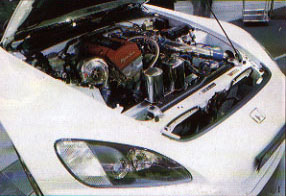
It was done by BD4s in Gladesville. The S in a direct import from Japan so it has the 11.7:1 compression ratio.
I've seen the dyno's with 340 crank and 290 at the wheels. These were early dyno's before tuning the Motec was complete.
Awesome car.
It was done by BD4s in Gladesville. The S in a direct import from Japan so it has the 11.7:1 compression ratio.
I've seen the dyno's with 340 crank and 290 at the wheels. These were early dyno's before tuning the Motec was complete.
Awesome car.

Thread
Thread Starter
Forum
Replies
Last Post
CatsS2000
Archived Member S2000 Classifieds and For Sale
6
Jul 21, 2013 11:52 AM