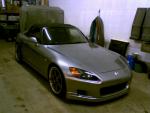
Official 2004 S2000 Specs by VTEC.net







Registered User
Joined: Aug 2002
Posts: 1,903
Likes: 0
From: Bellevue

If the wheels increased an inch... wouldn't that be a tad bit more mass to move? How much could this negate the increased torque? Until the 04 comes out, I doubt I can get a concrete answer to these questions... but, what about some physic answers?

Registered User

Joined: Oct 2000
Posts: 3,086
Likes: 0
From: St. Pete, Florida
Sure, you could probably get 350 hp out of it if you could rev it to 12,000 rpm 
Originally posted by SJSHARKS
Time for a stupid question.
The displacement increases 10%.
The torque increases 5%.
But the HP remains the came.
Do the lower rpms have some bearing on it?
Time for a stupid question.
The displacement increases 10%.
The torque increases 5%.
But the HP remains the came.
Do the lower rpms have some bearing on it?

Registered User
Joined: May 2001
Posts: 7,768
Likes: 2
From: Bellevue, WA
Originally posted by SJSHARKS
Time for a stupid question.
The displacement increases 10%.
The torque increases 5%.
But the HP remains the came.
Do the lower rpms have some bearing on it?
Time for a stupid question.
The displacement increases 10%.
The torque increases 5%.
But the HP remains the came.
Do the lower rpms have some bearing on it?

Registered User
Joined: Dec 2002
Posts: 642
Likes: 0
From: STOCKTON
This brings up more questions:
Why does increasing displacement automatically reduce the RPMS?
How did Honda increase displacement? Was it bored or stroked or both, and does it matter with regard to the lower rpms phenomonen if it is one or the other?
If the 2200 was stroked, how is this done? Longer rods, Pistons, does the block need to be given extra height, and what about the crankshaft? Does it need a larger arc?
Actually, there was no mention about the redline being lowered.
Why does increasing displacement automatically reduce the RPMS?
How did Honda increase displacement? Was it bored or stroked or both, and does it matter with regard to the lower rpms phenomonen if it is one or the other?
If the 2200 was stroked, how is this done? Longer rods, Pistons, does the block need to be given extra height, and what about the crankshaft? Does it need a larger arc?
Actually, there was no mention about the redline being lowered.