


Want steering feel?


Thread Starter

Joined: Jul 2003
Posts: 297
Likes: 0
From: concord

So i did this last night... one thing. I saw the "I turned the car off and pulled the fuse" line and went wait, what? Not disconnect power? OK.
... 30 seconds later, i was breaking the tackweld between the screwdriver and hood damper. Disconnect the battery if you do this, guys.
That said, my review largely jives with the OP except for one thing- You're trading dead feeling for excessive weight below 20mph. Precision in lowspeed corners goes right out the window. It's not that i'm unused to manual steering. I've had manual steering cars at pretty much all points in the last 10 years... it's that this car doesn't handle it well in my opinion and feels like a HPS rack with fluid in it still.
My Elise was manual steering, and awesome.
My Miata was depowered, and about like this. I then pulled the hydro piston from inside the rack and it got markedly better.
I find myself curious how this setup would feel without the electric motor drag on it... it might get better. EPS isn't electro-hydraulic, right? It's pure electric?
For me, i'm going back to EPS, the tradeoff at low speed in precision isn't worth the feedback i get through the wheel. Man did i like having that weight in the wheel though!
... 30 seconds later, i was breaking the tackweld between the screwdriver and hood damper. Disconnect the battery if you do this, guys.
That said, my review largely jives with the OP except for one thing- You're trading dead feeling for excessive weight below 20mph. Precision in lowspeed corners goes right out the window. It's not that i'm unused to manual steering. I've had manual steering cars at pretty much all points in the last 10 years... it's that this car doesn't handle it well in my opinion and feels like a HPS rack with fluid in it still.
My Elise was manual steering, and awesome.
My Miata was depowered, and about like this. I then pulled the hydro piston from inside the rack and it got markedly better.
I find myself curious how this setup would feel without the electric motor drag on it... it might get better. EPS isn't electro-hydraulic, right? It's pure electric?
For me, i'm going back to EPS, the tradeoff at low speed in precision isn't worth the feedback i get through the wheel. Man did i like having that weight in the wheel though!
Agreed on all points. Removing the EPS adds feel, but it's not ideal. Something in between would be nice, not to heavy and not too light. Although I'm sure you could redesign or reprogram the EPS circuit to reduce its power assistance, I unfortunately have neither the knowledge or expertise to do so.

Registered User
Joined: Jul 2007
Posts: 43
Likes: 0
From: Odenton, MD
Reviving an old thread to share information to interested parties.
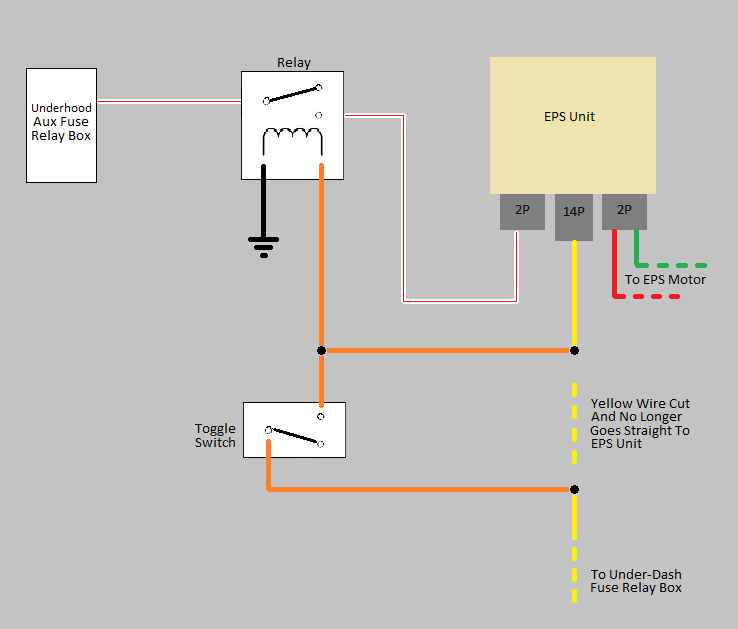
So I've implemented the idea presented by vividracing, and after a couple of weeks testing, it's not too ideal. Used the relay from the air pump (system completely removed previously), and a generic switch from AdvanceAuto. The relay sits right after the secondary fuse box and is wired in-line to the EPS 10 gauge line (white-red), and then got it wired to the generic switch in the interior.
With the switch on, EPS will operate like normal. When I toggle the switch off, EPS will shut off. But when I toggle the switch back on within the same driving cycle, EPS will stay disabled until I shut the car off and turn it back on. I'm assuming the EPS module thinks there's an issue with the EPS motor when I toggle my switch off so it stays off completely until the next self check diagnostic. So you can see why this isn't the ideal solution.
What I will attempt tomorrow, is to see if I can utilize the ECU signal wire to the EPS module and install a switch in-line with that so I can hopefully turn EPS back on within the same driving cycle. Also (if this works) will make this mod very simplistic.
So I've implemented the idea presented by vividracing, and after a couple of weeks testing, it's not too ideal. Used the relay from the air pump (system completely removed previously), and a generic switch from AdvanceAuto. The relay sits right after the secondary fuse box and is wired in-line to the EPS 10 gauge line (white-red), and then got it wired to the generic switch in the interior.
With the switch on, EPS will operate like normal. When I toggle the switch off, EPS will shut off. But when I toggle the switch back on within the same driving cycle, EPS will stay disabled until I shut the car off and turn it back on. I'm assuming the EPS module thinks there's an issue with the EPS motor when I toggle my switch off so it stays off completely until the next self check diagnostic. So you can see why this isn't the ideal solution.
What I will attempt tomorrow, is to see if I can utilize the ECU signal wire to the EPS module and install a switch in-line with that so I can hopefully turn EPS back on within the same driving cycle. Also (if this works) will make this mod very simplistic.
Registered User
Joined: Jul 2007
Posts: 43
Likes: 0
From: Odenton, MD
*sigh* no luck with the wire that I was testing today. After reading through the FSM (should have done in the first place), the blue/black wire that connects between the ECU and the EPS module only "provides idle speed-up signal to the ECM"
One last attempt I'm going to do tomorrow is to play with the yellow (ignition) wire on the EPS module connector and see if I can get desired results.
One last attempt I'm going to do tomorrow is to play with the yellow (ignition) wire on the EPS module connector and see if I can get desired results.

Registered User
Joined: May 2010
Posts: 228
Likes: 0
From: Glasgow
Keep going!
I was thinking about this the other day. Pardon my ignorance if I'm talking crap, both in terms of how the s2k works and electrical engineering.
The EPS system decreases its strength or power with increasing speed, according to the speed sensor, right?
So, isn't it the case that what we really want is not an on/off switch, but some kind of voltage amplifier (assuming the speed sensor outputs increasing voltage with speed) that fools the EPS into thinking speed is much higher and therefore reduces assistance much sooner, such that beyond 5-10mph it is basically off.
I was thinking about this the other day. Pardon my ignorance if I'm talking crap, both in terms of how the s2k works and electrical engineering.
The EPS system decreases its strength or power with increasing speed, according to the speed sensor, right?
So, isn't it the case that what we really want is not an on/off switch, but some kind of voltage amplifier (assuming the speed sensor outputs increasing voltage with speed) that fools the EPS into thinking speed is much higher and therefore reduces assistance much sooner, such that beyond 5-10mph it is basically off.
Registered User
Joined: May 2010
Posts: 228
Likes: 0
From: Glasgow
voltage multiplier: http://www.coolcircuit.com/circuit/voltage/
voltage clamp to erm not over volt the eps unit? http://www2.electronicproducts.com/V...2008-html.aspx
hopefully someone with more understamding of electronics than me (almost none) can chime in with some suggestions. And maybe design a circuit, box itand sell it for some bucks.
What exactly is the speed sensor output? 0 to 5 volt? linear response?
is this stupid?
voltage clamp to erm not over volt the eps unit? http://www2.electronicproducts.com/V...2008-html.aspx
hopefully someone with more understamding of electronics than me (almost none) can chime in with some suggestions. And maybe design a circuit, box itand sell it for some bucks.
What exactly is the speed sensor output? 0 to 5 volt? linear response?
is this stupid?
Registered User
Joined: Jul 2007
Posts: 43
Likes: 0
From: Odenton, MD
Haha, ignorance pardoned, since I don't have a complete grasp on how the EPS operates either.
According to the EPS section of the FSM, the EPS indicator will come on under the following conditions:
Whether this will cause the EPS module to run in a fail-safe mode, disable the EPS system, or continue to run normally I am unsure of.
I didn't explore decreasing the amount of PS assist as I am intimidated by the potential high effort required to complete something like that. That and I don't know the types of signals (pulse, voltage, resistance, etc) for all inputs so I don't know what kind of signal altering electronics I can use. Therefor I just opted to go for a toggle switch to the EPS system in it's entirety.
One tid bit that the FSM mentions though is "When the Control unit detects heat build-up in the motor, it reduces the electric current to the motor gradually to protect the system, and it restricts the power assist operation. The EPS indicator does not come on during this function." So if this self-protection function can be hijacked to work for us (if technically viable) then that would be awesome. But unfortunately I won't be pursuing this.
According to the EPS section of the FSM, the EPS indicator will come on under the following conditions:
- When the vehicle is barely moving, 0.62 mph (1 kmh) or stopped, and the engine speed is 2,000 rpm or higher for about 3 minutes.
- When the engine speed is 500 rpm or less, and the vehicle is traveling at a speed of 6.2 mph (10 kmh) or more for about 3 minutes.
Whether this will cause the EPS module to run in a fail-safe mode, disable the EPS system, or continue to run normally I am unsure of.
I didn't explore decreasing the amount of PS assist as I am intimidated by the potential high effort required to complete something like that. That and I don't know the types of signals (pulse, voltage, resistance, etc) for all inputs so I don't know what kind of signal altering electronics I can use. Therefor I just opted to go for a toggle switch to the EPS system in it's entirety.
One tid bit that the FSM mentions though is "When the Control unit detects heat build-up in the motor, it reduces the electric current to the motor gradually to protect the system, and it restricts the power assist operation. The EPS indicator does not come on during this function." So if this self-protection function can be hijacked to work for us (if technically viable) then that would be awesome. But unfortunately I won't be pursuing this.
Registered User
Joined: Jul 2007
Posts: 43
Likes: 0
From: Odenton, MD
So after going back to stock wiring with the EPS system and then installing the switch to the yellow ignition wire to the EPS module, I ran in to something interesting...
If I leave the switch on, and turn the car on, EPS will operate of course. But when I toggle the switch off, EPS will continue to operate with all of it's power steering glory (and light the EPS indicator) until I turn the car off. Not what I wanted...
I'm guessing Honda designed their EPS so that if for whatever reason power got cut to the yellow wire, it then utilizes the power from the white/red 10 gauge wire until the engine turns off. Probably a liability issue as it could create a potential accident if the driver didn't expect power steering to stop being powered?
Had to re-install the relay I did previously for the white/red wire and utilize the yellow ignition wire to the EPS module, and finally I got EPS to toggle on/off within the same driving cycle.
I'll post up a terrible MS-Paint drawing of what I've done so I can share to all.
If I leave the switch on, and turn the car on, EPS will operate of course. But when I toggle the switch off, EPS will continue to operate with all of it's power steering glory (and light the EPS indicator) until I turn the car off. Not what I wanted...
I'm guessing Honda designed their EPS so that if for whatever reason power got cut to the yellow wire, it then utilizes the power from the white/red 10 gauge wire until the engine turns off. Probably a liability issue as it could create a potential accident if the driver didn't expect power steering to stop being powered?
Had to re-install the relay I did previously for the white/red wire and utilize the yellow ignition wire to the EPS module, and finally I got EPS to toggle on/off within the same driving cycle.
I'll post up a terrible MS-Paint drawing of what I've done so I can share to all.
Registered User
Joined: May 2010
Posts: 228
Likes: 0
From: Glasgow
good work Spinpio, On/Off is better than nothing
Its frustrating because its probably something an electrical engineer could figure out in no time, and maybe suggest the appropriate gizmo to solder in line. I was hopping there would be someone like that here.
I imagine a probing procedure along the lines of:
- Lift the rear wheels of the ground (find a safe way to do that).
- Determine whether power assist does vary with increasing speed by turning the wheel at various speeds.
- Plug volt meter to speed sensor wire. Determine min/max voltages, plot speed vs voltage graph. If it doesnt make sense check signal with osciloscope. Hopefully its not a pulse signal coz that sounds a heck more complicated to manipulate...
Id love to give this a try but I have zero leccy tools and no means to lift the car.
Its frustrating because its probably something an electrical engineer could figure out in no time, and maybe suggest the appropriate gizmo to solder in line. I was hopping there would be someone like that here.
I imagine a probing procedure along the lines of:
- Lift the rear wheels of the ground (find a safe way to do that).
- Determine whether power assist does vary with increasing speed by turning the wheel at various speeds.
- Plug volt meter to speed sensor wire. Determine min/max voltages, plot speed vs voltage graph. If it doesnt make sense check signal with osciloscope. Hopefully its not a pulse signal coz that sounds a heck more complicated to manipulate...
Id love to give this a try but I have zero leccy tools and no means to lift the car.