


Door Hinge Creak






Joined: Jul 2013
Posts: 5,734
Likes: 632

WD40 ie water dispersant formula 40 is not a lubricant. Don't waste your time with that lithium grease spray, that's as runny as baby poop, do it right and get some super white lithium paste in a tub. Apply with a rag, or use gloves.


Joined: Apr 2004
Posts: 292
Likes: 5
From: PA
This thread is titled "Door Hinge Creak" to which I am replying (although the body text describes knocking).
I was able to nearly eliminate the nasty creaky door sound on both driver and passenger side. I would describe the remaining sound as a "light pistoning" which only occurs at the middle and at end of the door travel. It sounds like something precise is happening.
For me, the "creak" sounded like rubber-on-rubber. The sound becomes strongest when the door is nearly all the way open. Not unlike wet shoes on a waxed floor. Worse after a car wash.
Originally I lubricated the hinge pins, used shin-etsu grease on all the weather-stripping and wire boot, also rubbed lithium grease on all 4 sides of the door checker shaft. These did nothing to eliminate the squeaky noise, though they probably solved any knocking sound I may have had.
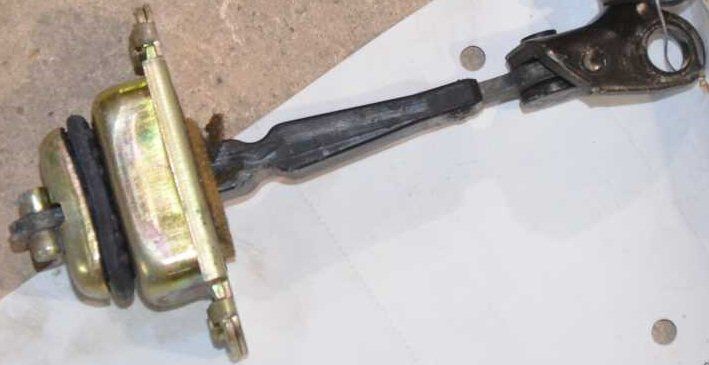
The sound came from the middle device between the main door hinges. After finding a parts diagram, I determined the violating component is the "Door Checker". I then searched images on the internet for a real life picture of an assembly. Once I saw the mechanism in all its glory, I realized all the grease I was putting on the shaft wasn't lubricating deep enough inside the assembly.
There is a rubber bump stop connected to the far end of the checker shaft. This rubber meets metal when the door is fully opened, providing a somewhat soft stop for the door when reaching the full open position. I feel this rubber part is the source of the noise.
Here is where I came up with my plan. Instead of disassembling the door to get to this rubber part, I decided to lubricate the rubber stop through the shaft passageway. Fortunately, I found a can of aerosol spray white lithium grease with the little red extender tube taped to the side.
With the window up to avoid greasing the glass, I opened the door the whole way and then pulled it a few inches back toward closed. This does two things: (1) Creates a gap between the rubber and the metal, and (2) loosens the shaft which allows room for the spray extender.
With the door this way, I was able to slip the tube through the foam gasket, and about an inch along the near and far sides of the checker shaft. The tip eventually came to a solid stop, probably the rubber part. I activated the spray while pulling backwards a half inch - I could hear the gurgling spray sound transition from being deep in the door to up near the surface while the tip was still under the foam gasket.
Directly afterwards I rocked the door between fully open and halfway repeatedly to distribute the grease before it thickened. I could hear the sound going away, though I did have to repeat the procedure a couple times before fully silent. Each time I tried to angle the tube slightly differently along the shaft opening.
I am a little concerned I might have a bit of a mess inside the door from overspray by doing it this way.
The image below is not my door checker, though it is one for an S2000. The pancake of rubber to the left is the item to be lubed.
I was able to nearly eliminate the nasty creaky door sound on both driver and passenger side. I would describe the remaining sound as a "light pistoning" which only occurs at the middle and at end of the door travel. It sounds like something precise is happening.
For me, the "creak" sounded like rubber-on-rubber. The sound becomes strongest when the door is nearly all the way open. Not unlike wet shoes on a waxed floor. Worse after a car wash.
Originally I lubricated the hinge pins, used shin-etsu grease on all the weather-stripping and wire boot, also rubbed lithium grease on all 4 sides of the door checker shaft. These did nothing to eliminate the squeaky noise, though they probably solved any knocking sound I may have had.
The sound came from the middle device between the main door hinges. After finding a parts diagram, I determined the violating component is the "Door Checker". I then searched images on the internet for a real life picture of an assembly. Once I saw the mechanism in all its glory, I realized all the grease I was putting on the shaft wasn't lubricating deep enough inside the assembly.
There is a rubber bump stop connected to the far end of the checker shaft. This rubber meets metal when the door is fully opened, providing a somewhat soft stop for the door when reaching the full open position. I feel this rubber part is the source of the noise.
Here is where I came up with my plan. Instead of disassembling the door to get to this rubber part, I decided to lubricate the rubber stop through the shaft passageway. Fortunately, I found a can of aerosol spray white lithium grease with the little red extender tube taped to the side.
With the window up to avoid greasing the glass, I opened the door the whole way and then pulled it a few inches back toward closed. This does two things: (1) Creates a gap between the rubber and the metal, and (2) loosens the shaft which allows room for the spray extender.
With the door this way, I was able to slip the tube through the foam gasket, and about an inch along the near and far sides of the checker shaft. The tip eventually came to a solid stop, probably the rubber part. I activated the spray while pulling backwards a half inch - I could hear the gurgling spray sound transition from being deep in the door to up near the surface while the tip was still under the foam gasket.
Directly afterwards I rocked the door between fully open and halfway repeatedly to distribute the grease before it thickened. I could hear the sound going away, though I did have to repeat the procedure a couple times before fully silent. Each time I tried to angle the tube slightly differently along the shaft opening.
I am a little concerned I might have a bit of a mess inside the door from overspray by doing it this way.
The image below is not my door checker, though it is one for an S2000. The pancake of rubber to the left is the item to be lubed.




Thread
Thread Starter
Forum
Replies
Last Post