Half shaft spacers.



Joined: Jan 2006
Posts: 4,953
Likes: 25
From: 17 ft below sea level.

RED MX5 Posted on Jun 5 2007, 08:41 PM
Allready done and posted on Jun 1 2007, 10:51 PM
Billmans suspension components measurements will show how accurate my measurements were.
My car is an AP1.

PM me your scale drawings and I'll create an animation if I end up with enough extra time on my hands. 
Billmans suspension components measurements will show how accurate my measurements were.
My car is an AP1.
Registered User

Joined: Oct 2000
Posts: 15,323
Likes: 28
From: Longmont, CO
Scenario 1: Brand new car gets lowered on the showroom floor via aftermarket coilovers. After many thousands of miles, pits have formed on the inner CV cups but there's no vibration because the wear is even. The OEM coilovers are reinstalled into the car and suddenly there's vibration because even that tiny 1mm difference in the spiders' location means they're running in and out of the pits.
Scenario 2: Same as above except the cars starts with OEM suspension and later goes aftermarket.
Are the above two scenarios reasonable and realistic? If so, then:
Scenario 3: Both cars from above get half-shaft spacers when they swap coilovers after pits have formed. The vibration goes away because the spiders are in contact with virgin inner CV cup.
Also true? In other words, the spacers do nothing to prevent the source of the issue (pitting) but are still an efffective bandaid?
Scenario 2: Same as above except the cars starts with OEM suspension and later goes aftermarket.
Are the above two scenarios reasonable and realistic? If so, then:
Scenario 3: Both cars from above get half-shaft spacers when they swap coilovers after pits have formed. The vibration goes away because the spiders are in contact with virgin inner CV cup.
Also true? In other words, the spacers do nothing to prevent the source of the issue (pitting) but are still an efffective bandaid?


Thread Starter
Registered User

Joined: Feb 2004
Posts: 7,087
Likes: 2
From: Dry Branch
Originally Posted by slam126,Jun 5 2007, 06:48 PM
Interesting that you don't hear anything from the vendors anymore defending their product.

I was skeptical about the spacers because of the many obviously incorrect way's the benefits have been explained, but I was hoping that my doubts could be put to rest.
Originally Posted by SpitfireS,Jun 5 2007, 03:31 PM
Allready done and posted on Jun 1 2007, 10:51 PM
Billmans suspension components measurements will show how accurate my measurements were.
My car is an AP1.
Billmans suspension components measurements will show how accurate my measurements were.
My car is an AP1.
My car is also an AP1, and I think Billman's is too.
-------------------------------
EDIT/UPDATE: SpitfireS, I just did a scale drawing in Dr. Geo, and worked the suspension up and down, and guess what?
 When the wishbones are fully extended as they can get, the spider is pulled out as far as it ever gets pulled. Exactly like in the animation above.
I'd post a scale animation, but Dr. Geo lets some of the points shift around and they have to be readjused manually (repositioned using the mouse, rather than keying in values) so doing a 25 frame animation is out of the question. Since I don't know what the position of the suspension is at stock ride height I can't say which way a 1" drop is going to move the spider, but it's VERY clear that it's not going to move it by much.
I need to do a little research to verify my thinking, but I think the S2000 arm and shaft length-ratios are "typical" for unequal length wishbones. If not, can somebody site some counter examples?
Originally Posted by http://en.wikipedia.org/wiki/Double_wishbone
]The advantage of a double wishbone suspension is that it is fairly easy to work out the effect of moving each joint, so you can tune the kinematics of the suspension easily and optimize wheel motion. It is also easy to work out the loads that different parts will be subjected to which allows more optimized lightweight parts to be designed.

Thread Starter
Registered User
Joined: Feb 2004
Posts: 7,087
Likes: 2
From: Dry Branch
LOL, I'm glad you guys posted some counter examples, while I was away playing with scale drawings of our rear suspension. I realized something I hadn't thought of before, and wanted it in a new post ... and thanks to you guys I don't have to double post. 
What I (finally) figured out (just a few moments ago) was that the real issue here is that the CV joint has to slide because the wheels move in and out as the wishbones go up and down, not as a result of the angle of the half shaft. Because the half shaft is always longer than the arms, the shorter arms will always be the dominating factor. Does anyone think the wheels move out 7mm or 10mm (that would result in a rear track increase of either 14mm or 20mm!) when the car is lowered ONE inch or less? We've been told that we need the spacers on cars lowered UP TO an inch (among other things, many of which are contradictory) but if the rear track isn't being increased by 14mm or 20mm then the outer CV joint hasn't moved out that far, so what do the spacers accomplish? It seems to me that all they do is move the cup outward so that the spider rides deeper in the cup, where it has a new surface, a trick that might prevent or cure problems with older wear patterns. I wonder if you could double the live of the CV joints by wearing them out without spacers, and they putting in the spacers to run on a new surface that you could wear out all over again. If so, the spacers could make every pair of cups last twice as long. At that rate, how long would it take to amortize the cost of the spacers?
If anyone sees any other possible benefit from the spacers, please speak up. Our suspension is (apparently, I haven't actually checked it yet) angled down at stock ride height, so the spider IS going to move outward a little when the suspension is compressed, before it starts moving inward again, but the total outward movement is very small, and at 1" of suspension movement it's tiny. Anyone?
 Now that's a classic setup if ever there was one.
Beauty in both form and function.
What I (finally) figured out (just a few moments ago) was that the real issue here is that the CV joint has to slide because the wheels move in and out as the wishbones go up and down, not as a result of the angle of the half shaft. Because the half shaft is always longer than the arms, the shorter arms will always be the dominating factor. Does anyone think the wheels move out 7mm or 10mm (that would result in a rear track increase of either 14mm or 20mm!) when the car is lowered ONE inch or less? We've been told that we need the spacers on cars lowered UP TO an inch (among other things, many of which are contradictory) but if the rear track isn't being increased by 14mm or 20mm then the outer CV joint hasn't moved out that far, so what do the spacers accomplish? It seems to me that all they do is move the cup outward so that the spider rides deeper in the cup, where it has a new surface, a trick that might prevent or cure problems with older wear patterns. I wonder if you could double the live of the CV joints by wearing them out without spacers, and they putting in the spacers to run on a new surface that you could wear out all over again. If so, the spacers could make every pair of cups last twice as long. At that rate, how long would it take to amortize the cost of the spacers?
If anyone sees any other possible benefit from the spacers, please speak up. Our suspension is (apparently, I haven't actually checked it yet) angled down at stock ride height, so the spider IS going to move outward a little when the suspension is compressed, before it starts moving inward again, but the total outward movement is very small, and at 1" of suspension movement it's tiny. Anyone?
Originally Posted by Elistan,Jun 5 2007, 09:09 PM
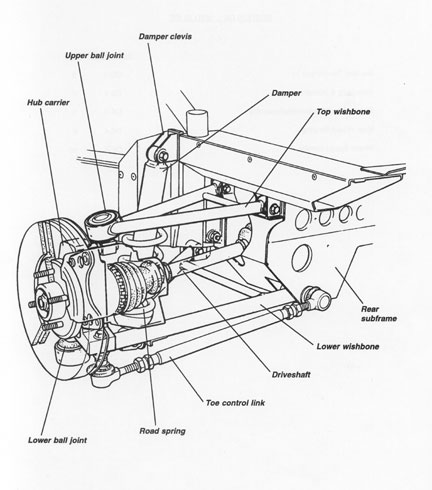
Elise rear suspension photo:
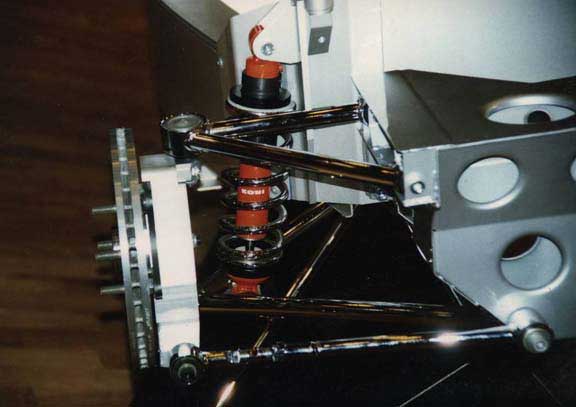
Now that's a classic setup if ever there was one. Beauty in both form and function.