Days til DBRXI...







Joined: Apr 2002
Posts: 15,342
Likes: 103
From: Raleigh

Originally Posted by RedCelica' timestamp='1306355736' post='20615278
[quote name='Lovetodrive2000' timestamp='1306354858' post='20615202']
I think almost all cars will take the same amount of time in the 1/4 mile....
If the 1/4 mile is vertical and they are dropped from a plane!
I think almost all cars will take the same amount of time in the 1/4 mile....
If the 1/4 mile is vertical and they are dropped from a plane!

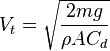
where
Vt = terminal velocity,
m = mass of the falling object,
g = acceleration due to gravity,
Cd = drag coefficient,
ρ = density of the fluid through which the object is falling, and
A = projected area of the object.
So an s2000 might have a terminal velocity of:
m = 2850 lbs
g = 32.174 fps^2
Cd = 0.29 (top up)
p = http://en.wikipedia.org/wiki/Density_of_air assumed 25 deg C (77F) air temp avg. density is calculated as 1.1839 kg/m^-3 or .7513148 kg/m converted to lb/ft = 5.43439476286025 lb/ft
A = This is kinda hard, so Im going to guess knowing that the s2000 is 68.9 in wide and 50.0 in high and then take 33% of that is roughly 94.7375 ft^2
sqroot of 183391.8/149.304 = 35.047 fps
The terminal velocity of an S2000 is approx. 35.047 feet per second.
Using the basic formula for a falling object sqroot(2d/v) = sqroot(2640/35.0470) = 8.679 seconds @ 207.27 mph
The result assumes that the 1320 ft begins with the point at which the vehicle reaches terminal velocity...I'll have to calculate the differentiation between acceleration between initial and terminal velocities.
Now...please someone check my math

[/quote]
probably some damned conversion

Ah...1.1839^-3 isn't .7xxx it's .6026358148...damned microsoft calculators!
 Trusty Ti-83 works great though
 p = 4.3486
CdA = http://en.wikipedia.org/wiki/Automob...ag_coefficient I was totally off
Let's just call it 6.0 ft ^2Vt = sqroot(((2*2850)*32.174)/(6*4.3486)) = 83.84 fps = 57.16 mph
1320ft / 57.16 mph = 15.744 seconds @ 57.16 mph...yep we do better under the power of the F2xC