


Dealing with the "crappy tune zone"

Registered User
Joined: Mar 2010
Posts: 1,062
Likes: 1
From: Montgomery Alabama

This was a great read through. Now im starting to realize why everyone says ITBs are a PITA to tune. That "crappy tune zone" is almost your entire rev range. One guy i talked to said if you use Alpha-N for itbs they are not too tragic but when the weather changes your screwed.
I have yet to put mine on yet, but i can see myself messing with the tune in the future. Thanks for the good read.
I have yet to put mine on yet, but i can see myself messing with the tune in the future. Thanks for the good read.


Joined: Dec 2010
Posts: 637
Likes: 2
I just thought about this again. Weather and altitude issues would be suboptimal for a Pure alpha-N model (tps only). The hybrid alpha-n EMS default uses the MAP sensor for (boost trim) actually the vacuum portion 101 to 0kpa. Changes in Alt and baro would be reflected by this trim. Higher altitude (less kpa) would mean the trim would be a lower (negative % trim) therefore less fuel.
The alternative would be to vent the MAP to open air as a baro compensator using the baro trim table. Or could use baro sensor built in the EMS.
I saw something called ITB model in the mega manual where you can divide a table 'diagonally'. The bottom half would use speed density and the top half would be tps based. The dividing breakpoints being the TPS %'s @ zero vacuum. This theoretically would attempt to get the advantages of both models.
I wonder what new models are available for the infinity series ems.
Sent from my T-Mobile G2 using Tapatalk 2
The alternative would be to vent the MAP to open air as a baro compensator using the baro trim table. Or could use baro sensor built in the EMS.
I saw something called ITB model in the mega manual where you can divide a table 'diagonally'. The bottom half would use speed density and the top half would be tps based. The dividing breakpoints being the TPS %'s @ zero vacuum. This theoretically would attempt to get the advantages of both models.
I wonder what new models are available for the infinity series ems.
Sent from my T-Mobile G2 using Tapatalk 2

Thread Starter
Former Sponsor
Joined: Mar 2002
Posts: 15,526
Likes: 19
I just thought about this again. Weather and altitude issues would be suboptimal for a Pure alpha-N model (tps only). The hybrid alpha-n EMS default uses the MAP sensor for (boost trim) actually the vacuum portion 101 to 0kpa. Changes in Alt and baro would be reflected by this trim. Higher altitude (less kpa) would mean the trim would be a lower (negative % trim) therefore less fuel.
The alternative would be to vent the MAP to open air as a baro compensator using the baro trim table. Or could use baro sensor built in the EMS.
I saw something called ITB model in the mega manual where you can divide a table 'diagonally'. The bottom half would use speed density and the top half would be tps based. The dividing breakpoints being the TPS %'s @ zero vacuum. This theoretically would attempt to get the advantages of both models.
I wonder what new models are available for the infinity series ems.
Sent from my T-Mobile G2 using Tapatalk 2
The alternative would be to vent the MAP to open air as a baro compensator using the baro trim table. Or could use baro sensor built in the EMS.
I saw something called ITB model in the mega manual where you can divide a table 'diagonally'. The bottom half would use speed density and the top half would be tps based. The dividing breakpoints being the TPS %'s @ zero vacuum. This theoretically would attempt to get the advantages of both models.
I wonder what new models are available for the infinity series ems.
Sent from my T-Mobile G2 using Tapatalk 2
Registered User
Joined: Aug 2009
Posts: 876
Likes: 0
From: Richmond, VA
You should try tuning a car with a small turbo that reaches max boost at very low throttle positions (i.e. greddy kit). This causes extreme rich conditions under part throttle boost. Having an EMS like AEM with throttle mod tables can help in this situation. Also remember guys different barometric pressure will affect exhaust pressure, which will change required fueling at any given intake manifold pressure. Having a Baro sensor and compensation tables to correct for this would be the best option.
As for changing the DBW throttle map I can see where this would increase fuel economy. Before in the "crap zone" you were essentially using the same amount of fuel as WOT with less power output. A throttle based fuel correction would keep you from having to do this with the DBW table. Too bad the Hondata is somewhat limited.
As for changing the DBW throttle map I can see where this would increase fuel economy. Before in the "crap zone" you were essentially using the same amount of fuel as WOT with less power output. A throttle based fuel correction would keep you from having to do this with the DBW table. Too bad the Hondata is somewhat limited.

Registered User
Joined: Sep 2009
Posts: 81
Likes: 0
I would not want to use an Alpha-N tuning model, since that would run rich or lean depending on changes in weather or altitude. I think the ideal tuning model would be to add fuel and timing compensation tables by RPM and TPS to the standard Speed Density tuning model.
The adjustments I made to the DBW throttle map were not an attempt to fix the tune as much as spending less time in the "crappy tune zone".
The adjustments I made to the DBW throttle map were not an attempt to fix the tune as much as spending less time in the "crappy tune zone".
You should try tuning a car with a small turbo that reaches max boost at very low throttle positions (i.e. greddy kit). This causes extreme rich conditions under part throttle boost. Having an EMS like AEM with throttle mod tables can help in this situation. Also remember guys different barometric pressure will affect exhaust pressure, which will change required fueling at any given intake manifold pressure. Having a Baro sensor and compensation tables to correct for this would be the best option.
As for changing the DBW throttle map I can see where this would increase fuel economy. Before in the "crap zone" you were essentially using the same amount of fuel as WOT with less power output. A throttle based fuel correction would keep you from having to do this with the DBW table. Too bad the Hondata is somewhat limited.
As for changing the DBW throttle map I can see where this would increase fuel economy. Before in the "crap zone" you were essentially using the same amount of fuel as WOT with less power output. A throttle based fuel correction would keep you from having to do this with the DBW table. Too bad the Hondata is somewhat limited.
If i'm reading this correctly you are both suggesting that at part throttle, with full map, (aka crappy tune zone) one needs to reduce fuel and advance timing (tps based) in order to achieve a good tune. Can you please confirm. (I think this explains for me how my fuel trims go one way when cruising and the other way when idling - I never considered intake/valves/exhaust resonance)
In the dbw cars, its nice how you can just open the throttle plate fully and just get out of the crappy tune zone. And it will help with mpg as well as Gernby discovered. Thats part of the reason diesels get better mpg too, as there is no throttle plate.
On an ap1, this is not possible, but I can try to play with an extra tps compensation table, on top of the map tables, using the Greddy Ultimate. The fuel I should be able to see which way it needs to go when I start forcing the car into open loop early by the tps intercept(over 60%tps = open loop). I'm not sure about the ignition timing, but I'm guessing it will need to advance, as it would when there was less map, as there is less resonance... Can you please confirm?
Also regarding the ignition advance when lowering vtec, is it really almost +10? I'm not at +5 with good results and no knock. Should I try a bit more?
This forum is so great I can not say thank you enough times. Gernby's posts have been source of inspiration for so long on tuning the S2K and understanding the physics involved, but I should also mention MugenRioS2k, urBan_dK and Karcepts for their great contributions to tuning the s2000 with the greddy. Sorry for the off topic.

Joined: Apr 2010
Posts: 570
Likes: 16
Gernby, can you clarify something for me?
In your proposed throttle table:
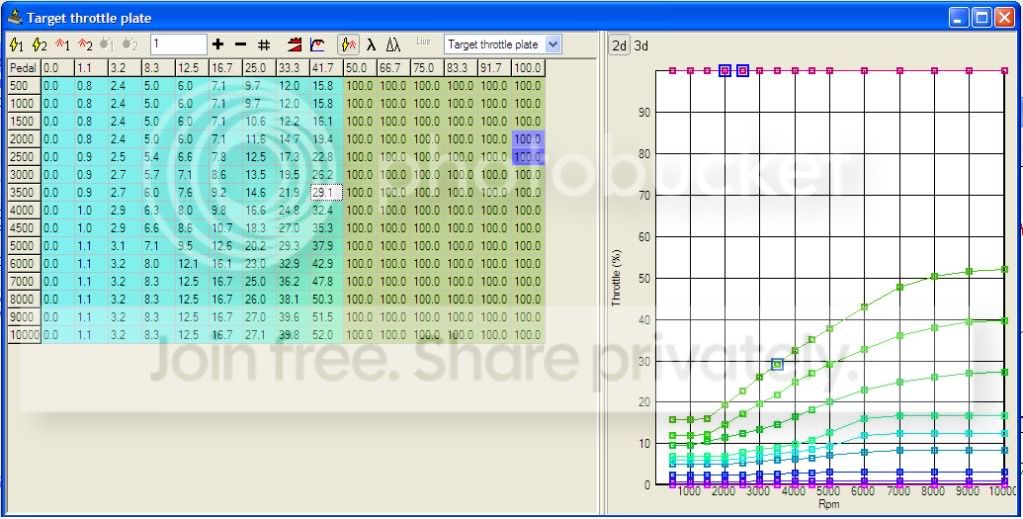
Is it safe to assume that once the accelerator pedal hits 50%, the throttle plate is wide open and we have achieved maximum load for that RPM? While I have yet to employ this method, I'm having a hard time grasping how the car will drive with only half the accelerator pedal being necessary for WOT. On late model STIs, Subaru used boost to add torque to the rest of the throttle pedal (0-60% APP is throttle plate, 61-100% APP is boost). You've created all this extra resolution near WOT, but what is causing you to achieve loads slightly less than your max MAP besides weather fluctuations? I feel like I'm missing something.
I just have to ask: have you found a way around the lack of altitude compensation?
In your proposed throttle table:
Is it safe to assume that once the accelerator pedal hits 50%, the throttle plate is wide open and we have achieved maximum load for that RPM? While I have yet to employ this method, I'm having a hard time grasping how the car will drive with only half the accelerator pedal being necessary for WOT. On late model STIs, Subaru used boost to add torque to the rest of the throttle pedal (0-60% APP is throttle plate, 61-100% APP is boost). You've created all this extra resolution near WOT, but what is causing you to achieve loads slightly less than your max MAP besides weather fluctuations? I feel like I'm missing something.
I just have to ask: have you found a way around the lack of altitude compensation?


Joined: Mar 2010
Posts: 4,742
Likes: 211
I don't mean to take this thread on a tangent but have you gone the other way and tried "adding" some resolution to the pedal by pushing WOT/66% past 50% of pedal travel? I'm thinking about giving this a shot as I think it would make modulating the part throttle window easier on the track. This weekend sometimes it felt like it was almost an on/off switch, and having a litle more resolution for my right foot wouldn't hurt.
Also, is 50% on the table really equal to 50% of the pedal travel? Just curious if you could share any insights as to save me some time via trial and error. I think I'm going to try to add a little resolution for the gas pedal throughout the range to help with modulating the throttle. I wonder what the "throttle curve" looks like on a non-DBW s2k. I guess easier way is just popping off the intake and looking at the throttle plate, anyone have any idea if ~60% of pedal position = fully open throttle plate on a cabled car? I'd guess it's not WOT..
Also, is 50% on the table really equal to 50% of the pedal travel? Just curious if you could share any insights as to save me some time via trial and error. I think I'm going to try to add a little resolution for the gas pedal throughout the range to help with modulating the throttle. I wonder what the "throttle curve" looks like on a non-DBW s2k. I guess easier way is just popping off the intake and looking at the throttle plate, anyone have any idea if ~60% of pedal position = fully open throttle plate on a cabled car? I'd guess it's not WOT..
Thread Starter
Former Sponsor
Joined: Mar 2002
Posts: 15,526
Likes: 19
Below is the throttle map that I've been using for over a year, and I think it's perfect. It makes the throttle much less sensitive at low RPMs, like in parking lots, where you don't want the car to be so "twitchy". It also makes it easier to accellerate away from a stop light smoothly and quietly. However, it still accellerates the transition from part throttle to WOT once the pedal is pressed further. Basically it reduces resolution in the higher throttle range in order to increase resolution in the lower throttle range. However, once you move into the higher RPMs range, it goes back to the OEM throttle mapping.

Joined: Mar 2010
Posts: 4,742
Likes: 211
Thanks for sharing that Gernby. I guess the answer is to just try it out and see whatever works for you. I've noticed the DBW s2k's have a noticeably softer gas pedal, and modulating part throttle in a turn can be tricky getting just the right amount. Is it the case that 66.7% = WOT (think you said it)? I guess pulling off the intake hose with a gopro in front of the throttle body datalogging with the car off would be one way to be sure.
Thread Starter
Former Sponsor
Joined: Mar 2002
Posts: 15,526
Likes: 19
I haven't gone to great lengths to verify that 66.7% pedal on the table equals 100%, but all of the behaviors I've witnessed while messing with different throttle maps is that anything above 66% is the same as 100%