When you click on links to various merchants on this site and make a purchase, this can result in this site earning a commission. Affiliate programs and affiliations include, but are not limited to, the eBay Partner Network.
I did some research on Hymee. They are about 1000K north of me. Much closer to the Steve I thought you might be referring to. You know, the crocdile one.
Originally Posted by Richard Paul' date='Feb 5 2005, 05:47 PM
Adiabatic efficiencies in the 93% range are normal for gas turbine engine compressors. This compares to 50% for roots, 65% for centrifugal. I don't claim to reach the numbers that jet engines do but we regularly get 85% from my blowers.
This translates to lower outlet temps and less drive power lost. We don't use intercoolers on our regular 7 psi street systems. The added cost and complication is just not worth the trade off. The added heat of this blower is not enough to need reduction.
Even at 85% adiabatic efficiency, you're still talking about a significant rise in temperature just from increasing the pressure.
Also, I'm curious about packaging... the s2000's engine bay is pretty cramped, not sure where you'd put such a beast. I suspect you'd have to replace the intake manifold (not cheap, due to the castings required) or hang it off the front of the motor (not so good packaging-wise)
Still, interesting concept and if it's price competitive, I'd be interested. Remember the 00-03 and 04+ cars have different redlines and will need different pulleys as appropriate. Feel free to email me pictures and I'd be glad to post them for you as well.
That looks like the Williams International EJ22 Prototype compressor from the tiny 3 spool jet engine for Eclipse Aviation that I worked on. What is the diameter of this compressor? I don't know if using an axial flow comp. is going to be that much better over a centrifugal flow. Yes they are going to be more efficient. Meaning that you won't have to spin them as fast to get a specific boost pressure as compared to the centrifugal. But the S can only handle so much boost on a stock engine in this aspect of supercharging, boost is just boost.
The rotor tip dia is 4.4 inches.
As soon as I can get the time I'm going to give a plot or at least the equations to show the deltas from eff performance.
There is enough difference so as to eliminate the intercooler.
Remember if you got it hot you paid to do so. You can cool it off again but you pay for that too.
Boost is not Boost. It contains the element of heat. Mass is mass though. I will give a little lecture on this shortly. I shall show how to figure the actual mass increase vs the boost increase. It's quite different.
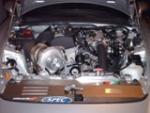
Just thought I'd post a picture of the old large size blower on an engine.
This is my own 396 small block for my El Camino. This blower put out 1180CFM at 14 psi. It was never run to design speed as the engine had to much compression.
As it was it made 738 HP at 6750 RPM.
Originally Posted by Richard Paul' date='Feb 8 2005, 06:22 PM
The rotor tip dia is 4.4 inches.
As soon as I can get the time I'm going to give a plot or at least the equations to show the deltas from eff performance.
There is enough difference so as to eliminate the intercooler.
Remember if you got it hot you paid to do so. You can cool it off again but you pay for that too.
Boost is not Boost. It contains the element of heat. Mass is mass though. I will give a little lecture on this shortly. I shall show how to figure the actual mass increase vs the boost increase. It's quite different.
Ok, so at sea level, with stock injectors, you'll get about 7psi on an S2000 at max. Let's say it's a nice sunny top down day, and it's 75 outside, or 535 rankin.
T2 = T1(P2/P1) ^ 0.283
T1 = 75 + 460 = 535
P1 = 14.7
P2 = 21.7 (7psi manifold pressure)
T2 = 535(21.7/14.7)^0.283
T2 = 597 rankin or 137 F
62 F temperature rise
Ideal temperature rise /Adiabatic efficiency = actual
62 / .85 = 72.94 or 147F total inlet temp.
Huh, that actually isn't too bad at all.
The Vortech V2-SQ had about a 70% adiabatic efficiency at peak horsepower on my M3, and put out 315 rwhp, with just water injection (no IC). It would pull 5-10 degrees of timing on the second or so lap... by the end of the session, it barely put out more power than stock. It was shoving 163 F into the motor at 75 degrees, though.
Anyway, interesting to see what you have to say about this... I would still want an intercooler on mine, though. (especially after tracking the M3, even with an air to water IC... )
I was wondering if this system could be used with my Comptech Air/Water system with just some fabricated intake plumbing to help control the temps! I have the Tech2 front mount intercooler as well.
Thank's Kit, that's exactly what I wanted to do. I was going to include the roots at 50% but smart readers can figure that one themselves. I must comment that you will not see that 70% from Vortec unless you get spot on the map at a very small island. Should have used 65%. No matter, the point is made.
The other point that should be made is that mine is a draw through system not a blow through. The difference is that the blow through is "on" all the time, meaning it is making heat and drawing HP even at cruise speed. Even with a BOV or recurc system you had to make the heat first.
Since the blower works on RPM it always Makes it's pressure at that RPM, so if your going half speed it doesn't know if you want the boost or your just on the freeway cruising. It gives you thhe boost and the heat with it, also takes the power to drive it. So your paying the tax whether or not you use the the goods. A BOV can help here but you will still pay somethings. You will always loose, proof is that the air being discharged is hot.
My system the engine doesn't know the blower is there until you call on it to produce power.
Now in a draw through the SC is running in a partial vacuume using almost no power and producing no heat. This is because with the throttle closed the air is too thin to compress. Thus the system isn't being pre warmed in the sense that the ducting and IC and fittings are hot. This heat retention must be disapated someplace, like into the air as it enters the engine.
With a draw through when you first nail the throttle on your aily drive your cool tract has all that area to draw BTU's and deliver a cooler charge to the engine on demand. This is a practical matter and shows up in actual application on street driven cars. This isn't something that shows on the dyno just a real world result. So look at the actual drivability of the system. Siomtimes it doesn't show in the numbers.
In my installation you can put your hand on the blower when it is just cruising or at idle. You can't do that with a push through system. Like I said anytime you make heat you paid for it. If you didn't then call the patent office because you invented perpetual motion or cold fussion.
You can add the IC if you want, It just isn't the end all wonder it is made out to be. First of all there has to be resistance to flow or it can't work. Then there is all the plumbing and weight. Not to mention the cost. Now did you know it can add heat to the system? Bet you didn't. Say your in traffic and not going that fast, the IC is picking up heat in all those fins from all the heat around it like the radiator. It has not got anywhere to go so it soaks it up. The previous mentioned hot air at cruise is put into the system. So when you first want to use power you'll have to get rid of that heat first for the system to function as designed. In real world operation you don't get what you think you paid for. It isn't often that you get to the design point because you don't have the time for everything to start to function.
Now I can't put up numbers to show you this because all operation are different. What I can tell you is that I have been doing this street superchrging since 1962. I have tried everything that you guys think is new technology. It has all been done before and I've tried it. The satasfaction of a street driven SC car is more then the sum of the parts. Or the parts count.
As soon as I buy a scanner I have some things I would like to publish for you to read. I just wish there was a way to put them in as attachment because if I put them in as photos it will take many pages of thread.
BTW are you sure you were getting true intake temp or really a wet bulb
reading????
Where would I put such a beast?/ Look back and see the blower compared to a can of WD 40. This is smaller and lighter then anything on the market. It is 5" in dia and 10" long weighing in under 12lbs. You just hold it in the palm of your hand.