


pro and cons of turbos

Registered User


Joined: Jun 2006
Posts: 2,433
Likes: 0
From: california

basically, all engines, given a certain displacement/volume, have a volumetric efficiency: s2000's with a 2.0 or 2.2 making 240 hp or 120hp per liter on 2.0 s2000's, 7.0 c6 zo6 corvettes making 500hp or ~71.43hp per liter. What forced induction does is increase the volumetric efficiency of that motor by utilizing expelled gases from the engine. great explanation by jaspah and funny avatar to boot 


Joined: Feb 2011
Posts: 357
Likes: 1
I agree with most of whats been said except for the "free power" mentioned above. Turbos take power to run just like everything else, but not as much as say a supercharger belt. Take this into consideration, have you ever driven a turbo'd car with a blown charge pipe? Absolutely worthless power wise because of the restriction in the turbine housing and wheel and your not getting anything back for this restriction, thus the reason that any turbo manufacturer will always recommend the biggest exhaust housing if your looking to make the maximum amount of power out of any line of turbocharger, less restrictive exhaust=better flow=more power. That being said obviously there are cons to bigger exhaust sides of turbo chargers, less bottom end, less mid range, not as street able, but strictly from a power output or drag racing point of view it is the way to go, as long as the motor is in efficiency the more the exhaust flows the better.

Registered User
Joined: May 2013
Posts: 301
Likes: 2
Well ok if you compare the exhaustgas flow of a stock s2000 to a turboed one, in this way the turbinewheel may consume some power. I haven't looked at it that way. Thanks for the imput.
There are some def cons to turbo's tho. It's really important to warm it up before pushing it, and because the turbinewheel will still be rotating after you shut down the engine (means no more oil flow) you do want the turbo rpm and temperature to be as low as possible. You do understand why, I presume.
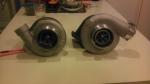
Another serious con of a turboed car is the damage that a turbo can do to your engine. When a turbo fails, and your compressor wheel looks like this:

....imagine where the shreds will go.
The bigger shreds will be stopped by your intercooler, sure... but some will always end up being sucked into the engine.
So the reliability of the whole engine does kind of depend on your right foot. This will always be the case, sure... but with turbo engines even more.
There are some def cons to turbo's tho. It's really important to warm it up before pushing it, and because the turbinewheel will still be rotating after you shut down the engine (means no more oil flow) you do want the turbo rpm and temperature to be as low as possible. You do understand why, I presume.
Another serious con of a turboed car is the damage that a turbo can do to your engine. When a turbo fails, and your compressor wheel looks like this:
....imagine where the shreds will go.
The bigger shreds will be stopped by your intercooler, sure... but some will always end up being sucked into the engine.
So the reliability of the whole engine does kind of depend on your right foot. This will always be the case, sure... but with turbo engines even more.

Registered User
Joined: Aug 2012
Posts: 106
Likes: 1
From: Roseville, Ca
I'm going to assume from the OP first post that he's looking for information about turbo cars versus non-turbo cars from the factory.
In an instance like the Supra, the addition of a turbocharger is purely for performance.
What you should also take into consideration is that in some factory turbo cars, a 4 cylinder turbo engine may be replacing a larger v6, or perhaps a turbo 6 is replacing a v8, etc etc. The utilization of a smaller engine can yield better economy not only from the engine itself but also from the improved body aerodynamics of the car, made possible by the smaller engine packaging.
If you look at engines coming out in the next 10 years, a LOT of them are turbocharged. Turbos have come a long long way since the 80's, improved performance (faster spool, higher efficiency), better reliability, and better consumer acceptance (The US really, the rest of the world was 10+ years ahead).
Have fun with your paper. I hope these few points help.
In an instance like the Supra, the addition of a turbocharger is purely for performance.
What you should also take into consideration is that in some factory turbo cars, a 4 cylinder turbo engine may be replacing a larger v6, or perhaps a turbo 6 is replacing a v8, etc etc. The utilization of a smaller engine can yield better economy not only from the engine itself but also from the improved body aerodynamics of the car, made possible by the smaller engine packaging.
If you look at engines coming out in the next 10 years, a LOT of them are turbocharged. Turbos have come a long long way since the 80's, improved performance (faster spool, higher efficiency), better reliability, and better consumer acceptance (The US really, the rest of the world was 10+ years ahead).
Have fun with your paper. I hope these few points help.



Thread Starter
Registered User
Joined: Apr 2013
Posts: 92
Likes: 0
I'm going to assume from the OP first post that he's looking for information about turbo cars versus non-turbo cars from the factory.
In an instance like the Supra, the addition of a turbocharger is purely for performance.
What you should also take into consideration is that in some factory turbo cars, a 4 cylinder turbo engine may be replacing a larger v6, or perhaps a turbo 6 is replacing a v8, etc etc. The utilization of a smaller engine can yield better economy not only from the engine itself but also from the improved body aerodynamics of the car, made possible by the smaller engine packaging.
If you look at engines coming out in the next 10 years, a LOT of them are turbocharged. Turbos have come a long long way since the 80's, improved performance (faster spool, higher efficiency), better reliability, and better consumer acceptance (The US really, the rest of the world was 10+ years ahead).
Have fun with your paper. I hope these few points help.
In an instance like the Supra, the addition of a turbocharger is purely for performance.
What you should also take into consideration is that in some factory turbo cars, a 4 cylinder turbo engine may be replacing a larger v6, or perhaps a turbo 6 is replacing a v8, etc etc. The utilization of a smaller engine can yield better economy not only from the engine itself but also from the improved body aerodynamics of the car, made possible by the smaller engine packaging.
If you look at engines coming out in the next 10 years, a LOT of them are turbocharged. Turbos have come a long long way since the 80's, improved performance (faster spool, higher efficiency), better reliability, and better consumer acceptance (The US really, the rest of the world was 10+ years ahead).
Have fun with your paper. I hope these few points help.



Joined: Dec 2007
Posts: 4,289
Likes: 12
If you stay out of boost, gas mileage can be better than N/A. Also, a con that surprisingly no one has mentioned is the extra heat. If you look around the F/I forum, you will see plenty of set ups where people are going the extra mile to make sure they dont melt anything and everything under the hood after slapping a turbo on.
Also, you are wrong about the s2000 actually making 200hp. You need to look up the differences between wheel horsepower and crank horsepower. Thats what you are seeing with the 200 number.
Also, you are wrong about the s2000 actually making 200hp. You need to look up the differences between wheel horsepower and crank horsepower. Thats what you are seeing with the 200 number.

Registered User
Joined: Jun 2010
Posts: 388
Likes: 1
Cons:
Higher chance of:
1 blown engine, blown transmission, blown differentials, blown axles.
2. Need tires more often.
3. More frequent oil change.
4. higher % of getting a ticket, go to jail, increase risk of accident.
5. Decrease comfort, increase in noise and vibration.
6. Value of resale decreases.
7. Costs $$$$
Higher chance of:
1 blown engine, blown transmission, blown differentials, blown axles.
2. Need tires more often.
3. More frequent oil change.
4. higher % of getting a ticket, go to jail, increase risk of accident.
5. Decrease comfort, increase in noise and vibration.
6. Value of resale decreases.
7. Costs $$$$