


Lowered Battle Stance


Thread Starter
Registered User

Joined: Nov 2014
Posts: 57
Likes: 0
 Lowered Battle Stance
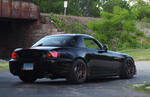
So I've looked a little bit but can't seem to find a way to lower the car but keep the camber at a track spec i.e. -2 degrees or so. I hear there's upper control arms but they are junk compared to factory, and something about switching the upper and lower adjustable aftermarket ball joints. Any insight would be great and if it's not possible, saying so is appreciated too haha. I'm just wondering if it's possible to tuck a little bit of rim and tire without doing the whole camber thing, it looks rediculous IMHO. I'm currently on 17x8 +45 in front and 18×8.5 +50 in the rear and I'm probably at an 1.5-2" drop at -2.2 degrees in rear and -0.7 in front.

Joined: May 2008
Posts: 1,298
Likes: 12
From: Edwards AFB
1.5"-2" drop is not too bad. If you get the right wheel/offset there should not be a problem with tucking and still retain your track spec.
Unless you are running like 900 lb-in springs, you may rub with tucking tire.
Unless you are running like 900 lb-in springs, you may rub with tucking tire.
Thread Starter
Registered User
Joined: Nov 2014
Posts: 57
Likes: 0
No I don't rub at all. The issue I'm having is I'd like to go probably an inch lower but keep the camber where it's at now. I have enough room, but as you lower the car it cambers more, I'd like to prevent that. I'm pretty much minimized on camber at the current height I'm at now.


Joined: Nov 2007
Posts: 8,841
Likes: 1,705
From: Illnoise. WAY downtown, jerky.
The car has stock camber adjustment available. You just need to specify the angle on an alignment. Give up or add toe/caster to give up or add camber. Its all on a curve. A good alignment guy should be able to figure it out
-2 degrees is no problem, even if the car is significantly lowered.
Edit: if you're lowering the car beyond 2" or so...there goes your "track spec" anyway. Why do you want the car to be lower? And what coilovers are you on? Hopefully something with full body adjustment. The rear shocks have a very short stroke already.
Why is -2 degrees "track spec"? Most tracked cars with street tires are at around -3 degrees (including mine).
-2 degrees is no problem, even if the car is significantly lowered.
Edit: if you're lowering the car beyond 2" or so...there goes your "track spec" anyway. Why do you want the car to be lower? And what coilovers are you on? Hopefully something with full body adjustment. The rear shocks have a very short stroke already.
Why is -2 degrees "track spec"? Most tracked cars with street tires are at around -3 degrees (including mine).
Thread Starter
Registered User
Joined: Nov 2014
Posts: 57
Likes: 0
Yes I'm aware, It's lowered to the point now that if I go any lower I will be going more negative camber than -2 with the bolt fully adjusted out. I don't want that, I want lower than where I'm at now with -2 or even -1.5 if I could. It won't go to that point anymore. I'm maxed on my adjustment. To reiterate, at my current height I can adjust it to go up to -4 degrees, again I don't want that, I want the car tucking wheels but at a -1.5 or -2 degree camber.
Joined: Nov 2007
Posts: 8,841
Likes: 1,705
From: Illnoise. WAY downtown, jerky.
Originally Posted by B serious' timestamp='1443808401' post='23764508
You guys....
The car has stock camber adjustment available. You just need to specify the angle on an alignment.
-2 degrees is no problem, even if the car is significantly lowered.
The car has stock camber adjustment available. You just need to specify the angle on an alignment.
-2 degrees is no problem, even if the car is significantly lowered.
I'm saying you can give or take from other adjustments to get more out of your camber adjuster.
Also wasn't sure why you had settled on the number -2. I was hoping to provide insight that -1.5 or -2 aren't considered track spec.
But it doesn't seem like you'll actually track the car. So if you want to maintain camber adjustment without adding some rear toe (positive), etc, then you can buy upper ball joints from SPC. I've had SPC joints on my car for years and they've never slipped or failed....even after smacking a raised section of track curbing and bending my spindle. Installing them properly is key.
Adjustable lower joints are available also, but are very expensive (J's racing). The advantage to these is the additonal roll center adjustment, which is advantageous for slammed cars. Since you didn't answer what type of coilovers you have, the downward adjusment of lower ball joints may or may not intrigue you.
Roll center adjusment is complex, though. I'd do upper joints if anything.
I'm not really buying that you can't adjust more positive than -2, though, because that's very unusual. I'm using SPC joints because I couldn't get ENOUGH negative camber (my adjuster stopped at -2.5 up front. I wanted -3.2)...which is common. But...why argue with you?
Trending Topics

Community Organizer

Joined: Jun 2007
Posts: 31,070
Likes: 566
Just for reference on a non camber corrected s2k. At nearly -2" drop/13" fender to hub. My rear camber is maxed positive -2.5, that’s with minimal .10 toe per side. Can’t reduce the camber any further. The front camber maxes at -2.5 with 6.8 caster and 0 toe. I can get less camber but the car works better there, so this is my track and street alignment I settle with. If I lower the car anything further, it would compromise adjustment range and best handling. Anything lower then -2" and I wouldn’t be able to drive it on the street either so its the best compromise anyway.
Thread Starter
Registered User
Joined: Nov 2014
Posts: 57
Likes: 0
Just for reference on a non camber corrected s2k. At nearly -2" drop/13" fender to hub. My rear camber is maxed positive -2.5, that’s with minimal .10 toe per side. Can’t reduce the camber any further. The front camber maxes at -2.5 with 6.8 caster and 0 toe. I can get less camber but the car works better there, so this is my track and street alignment I settle with. If I lower the car anything further, it would compromise adjustment range and best handling. Anything lower then -2" and I wouldn’t be able to drive it on the street either so its the best compromise anyway.
Joined: Nov 2007
Posts: 8,841
Likes: 1,705
From: Illnoise. WAY downtown, jerky.
0 rear toe is kinda weird. But that would actually allow you more camber adjustment in the positive direction.
Rear suspension:
Stock rear toe is highly positive for AP1's, and slightly positive for AP2's. That positive toe will wear tires more quickly than 0...but will create more EVEN tire wear with negative camber. So...in a way, it makes tires last longer to combine positive toe and negative camber. But...with positive toe, you reduce the amount of available positive camber adjustment.
When toe goes positive (toe IN), camber goes negative and vice versa. Thats how the stock REAR curve works.
I wouldn't recommend 0 toe out back unless you're aware that the car will be less stable, and will be slightly more oversteer prone.
Front suspension:
0 toe is normal, and its about what you want.
Rear suspension:
Stock rear toe is highly positive for AP1's, and slightly positive for AP2's. That positive toe will wear tires more quickly than 0...but will create more EVEN tire wear with negative camber. So...in a way, it makes tires last longer to combine positive toe and negative camber. But...with positive toe, you reduce the amount of available positive camber adjustment.
When toe goes positive (toe IN), camber goes negative and vice versa. Thats how the stock REAR curve works.
I wouldn't recommend 0 toe out back unless you're aware that the car will be less stable, and will be slightly more oversteer prone.
Front suspension:
0 toe is normal, and its about what you want.