


Strut Tower Bar


Former Sponsor
Joined: Oct 2007
Posts: 28,698
Likes: 38
From: Mooresville, NC

I just installed my Ebay STB and I have a K&N FIPK. It fit's fine. Just need to push it past the heat shields of the intake to bolt it down. No issues at all.
This one looks slightly different then the other ebay ones people have gotten. Was $35 shipped so not much more at all! I kinda like it I guess. I knew it would not improve any handling at all so just for looks/something to hold on to mostly when working under the hood.


This one looks slightly different then the other ebay ones people have gotten. Was $35 shipped so not much more at all! I kinda like it I guess. I knew it would not improve any handling at all so just for looks/something to hold on to mostly when working under the hood.



Registered User
Joined: Sep 2008
Posts: 1,006
Likes: 1
From: Philadelphia
http://www.modacar.com/products/Honda/S200...+S2000+Js+.html
If you are going to spend money get something that has form and function; above is the piece I'm ordering soon, combo !!!!
It matches the inside of the AP2's very nicely
If you are going to spend money get something that has form and function; above is the piece I'm ordering soon, combo !!!!
It matches the inside of the AP2's very nicely
Former Sponsor
Joined: Oct 2007
Posts: 28,698
Likes: 38
From: Mooresville, NC
Originally Posted by mjschrage,May 1 2009, 08:11 AM
http://www.modacar.com/products/Honda/S200...+S2000+Js+.html
If you are going to spend money get something that has form and function; above is the piece I'm ordering soon, combo !!!!
It matches the inside of the AP2's very nicely
If you are going to spend money get something that has form and function; above is the piece I'm ordering soon, combo !!!!
It matches the inside of the AP2's very nicely

Registered User
Joined: Aug 2003
Posts: 2,064
Likes: 5
From: Buffalo, NY
Originally Posted by 2003s2k2003,May 1 2009, 06:36 AM
Hmm that is just a hugr waste of money though. The STB has no more function than a cheap ebay one and you can also get an ebay engine torque damper that will do the exact same thing. So only real reason to get that is if you like the name and like spending $300 extra for it...


Joined: May 2007
Posts: 1,924
Likes: 0
From: OC
Originally Posted by joeydinc,Apr 18 2009, 08:25 PM
But what factors are involved here? The "fastest S2K" in Japan.... at what? what OTHER chassis bracing does it have. what is the driver -driving - style... When a overwhelming amount of people notice it, and when i go to the track and see people with them, there has to be some reason to believe they work. After all chassis stiffening is chassis stiffening... the rest should be tuned through the suspension.
I hardly see how the ebay ones work, they are flexible, and have JOINTS!!!!!!!!!!!!!!! I should know I just to sell them... But a triangular brace and under bracing might be kinda nice. May not be the best for stock suspension but it MUST have some affect positive or negative.
In fact, I am going to be ordering some material next week to test a couple of ideas I have... I am not an engineer, but I can try....
I hardly see how the ebay ones work, they are flexible, and have JOINTS!!!!!!!!!!!!!!! I should know I just to sell them... But a triangular brace and under bracing might be kinda nice. May not be the best for stock suspension but it MUST have some affect positive or negative.
In fact, I am going to be ordering some material next week to test a couple of ideas I have... I am not an engineer, but I can try....
Did these overwhelming number of people you saw at the track also have midship engines with a giant beam running in front of their engine? Or were their cars using struts unlike ours?
Yeah, the strut tower brace has an effect in our strut-less cars: weight.
Check the thread in my sig, if you want a physics based explanation. But even with science, it seems if people really believe in the strut bar, they will continue to do so.

Registered User
Joined: May 2008
Posts: 2,016
Likes: 0
From: Scotland
The best part of that entire thread is to read this bit here.... I can verify this drawing as I did it myself. It seems that the tiny force going lateral across the top of the damper towers is so minimal that it becomes negligible. Also the Integra Type R uses a double wishbone suspension like the s2000 but due to the transverse engine position the boxed brace that s2ks have isn't there so a STB is used instead. Also that lateral force is a component of the reactive force of the coilover/suspension piece
The quote was from FormulaRedline
If bling is y0 thang... then I would go for some j's racing... it's what i'll be doing more for aesthetics plus leaning over that engine bay is a PITA without something to hold onto!!
Luckily, this was just posted in another thread:

So that I could do some fancy MS Paint work:
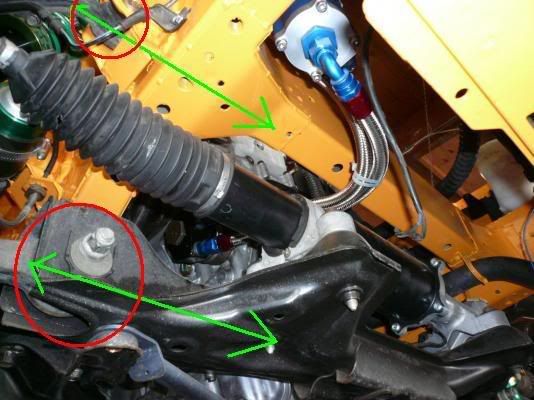
The red circles highlight where the a-arms attach to the body. This is where the cornering (horizontal) forces are transfered. The green lines show the force path (they have arrows on both sides because the force can go both ways depending on which way the car is turning). The green line along the top is the "fourth side to the open box."
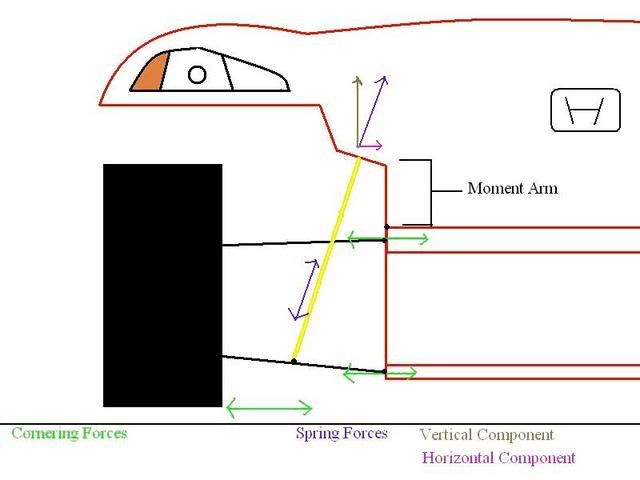
That's not to say the bars see no horizontal force. There is still a horizontal force that is imposed where the coilovers mount to the body. The problem is, since the a-arms oppose the forces and moments created by the force between the wheel and the road (side note: this is the important difference between struts and double wishbone, the lower control arm of the strut could oppose the horizontal force by itself, but must instead rely on the strut mount to also provide a horizontal force to balance the moments), the only force the body sees at the coilover attachment is the force of the compressed spring.
The spring force on a car pulling 1g with 100% lateral weight transfer is going to be about the same as the cornerning force (with two wheels providing useful traction at 1g, each is seeing about half the cars weight in cornering force, and with 100% weight transfer, both outside spring will be compressed by, and therefore pushing back with, half of the cars weight). However, while the cornering force is horizontal, this force is mostly vertical. Therefore the horizontal force is only a component of the total force, equal to the sine of the angle of the mount (around 20%). In addition, this force is acting to flex the chassis over a moment arm that only extends from the top of the large engine bay cross brace to the top of the shock towers instead of from the bottom of the chassis to the top of the strut towers. In the end this means that the top of the towers are only seeing about 6-7% of the horizontal force they would have in a strut configuration.
The nail in the coffin is that now that this bending moment has had is fulcrum moved to the engine bay brace, any deformation doesn't even effect the suspension geometry. You'd not only be resisting a smaller bending moment, you'd be doing it for no useful purpose.
Go MS Paint:
So that I could do some fancy MS Paint work:
The red circles highlight where the a-arms attach to the body. This is where the cornering (horizontal) forces are transfered. The green lines show the force path (they have arrows on both sides because the force can go both ways depending on which way the car is turning). The green line along the top is the "fourth side to the open box."
That's not to say the bars see no horizontal force. There is still a horizontal force that is imposed where the coilovers mount to the body. The problem is, since the a-arms oppose the forces and moments created by the force between the wheel and the road (side note: this is the important difference between struts and double wishbone, the lower control arm of the strut could oppose the horizontal force by itself, but must instead rely on the strut mount to also provide a horizontal force to balance the moments), the only force the body sees at the coilover attachment is the force of the compressed spring.
The spring force on a car pulling 1g with 100% lateral weight transfer is going to be about the same as the cornerning force (with two wheels providing useful traction at 1g, each is seeing about half the cars weight in cornering force, and with 100% weight transfer, both outside spring will be compressed by, and therefore pushing back with, half of the cars weight). However, while the cornering force is horizontal, this force is mostly vertical. Therefore the horizontal force is only a component of the total force, equal to the sine of the angle of the mount (around 20%). In addition, this force is acting to flex the chassis over a moment arm that only extends from the top of the large engine bay cross brace to the top of the shock towers instead of from the bottom of the chassis to the top of the strut towers. In the end this means that the top of the towers are only seeing about 6-7% of the horizontal force they would have in a strut configuration.
The nail in the coffin is that now that this bending moment has had is fulcrum moved to the engine bay brace, any deformation doesn't even effect the suspension geometry. You'd not only be resisting a smaller bending moment, you'd be doing it for no useful purpose.
Go MS Paint:
If bling is y0 thang... then I would go for some j's racing... it's what i'll be doing
more for aesthetics plus leaning over that engine bay is a PITA without something to hold onto!!