When you click on links to various merchants on this site and make a purchase, this can result in this site earning a commission. Affiliate programs and affiliations include, but are not limited to, the eBay Partner Network.
Just be super careful doing the work. The car will be a bit precarious not resting on the stand. Even though it's only barely up off the stand, its still not as stable as it was when resting firmly on the stand. Then you're going to crawl under there and torque hard on some wrenches.
You could die.
So be careful. I try not to actually get under the car when clocking the bushings.
Yeah, if you're doing this at a shop with an alignment rack...its best to leave the bolts loose, put the car down/drive onto the rack, and then tighten.
So, here I am with good news I took my car to a shop where usually this kind of work is done... better safe :P The job was pretty simple and cheap (118€). I personally saw them reclocking the front bushings so I´m also assuming they did the same to rear control arms. Camber and caster (front) have been tweeked as well...The car looks exactly how I wanted it to look the day I swapped wheels. It´s lower but with a considerable gap, enough to ensure no rubbing happens. The biggest difference I noticed while driving (for much much better) is weight transfer speed... I mean, the car is so much snappier (?) where weight locks so much quicker over the wheels... I think they did a good job and I´m happy with it
Thanks to all replies helping me decide to make this change
The effect you are feeling with increased steering response is due to the springs being progressive rate.
With straight rate springs, when the car tries to lean in a corner, the springs on the side that weight is being transferred to push back at the same rate that the springs on the side that weight is transferred from at tbe same rate.
With progressive rate springs, the rates are much different one side to the other in this scenario. The side being compressed resists with more and more rate. The springs on the side being lifted by weight transfer assist lifting less and less.
The result is the car stays very flat in corners, even with relatively comfortable ride quality. A secondary result is steering response is increased dramatically. The car feels so much more responsive.
While progressive springs have real drawbacks at the track, when driven at the very limit (their progressive nature means nonlinear responses, which makes balancing on the razors edge of traction much more difficult), they are ideally suited to the street.
This: The result is the car stays very flat in corners, even with relatively comfortable ride quality.
And this: A secondary result is steering response is increased dramatically. The car feels so much more responsive.
Actually, steering response has increased so much I need to get used to it and I hope it isn´t so twitchy at highway speed. Today I speed a bit on a road that kind allows it, but with some considerable depressions in turns and the back end wobbled quite a bit making me getting a grip on the steering. I should say this was maybe over 140km/h wich, honestly, is a bit too much for that road - I need to be carefull
p.s: sorry for delayed answer, had to reset my password




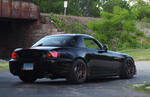


 I took my car to a shop where usually this kind of work is done... better safe :P The job was pretty simple and cheap (118€). I personally saw them reclocking the front bushings so I´m also assuming they did the same to rear control arms. Camber and caster (front) have been tweeked as well...The car looks exactly how I wanted it to look the day I swapped wheels. It´s lower but with a considerable gap, enough to ensure no rubbing happens. The biggest difference I noticed while driving (for much much better) is weight transfer speed... I mean, the car is so much snappier (?) where weight locks so much quicker over the wheels... I think they did a good job and I´m happy with it



 and I hope it isn´t so twitchy at highway speed. Today I speed a bit on a road that kind allows it, but with some considerable depressions in turns and the back end wobbled quite a bit making me getting a grip on the steering. I should say this was maybe over 140km/h wich, honestly, is a bit too much for that road - I need to be carefull
