KW V3 Tuning Guide

Thread Starter
Former Moderator


Joined: Jul 2005
Posts: 4,634
Likes: 28
From: West Virginia
 KW V3 Tuning Guide
I'm working up a KW V3 tuning guide based on the Penske shock tech manual. You KW users please take a look and offer suggestions or corrections. Billy, anything to add or change?
Here's the actual V3 shock tuning guide: http://robrobinette.com/S2000KWV3Tuning.htm
Basic KW V3 Shock Tuning
By Rob Robinette based on the Penske Tech Manual
This procedure is based on the Penske damper tuning "Basic Start-up Procedure" found in their tech manual. Starting with both compression and rebound set to full soft and working toward a baseline setting will teach you a lot about how your car feels when it needs damping adjustment so I believe it's a good idea to take the time to run through this full procedure even though the S2000 community has a pretty good handle on optimal settings of the KW V3. Although this guide is specific to the Honda S2000 KW V3 shock the basics will apply to any double adjustable (compression & rebound) shock.
Setting Compression
Compression, or bump setting, is on the bottom of shock. The old style adjusters use 1/4 turn "sweeps" using a KW provided pin tool. The adjuster is behind a plastic, pop-off cover. New style adjusters have a numbered wheel with clicks. Two clicks equal a 1/4 turn sweep.
Adjust compression to suit bumps in critical areas such as corners, corner exit and braking zones.
1. Set the rebound adjuster to full soft--turn the top shock adjuster out, counter-clockwise about 3 turns--as if screwing the adjuster up, out of the shock--don't force the adjuster beyond its limit.
2. Set the compression adjuster to full soft--turn the bottom shock adjuster from right-to-left--as if screwing the adjuster down, out of the bottom of the shock about 2 turns (8 sweeps or 16 clicks). Drive a lap with compression set at full soft to definitely feel what too soft feels like. Use caution because the car will handle poorly. The car should bounce and oscillate pretty badly. Come in and add compression (bottom of shock, move adjuster left-to-right, one sweep (or 2 clicks) at a time. Do not adjust rebound (top adjuster). Continue lapping and adding compression to minimize upsets until the car becomes harsh, loses tire compliance and traction. When this happens you have gone too far, back off 1 sweep (or 2 clicks).
Setting Rebound
The rebound setting is on top of shock, full soft is 3 turns out.
Adjust rebound to tighten up the car, stabilize the platform and eliminate the floating "Cadillac feeling." This will also reduce the rate of body roll. New style adjusters have 6 clicks per turn.
1. With the rebound set at or near full soft (top adjuster fully out counter-clockwise) drive a lap to definitely feel what too little rebound damping feels like. Add 1 full turn for the first adjustment then add 1/4 turn rebound (or 2 clicks to the top adjuster, clockwise) at a time until the car becomes "skittish" or the rear wheels hop under braking. When that happens you've gone too far so back off 1/6 turn (or 1 click, top adjuster counter-clockwise) at a time for fine tuning.
New Style Rebound Adjuster Uses Allen Wrench
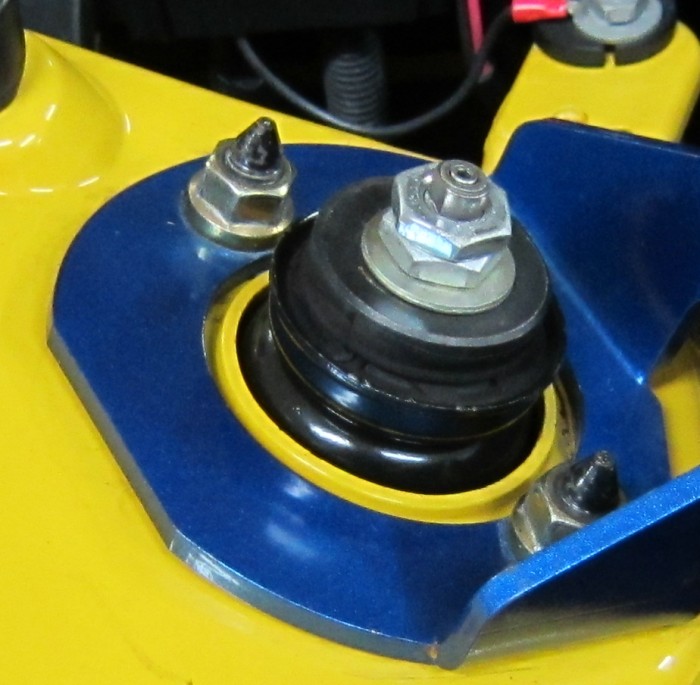
Once you get the settings right you might want to try this as a learning experience. Make sure you have your settings documented then set the compression to full soft and do a few laps to see what it feels like with the rebound set properly but compression too soft. Be cautious because the car will handle poorly. Then set compression back to the proper setting and set rebound to full soft and take the car out. This exercise may help you troubleshoot your damper settings in the future.
Notes
I remember which adjuster is which with this mnemonic: Bump is Bottom (bump = compression)
I shortened the compression adjustment pin tool to make it easier to make adjustments.
KW recommended track settings with original 80N-mm (457lb-in) springs:
.....Compression all around at 0.75 turn out from full stiff (3 sweeps or 6 clicks)
.....Rebound: Front 0.75 turn out (about 5 clicks); Rear 1.5 turns out (9 clicks)
If the spring/shock combination was balanced, the rule of thumb is a stiffer spring requires lower compression and higher rebound. A softer spring requires higher compression and lower rebound.
KW V3s for the S2000 have come from the factory with 80N-mm (Newton per milimeter or 457lbs-in, same springs front and rear) and 90N-mm (513lbs-in) springs. The top rebound adjusters originally came with no click adjusters that came with a plastic wheel for adjustments. Newer shocks come with an allen wrench adjuster with 6 clicks per turn. The bottom compression adjusters originally came with a 1/4 turn "sweep" adjustment made with a metal pin tool. Newer shocks come with a wheel that has 8 clicks per turn. The Club Sports come with 100N-mm (571lbs-in) springs. The newest Club Sports have new compression adjusters that are different between the front and rear.
For rain settings both compression and rebound should be reduced.
Adding rebound will add stability. Too little will let the car pitch and roll too much but will help with tire wear.
Rebound greatly affects weight transfer between the front and rear tires. Less front rebound damping allows weight transfer to the rear under acceleration--too little front rebound can cause push powering out of corners.
Less rear rebound allows more weight transfer during braking and turn in.
Too much rebound can make the car "pack down" in a series of bumps and the car will feel too stiff (this can easily be mis-diagnosed as too much compression damping). Too much rebound can also cause lack of grip in corners.
Controlling rebound is normally more important than compression. This is why most single adjustable shocks give you control of rebound.
To install & remove your shocks you have to move the lower suspension arm down and out of the way. Disconnect one end of each anti-roll (sway) bar to make this easier. If you have a helper have them push down or even stand on the wheel hub to move it down. If you are installing/removing the shocks alone a long breaker bar will help move the hub down and out of the way.
KW USA 800-445-3767
My Current Settings
Springs are: Front 628lbs-inch (110N-mm), Rear 571lbs-inch (100N-mm)
Compression
.....Front and rear: 1 turn out from full stiff (4 sweeps or 8 clicks)
Rebound
.....Front: 0.66 turns out (4/6 turn or 4 clicks)
.....Rear: 0.83 turn out (5/6 turn or 5 clicks)
Here's the actual V3 shock tuning guide: http://robrobinette.com/S2000KWV3Tuning.htm
Basic KW V3 Shock Tuning
By Rob Robinette based on the Penske Tech Manual
This procedure is based on the Penske damper tuning "Basic Start-up Procedure" found in their tech manual. Starting with both compression and rebound set to full soft and working toward a baseline setting will teach you a lot about how your car feels when it needs damping adjustment so I believe it's a good idea to take the time to run through this full procedure even though the S2000 community has a pretty good handle on optimal settings of the KW V3. Although this guide is specific to the Honda S2000 KW V3 shock the basics will apply to any double adjustable (compression & rebound) shock.
Setting Compression
Compression, or bump setting, is on the bottom of shock. The old style adjusters use 1/4 turn "sweeps" using a KW provided pin tool. The adjuster is behind a plastic, pop-off cover. New style adjusters have a numbered wheel with clicks. Two clicks equal a 1/4 turn sweep.
Adjust compression to suit bumps in critical areas such as corners, corner exit and braking zones.
1. Set the rebound adjuster to full soft--turn the top shock adjuster out, counter-clockwise about 3 turns--as if screwing the adjuster up, out of the shock--don't force the adjuster beyond its limit.
2. Set the compression adjuster to full soft--turn the bottom shock adjuster from right-to-left--as if screwing the adjuster down, out of the bottom of the shock about 2 turns (8 sweeps or 16 clicks). Drive a lap with compression set at full soft to definitely feel what too soft feels like. Use caution because the car will handle poorly. The car should bounce and oscillate pretty badly. Come in and add compression (bottom of shock, move adjuster left-to-right, one sweep (or 2 clicks) at a time. Do not adjust rebound (top adjuster). Continue lapping and adding compression to minimize upsets until the car becomes harsh, loses tire compliance and traction. When this happens you have gone too far, back off 1 sweep (or 2 clicks).
Setting Rebound
The rebound setting is on top of shock, full soft is 3 turns out.
Adjust rebound to tighten up the car, stabilize the platform and eliminate the floating "Cadillac feeling." This will also reduce the rate of body roll. New style adjusters have 6 clicks per turn.
1. With the rebound set at or near full soft (top adjuster fully out counter-clockwise) drive a lap to definitely feel what too little rebound damping feels like. Add 1 full turn for the first adjustment then add 1/4 turn rebound (or 2 clicks to the top adjuster, clockwise) at a time until the car becomes "skittish" or the rear wheels hop under braking. When that happens you've gone too far so back off 1/6 turn (or 1 click, top adjuster counter-clockwise) at a time for fine tuning.
New Style Rebound Adjuster Uses Allen Wrench
Once you get the settings right you might want to try this as a learning experience. Make sure you have your settings documented then set the compression to full soft and do a few laps to see what it feels like with the rebound set properly but compression too soft. Be cautious because the car will handle poorly. Then set compression back to the proper setting and set rebound to full soft and take the car out. This exercise may help you troubleshoot your damper settings in the future.
Notes
I remember which adjuster is which with this mnemonic: Bump is Bottom (bump = compression)
I shortened the compression adjustment pin tool to make it easier to make adjustments.
KW recommended track settings with original 80N-mm (457lb-in) springs:
.....Compression all around at 0.75 turn out from full stiff (3 sweeps or 6 clicks)
.....Rebound: Front 0.75 turn out (about 5 clicks); Rear 1.5 turns out (9 clicks)
If the spring/shock combination was balanced, the rule of thumb is a stiffer spring requires lower compression and higher rebound. A softer spring requires higher compression and lower rebound.
KW V3s for the S2000 have come from the factory with 80N-mm (Newton per milimeter or 457lbs-in, same springs front and rear) and 90N-mm (513lbs-in) springs. The top rebound adjusters originally came with no click adjusters that came with a plastic wheel for adjustments. Newer shocks come with an allen wrench adjuster with 6 clicks per turn. The bottom compression adjusters originally came with a 1/4 turn "sweep" adjustment made with a metal pin tool. Newer shocks come with a wheel that has 8 clicks per turn. The Club Sports come with 100N-mm (571lbs-in) springs. The newest Club Sports have new compression adjusters that are different between the front and rear.
Springs are 63mm in diameter x 140mm in length or 2.5 inches x 5.5 inches.
KW Club Sports have slightly firmer damper settings than the standard V3 and come with stiffer 571lbs-in springs all around and nice pillow-ball top hats but are almost twice as expensive.
For both the rebound and compression adjusters, screwing them into the shock adds damping; screwing them out reduces damping.For rain settings both compression and rebound should be reduced.
Adding rebound will add stability. Too little will let the car pitch and roll too much but will help with tire wear.
Rebound greatly affects weight transfer between the front and rear tires. Less front rebound damping allows weight transfer to the rear under acceleration--too little front rebound can cause push powering out of corners.
Less rear rebound allows more weight transfer during braking and turn in.
Too much rebound can make the car "pack down" in a series of bumps and the car will feel too stiff (this can easily be mis-diagnosed as too much compression damping). Too much rebound can also cause lack of grip in corners.
Controlling rebound is normally more important than compression. This is why most single adjustable shocks give you control of rebound.
To install & remove your shocks you have to move the lower suspension arm down and out of the way. Disconnect one end of each anti-roll (sway) bar to make this easier. If you have a helper have them push down or even stand on the wheel hub to move it down. If you are installing/removing the shocks alone a long breaker bar will help move the hub down and out of the way.
KW USA 800-445-3767
My Current Settings
Springs are: Front 628lbs-inch (110N-mm), Rear 571lbs-inch (100N-mm)
Compression
.....Front and rear: 1 turn out from full stiff (4 sweeps or 8 clicks)
Rebound
.....Front: 0.66 turns out (4/6 turn or 4 clicks)
.....Rear: 0.83 turn out (5/6 turn or 5 clicks)
Spring Perch Setting for Approximately 1 inch Lower Than Stock
.....Front shocks measured from the ridge just below the threads to the leading edge of the adjuster ring: 2.6 inches.
.....Rear shocks measured from the beginning of the threads to the leading edge of the adjuster ring: 1.67 inches.
Thread Starter
Former Moderator
Joined: Jul 2005
Posts: 4,634
Likes: 28
From: West Virginia


Joined: Mar 2010
Posts: 3,601
Likes: 103
From: Toronto
Originally Posted by afzan' timestamp='1349203048' post='22053303
the current spring rate on v3's is 80nm (as of 2 months ago when I got mine and called KW to confirm they were the latest rate)

Not sure about the club sports.

Joined: Apr 2011
Posts: 19
Likes: 0
Originally Posted by afzan' timestamp='1349203048' post='22053303
the current spring rate on v3's is 80nm (as of 2 months ago when I got mine and called KW to confirm they were the latest rate)
-Bill
Thread Starter
Former Moderator
Joined: Jul 2005
Posts: 4,634
Likes: 28
From: West Virginia
Thanks Bill. The Club Sports damping is the same as the standard V3 right, but they come with the cool top hats and stiffer springs?
I think the reason KW went back to 80N-mm springs on the standard V3s was to put more distance between them and the Club Sports--probably just a marketing decision.
I think the reason KW went back to 80N-mm springs on the standard V3s was to put more distance between them and the Club Sports--probably just a marketing decision.
Trending Topics
Thread Starter
Former Moderator
Joined: Jul 2005
Posts: 4,634
Likes: 28
From: West Virginia