


My homemade alignment string setup


Thread Starter
Registered User
Joined: Oct 2012
Posts: 59
Likes: 0

I used a smart strings setup yesterday and strung up my car just to get an exact box around the car and see what the measurement difference is front to rear on my ap2 with stock ap2 wheels. Using the extremely accurate smart strings setup, I found each side to be 1.125" or 1 1/8" exactly front to rear EACH SIDE. For a total track width difference of 2.25" When using this string up measurement, my alignment settings were exactly what we had set it for on an real laser alignment rack at a buddies shop.
I know it goes against all things I've read as far as track widths, but I have no reason to believe my 2.25" total track width is wrong. Or 1.125" on each side.
I know it goes against all things I've read as far as track widths, but I have no reason to believe my 2.25" total track width is wrong. Or 1.125" on each side.
Former Moderator


Joined: Jul 2005
Posts: 4,634
Likes: 28
From: West Virginia
Andrew, I measured 2.375" less distance between the front and rear wheel mounting surfaces using a tape measure and a buddy so I'm going to go with your 2.25" measurement and update my website. It does appear that my AP1 is within about 1/10th of an inch of Andrew's AP2--they could be exactly the same figuring in my tape measure measuring error.
Andrew, what you're measuring isn't track width though--that's measured at the outside wheel (or tire). The wheel's offset and backspacing affect track.
Andrew, what you're measuring isn't track width though--that's measured at the outside wheel (or tire). The wheel's offset and backspacing affect track.

Registered User
Joined: Mar 2013
Posts: 22
Likes: 1
The plumb bob says 1 3/16" difference from the hub faces. And by plumb bob I mean nuts on the end of fishing line. Anyway, using the earlier numbers that would make a 1.5" track difference measured from the rim of the tire, and presumably also the center line of the tire, although I didn't verify that.
That would make my new number for the center cap setup difference 3/4 (half the track difference) + 1/8 (difference between the center cap to rim edge) = 7/8. Which is fairly close to the original 13/16.
Conclusion- time to build a smart string setup, because it gives you a known square, or at worst a slight parallelogram. Also, there's a lot of potential inaccuracy built into my measuring, so take all these numbers with a grain of salt.
That would make my new number for the center cap setup difference 3/4 (half the track difference) + 1/8 (difference between the center cap to rim edge) = 7/8. Which is fairly close to the original 13/16.
Conclusion- time to build a smart string setup, because it gives you a known square, or at worst a slight parallelogram. Also, there's a lot of potential inaccuracy built into my measuring, so take all these numbers with a grain of salt.
Former Moderator
Joined: Jul 2005
Posts: 4,634
Likes: 28
From: West Virginia
So far we have 3 wheel mating difference measurements: My 2.375", Andrew's 2.25", and George's 1 3/16". We need more AP1 & AP2 measurements to confirm what's the real number(s).
Anyone have these AP1 wheel measurements?:
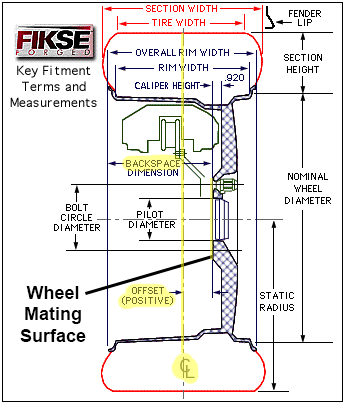
Anyone have these AP1 wheel measurements?:

Joined: May 2008
Posts: 369
Likes: 3
From: Central Ar.
I think I may be misunderstanding what the question is but I believe the differences being noted in track width are due to different ride heights of the comparing cars. The more horizontal the arms are the wider the track will be.
The important thing to start with is to verify square of pickup points (subframe). After that is verified and corrected if needed the relationship of each corners toe to the centerline of the chassis is what we are trying to adjust that is why the strings need to be parallel to center of the chassis not the same distance from front and rear hubs. Does that make sense? So the string should be the same distance from the hubs (left and right) in the rear first since it will be wider than the front and then this distance from the chassis centerline noted and duplicated at the front of the car so that the strings are parallel to the centerline and to each other. I don’t think it’s absolutely necessary to start at the rear but when setting up it might save a step.
The important thing to start with is to verify square of pickup points (subframe). After that is verified and corrected if needed the relationship of each corners toe to the centerline of the chassis is what we are trying to adjust that is why the strings need to be parallel to center of the chassis not the same distance from front and rear hubs. Does that make sense? So the string should be the same distance from the hubs (left and right) in the rear first since it will be wider than the front and then this distance from the chassis centerline noted and duplicated at the front of the car so that the strings are parallel to the centerline and to each other. I don’t think it’s absolutely necessary to start at the rear but when setting up it might save a step.

Registered User
Joined: Dec 2011
Posts: 144
Likes: 0
From: Portland, OR
if your front & rear droop travel is different you'll end up with skewed numbers and be back to a parallelogram - albeit a very small one.
the easiest way to get that would probably be measure a known distance at ride height - pop the springs out and use jack stands and set a front and rear suspension to the same height from the body and then get the plumb bob out and find the difference between the front and rear - it should be wider at ride height than at full droop.
And as a few others have said - trackwidth is another one of those fun measurements that different people measure different ways - it's 'supposed' to be the middle of the tread width of the tires at either end of a car. it's very frequently measured as the outside of the tread width of the tire and just as commonly measured as the outside of the section width of the tires.
Registered User
Joined: Mar 2013
Posts: 22
Likes: 1
I just came up* with a $100 DIY alternative to smart strings that should be just as accurate. The design basis as I understand it is that as long as the front and rear distance between the strings is identical, the worst you can do is make a slight parallelogram. You can pick any point on the front and rear that is the same side to side but not necessarily front to rear (front hub face, axle stubs) to square it up within a 32nd, and the parallelogram aspect will be very small indeed. Then all of these numbers we're wondering about will be irrelevant. I'll post it this weekend in a new thread when my girlfriend stops yelling at me for working on the car.
*By I came up with, I mean I ripped off my brother who runs spec miata and won't see this. I just added a couple of user friendly options.
*By I came up with, I mean I ripped off my brother who runs spec miata and won't see this. I just added a couple of user friendly options.
Former Moderator
Joined: Jul 2005
Posts: 4,634
Likes: 28
From: West Virginia
if your front & rear droop travel is different you'll end up with skewed numbers and be back to a parallelogram - albeit a very small one.
measuring front & rear at ride height is going to be the only way to get it precisely accurate.

Registered User
Joined: May 2014
Posts: 594
Likes: 24
From: Pittsburgh
Thanks for the earlier posts. Good info.
Let's talk about the tolerance stackup. Lots of things to consider here but let's start with the biggest contributor for most. Being able to measure to 1/32nds sounds impressive but it's not that great. Let's say everything is boxed up perfectly and you are measuring the leading and trailing edge of the wheel to within a range of 1/32" or +- 1/64". You are making 4 measurements per axle for toe and worst case scenario you could make all of them wrong by 1/64". That is 1/16" of total measurement error per axle. For a 17" wheel that results in about 0.20 degrees of total toe error using this trig calculator. I believe the factory says that total toe range is about 0.40 degrees so you've eaten up almost half of the entire range.
Obviously, the key to a good alignment is to reduce that per measurement error. Some people are good doing it consistently and looking for the diffused light through the fishing line as the lines on the scale underneath show up. I personally chose to use a Vernier caliper with a dial in inches. I took the same measurement multiple times and found I could generally get the values to within a range of 0.015". That is +- 0.075" times 4 = 0.03" of total measurement error per axle. That is total toe error of 0.10 degrees which is almost twice as good as using a ruler that reads to 1/32nds.
So the moral of this story, ditch the little ruler and use some Vernier calipers. Also, do a 'Gage R&R' on yourself and for your first time, take those same 8 measurements 10 times over. See what kind of measurement range you get. I was within 0.015".
The error in trackwidth between Rob's and Andrew's measurements by comparison is about 1/32" over 94.5" which only results in an error of 0.02 degrees.
Also there are other variables like wheel runout which can be quantified by a dial gauge which wouldn't be a bad idea to do.
Let's talk about the tolerance stackup. Lots of things to consider here but let's start with the biggest contributor for most. Being able to measure to 1/32nds sounds impressive but it's not that great. Let's say everything is boxed up perfectly and you are measuring the leading and trailing edge of the wheel to within a range of 1/32" or +- 1/64". You are making 4 measurements per axle for toe and worst case scenario you could make all of them wrong by 1/64". That is 1/16" of total measurement error per axle. For a 17" wheel that results in about 0.20 degrees of total toe error using this trig calculator. I believe the factory says that total toe range is about 0.40 degrees so you've eaten up almost half of the entire range.
Obviously, the key to a good alignment is to reduce that per measurement error. Some people are good doing it consistently and looking for the diffused light through the fishing line as the lines on the scale underneath show up. I personally chose to use a Vernier caliper with a dial in inches. I took the same measurement multiple times and found I could generally get the values to within a range of 0.015". That is +- 0.075" times 4 = 0.03" of total measurement error per axle. That is total toe error of 0.10 degrees which is almost twice as good as using a ruler that reads to 1/32nds.
So the moral of this story, ditch the little ruler and use some Vernier calipers. Also, do a 'Gage R&R' on yourself and for your first time, take those same 8 measurements 10 times over. See what kind of measurement range you get. I was within 0.015".
The error in trackwidth between Rob's and Andrew's measurements by comparison is about 1/32" over 94.5" which only results in an error of 0.02 degrees.
Also there are other variables like wheel runout which can be quantified by a dial gauge which wouldn't be a bad idea to do.