


Rear wing


Registered User
Joined: Jul 2007
Posts: 49
Likes: 0
From: Toronto, ON

Originally Posted by BKL,Jul 10 2007, 08:52 PM
malcolm,
What mikegarrison said is correct. I am a mechanical engineer myself. More specifically, I currently work at a racing company where we tune high end race cars for FIA GT all the way to LeMans and even Formula 1.
The canards do not provide much downforce by their surface area, they generate vortices which that goes down the sides of the car to keep the high-pressure region around the car from going to the underbody region of the car (where is low in pressure). It is in my opinion more of a preventive measure to maintain downforce rather than a a "provider" in my opinion. What you stated are valid as well, but in my opinion that is not their primary function.
Either way, it seems you are very experienced in motorsports in ontario. I am in ontario as well, hopefully one day I can see you at the tracks.
What mikegarrison said is correct. I am a mechanical engineer myself. More specifically, I currently work at a racing company where we tune high end race cars for FIA GT all the way to LeMans and even Formula 1.
The canards do not provide much downforce by their surface area, they generate vortices which that goes down the sides of the car to keep the high-pressure region around the car from going to the underbody region of the car (where is low in pressure). It is in my opinion more of a preventive measure to maintain downforce rather than a a "provider" in my opinion. What you stated are valid as well, but in my opinion that is not their primary function.
Either way, it seems you are very experienced in motorsports in ontario. I am in ontario as well, hopefully one day I can see you at the tracks.
I thought it was mainly the hard edge used along the bottom of the sides of the car to generate vorticies, but I can see how the two could be used in conjunction. Also, I guess with the new ACO rules with the curved-bottom on the sides of the LMP's, alternate forms of vortex generation need to be used.
I am mostly at regional events at Mosport... but if you see a guy packing loads of ALMS throw-away tires into a old dually at the ALMS weekend, that's me! Gotta love low-budget racing...


Registered User
Joined: Mar 2005
Posts: 1,248
Likes: 0
From: Vancouver
Yeah, Multimatic. Hehe, its not too low budget if you can go Dynamic suspensions imo 
I'm no expert at tracking though, I would love to meet you and learn a thing or two about driving from you one day
I'm no expert at tracking though, I would love to meet you and learn a thing or two about driving from you one day


Registered User
Joined: Jul 2007
Posts: 49
Likes: 0
From: Toronto, ON
wings: you need to know what a good profile looks like.
here are some examples of good profiles:
low downforce:

high downforce:


here is a BAD profile (nice cat though):

^^what you should notice here is the lack of curvature at the front of the wing on the underside, and the excessive curvature of the underside of the wing at the rear. This will likely cause flow-separation, and therefore lots of drag and little downforce.
Now if you look at the wings above the last one, most of the curvature is at the front of the wing, and then the curve opens up as it goes back to the trailing edge (ie. having maximum camber toward the front of the wing). What is on top of the wing has little effect on downforce, as long as the wing has sufficient camber.
The reasoning behind this is somewhat like nozzle/diffuser theory. You can use a nozzle of just about any angle/geometry to accelerate the flow with little penalty.... however, the diffuser needs to be very carefully designed to prevent flow separation. The first part of the wing (from the leading edge to the thickest point) is like the nozzle, and can have a tight radius. The second part of the wing (from the thickest point to the trailing edge) is like the diffuser, and can't have a tight radius, or else it will induce flow separation.
does that help?
here are some examples of good profiles:
low downforce:
high downforce:
here is a BAD profile (nice cat though):
^^what you should notice here is the lack of curvature at the front of the wing on the underside, and the excessive curvature of the underside of the wing at the rear. This will likely cause flow-separation, and therefore lots of drag and little downforce.
Now if you look at the wings above the last one, most of the curvature is at the front of the wing, and then the curve opens up as it goes back to the trailing edge (ie. having maximum camber toward the front of the wing). What is on top of the wing has little effect on downforce, as long as the wing has sufficient camber.
The reasoning behind this is somewhat like nozzle/diffuser theory. You can use a nozzle of just about any angle/geometry to accelerate the flow with little penalty.... however, the diffuser needs to be very carefully designed to prevent flow separation. The first part of the wing (from the leading edge to the thickest point) is like the nozzle, and can have a tight radius. The second part of the wing (from the thickest point to the trailing edge) is like the diffuser, and can't have a tight radius, or else it will induce flow separation.
does that help?
Registered User
Joined: Jul 2007
Posts: 49
Likes: 0
From: Toronto, ON
good call.
flow separation is when the air just can't stay attached to the surface of the wing. If a curve is too harsh, or the angle of the wing is too steep, then the air flow will just detach from the surface of the wing and massive turbulence takes over. here's a nifty little image:
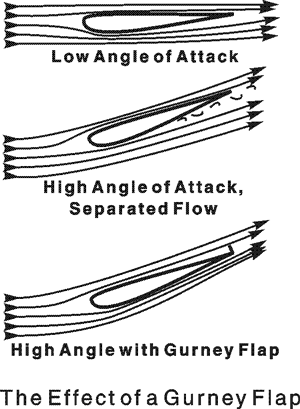
that clear things up a little?
flow separation is when the air just can't stay attached to the surface of the wing. If a curve is too harsh, or the angle of the wing is too steep, then the air flow will just detach from the surface of the wing and massive turbulence takes over. here's a nifty little image:
that clear things up a little?


Joined: Sep 2006
Posts: 4,762
Likes: 3
From: San Diego
malcolm
I know many aftermarket companies get their ideas from race cars, but racecars are always built around governing rules therefor they may not be the most efficient design for any given car. Some good articles in RCE about aero. We've been having some good conversations about aero over on BF.C, very knowledgable people on the track forum. My question brings us back to the topic of aero efficieny. What do you believe is a more effecient wing design, multi element or single?
-Dino
I know many aftermarket companies get their ideas from race cars, but racecars are always built around governing rules therefor they may not be the most efficient design for any given car. Some good articles in RCE about aero. We've been having some good conversations about aero over on BF.C, very knowledgable people on the track forum. My question brings us back to the topic of aero efficieny. What do you believe is a more effecient wing design, multi element or single?
-Dino