


S2000 Aerodynamics


Former Sponsor
Joined: May 2006
Posts: 16,133
Likes: 2
From: Chicago Burbs

Banned
Joined: Jul 2012
Posts: 691
Likes: 0

I have been wanting to make full undertray and rear diffuser for s2000 for some time now. however, everyone talks about diff and tranny temps. so I am wondering if anybody actually knows what is the optimum temperature range for the two?
I am not sure if NACA ducts under the car can create a good cooling system for the diff and tranny however i do know a better and more efficient way of cooling it if necessary I will be making a kit soon (couple of weeks) and as usual will test it on the track and get some temperature readings on both diff and tranny with no ducting and with NACA ducts.
I am not sure if NACA ducts under the car can create a good cooling system for the diff and tranny however i do know a better and more efficient way of cooling it if necessary
I will be making a kit soon (couple of weeks) and as usual will test it on the track and get some temperature readings on both diff and tranny with no ducting and with NACA ducts.
Joined: Aug 2007
Posts: 652
Likes: 1
From: San Deigo
I have been wanting to make full undertray and rear diffuser for s2000 for some time now. however, everyone talks about diff and tranny temps. so I am wondering if anybody actually knows what is the optimum temperature range for the two?
I am not sure if NACA ducts under the car can create a good cooling system for the diff and tranny however i do know a better and more efficient way of cooling it if necessary I will be making a kit soon (couple of weeks) and as usual will test it on the track and get some temperature readings on both diff and tranny with no ducting and with NACA ducts.
I am not sure if NACA ducts under the car can create a good cooling system for the diff and tranny however i do know a better and more efficient way of cooling it if necessary
I will be making a kit soon (couple of weeks) and as usual will test it on the track and get some temperature readings on both diff and tranny with no ducting and with NACA ducts.A Big
 to you..

Registered User
Joined: Dec 2011
Posts: 144
Likes: 0
From: Portland, OR
Originally Posted by s2000vtecvtec' timestamp='1369766300' post='22571717
http://mandm-honda.com/product_ap1_a...atbottom_.html
http://ameblo.jp/mandm-honda/entry-11414364949.html
M&M honda has a flat bottom diffuser, and the maintenance isn't going to be an issue. but it's insane expensive for few pieces of aluminum.
http://ameblo.jp/mandm-honda/entry-11414364949.html
M&M honda has a flat bottom diffuser, and the maintenance isn't going to be an issue. but it's insane expensive for few pieces of aluminum.
They lost all validity when. I realized they have R1Rs on the car...
as to how effective NACA ducts can be under the car - as long as you're running attached flow - aka a flat undertray you should have good success with them under a car. Ideally you'd locate them wherever you have the most attached airflow which may not be by default on an undertray.
I have been wanting to make full undertray and rear diffuser for s2000 for some time now. however, everyone talks about diff and tranny temps. so I am wondering if anybody actually knows what is the optimum temperature range for the two?
I am not sure if NACA ducts under the car can create a good cooling system for the diff and tranny however i do know a better and more efficient way of cooling it if necessary I will be making a kit soon (couple of weeks) and as usual will test it on the track and get some temperature readings on both diff and tranny with no ducting and with NACA ducts.
I am not sure if NACA ducts under the car can create a good cooling system for the diff and tranny however i do know a better and more efficient way of cooling it if necessary
I will be making a kit soon (couple of weeks) and as usual will test it on the track and get some temperature readings on both diff and tranny with no ducting and with NACA ducts.Most pure race cars that run very high specific output motors with full tunnels/floors tend to run cooling pumps/radiators for diffs & trans to keep the temps down and those are way more efficient with air use then passive cooling of the outside of a diff or trans.

Thread Starter
Former Moderator


Joined: Jul 2005
Posts: 4,634
Likes: 28
From: West Virginia
I added splitter dams to my splitter's outside edge to bumper junction to try and keep the very high velocity air spilling around the splitter/bumper junction from hitting the front tires. The S2000's nose shape will cause even more air to flow around the sides of the car than the Ford Fusion NASCAR in the CFD diagram posted earlier. Running wider than stock front tires will increase the drag caused by this side airflow because the tires extend out into the airstream. I run a square 255 width tire setup (stock is 205) and the front tires extend over three inches outward beyond the front bumper.
In the book, Competition Car Aerodynamics, by Simon McBeath (yea, tell your friends you enjoyed reading McBeath) he discusses how splitter dams (he refers to them as a "vertical fence") increase downforce by creating a high pressure area on top of the splitter in front of the dams--so they are a win-win with less drag than bare tires in the airstream plus additional splitter downforce.
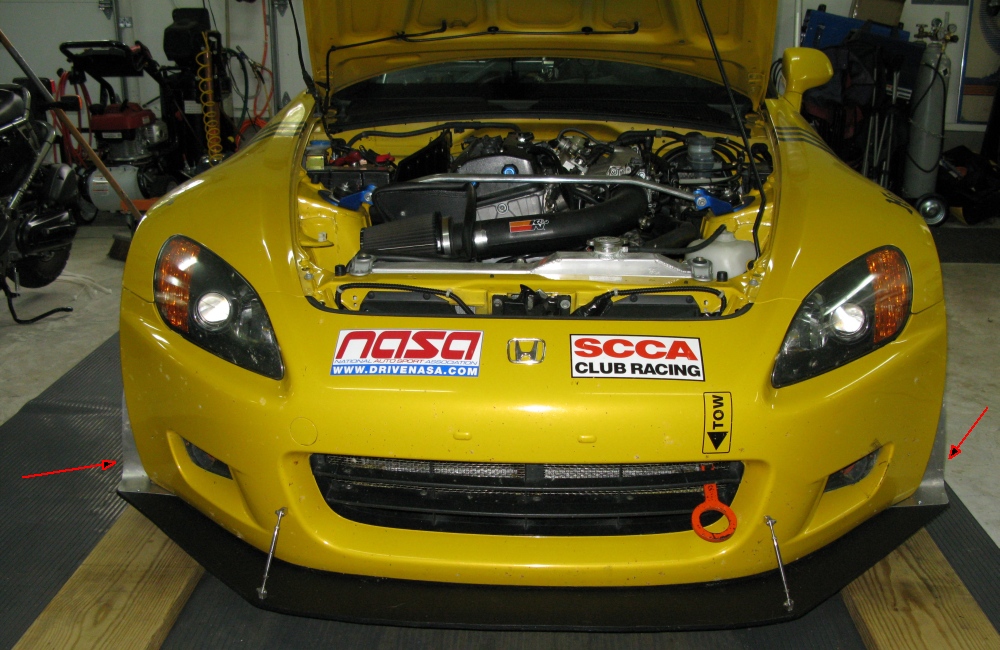
In the book, Competition Car Aerodynamics, by Simon McBeath (yea, tell your friends you enjoyed reading McBeath) he discusses how splitter dams (he refers to them as a "vertical fence") increase downforce by creating a high pressure area on top of the splitter in front of the dams--so they are a win-win with less drag than bare tires in the airstream plus additional splitter downforce.


Joined: Jun 2011
Posts: 356
Likes: 0
From: Los Angeles, CA
Does the book address the pros/cons of those versus dive planes? Since both would direct air around/over the front tire. The latter visually would seem to introduce less drag (as the splitter dam appears to be more of a 90 degree angle), but I am aware that what looks intuitive isn't always actually right when it comes to aero


Registered User
Joined: Feb 2009
Posts: 224
Likes: 0
so is it necessary to have splitter Dams and splitter side plate together? Do you think it will creat alot of Drag ?
in progress to build my splitter right now, any word would be help.
Like the pic below from Nemo EVO .

in progress to build my splitter right now, any word would be help.
Like the pic below from Nemo EVO .
Thread Starter
Former Moderator
Joined: Jul 2005
Posts: 4,634
Likes: 28
From: West Virginia
McBeath tested 3 different size dive planes with and without a dam. The dam without a dive plane gave the most downforce and least added drag which surprised him. The discussion is on page 256.
For an S2000 the drag generated with a splitter with a dam and end plate might be excessive enough to slow lap times. I would think if you're running 255 or wider front tires then a splitter dam would probably be optimal. The Evo pictured has excessive horsepower so the drag is not as important as the added downforce.
For an S2000 the drag generated with a splitter with a dam and end plate might be excessive enough to slow lap times. I would think if you're running 255 or wider front tires then a splitter dam would probably be optimal. The Evo pictured has excessive horsepower so the drag is not as important as the added downforce.
Joined: Jun 2011
Posts: 356
Likes: 0
From: Los Angeles, CA
McBeath tested 3 different size dive planes with and without a dam. The dam without a dive plane gave the most downforce and least added drag which surprised him. The discussion is on page 256.
For an S2000 the drag generated with a splitter with a dam and end plate might be excessive enough to slow lap times. I would think if you're running 255 or wider front tires then a splitter dam would probably be optimal. The Evo pictured has excessive horsepower so the drag is not as important as the added downforce.
For an S2000 the drag generated with a splitter with a dam and end plate might be excessive enough to slow lap times. I would think if you're running 255 or wider front tires then a splitter dam would probably be optimal. The Evo pictured has excessive horsepower so the drag is not as important as the added downforce.