


S2000 Aerodynamics


Joined: Nov 2011
Posts: 314
Likes: 3

Notice what I bolded in the quote
For examples, they all have varying levels of a upward curve/lip preceding the opening vent. I'll add that I think the primary purpose of the upward lip is to create an even greater low pressure zone directly behind the raised lip helping to extract more air out of the engine bay. But I think they generate a smidge of downforce purely due to fluid mechanics:
For examples, they all have varying levels of a upward curve/lip preceding the opening vent. I'll add that I think the primary purpose of the upward lip is to create an even greater low pressure zone directly behind the raised lip helping to extract more air out of the engine bay. But I think they generate a smidge of downforce purely due to fluid mechanics:
Yep, I misunderstood. I agree with you completely. I thought about trying to bend the leading edge of my hood vent up and the trailing edge down but I was afraid I'd end up chipping off the paint so I left it alone.

Thread Starter
Former Moderator


Joined: Jul 2005
Posts: 4,634
Likes: 28
From: West Virginia
David, the stock S2000 deck lid spoiler should be at least slightly functional. The deck lid spoiler theory of operation is it "spoils" the airflow forward of the spoiler--over the trunk and rear of the top--so a low velocity, high pressure pool of air stagnates there, replacing the high speed, low pressure (lift creating) air that would normally be there. A little downforce can be created when airflow over the spoiler is deflected upward.
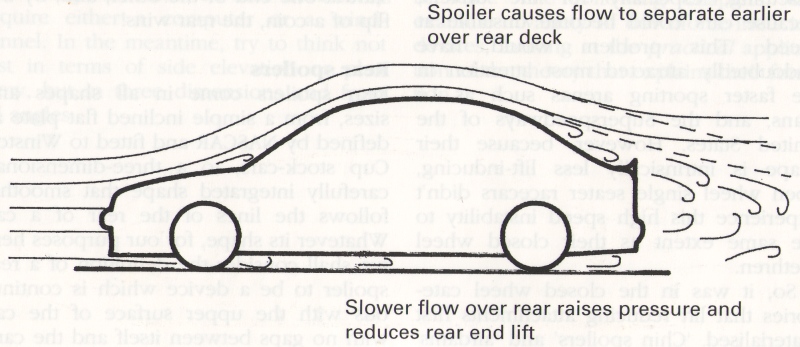
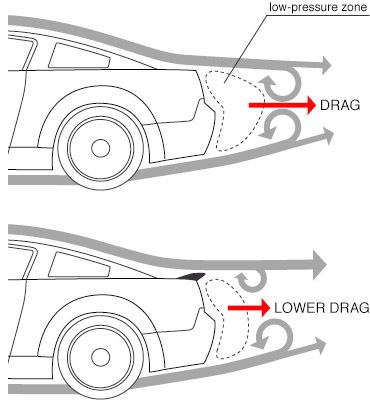
It may also clean up the airflow behind the car and reduce drag. In the below graphic the "low pressure zone" (dashed line area) literally sucks on the back of the car creating drag. The deck lid spoiler reduces low pressure zone trailing the car. I'd leave the spoiler in place.
It may also clean up the airflow behind the car and reduce drag. In the below graphic the "low pressure zone" (dashed line area) literally sucks on the back of the car creating drag. The deck lid spoiler reduces low pressure zone trailing the car. I'd leave the spoiler in place.
Thread Starter
Former Moderator
Joined: Jul 2005
Posts: 4,634
Likes: 28
From: West Virginia
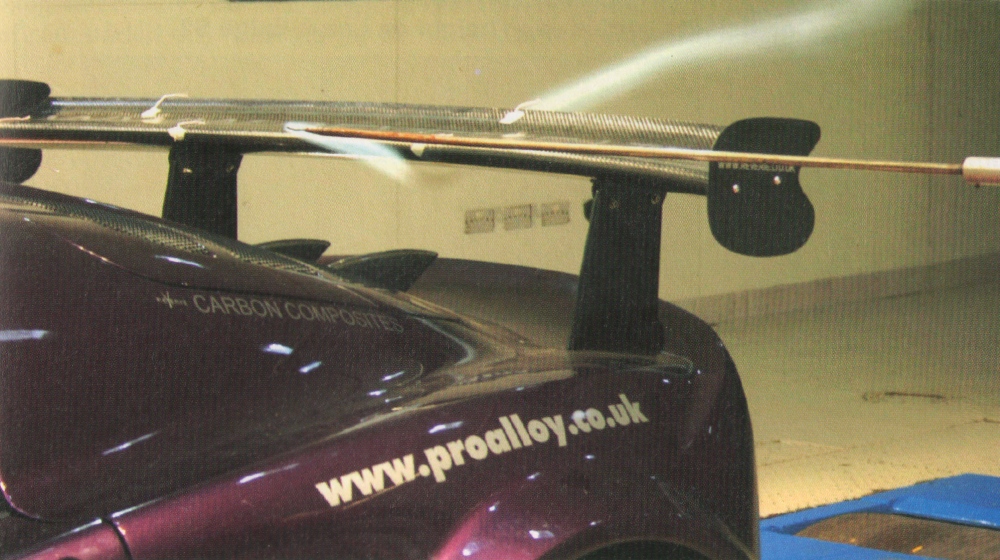
Dries, I finally found a wind tunnel test pic with the smoke wand between the car roof and wing. This pic shows very good airflow below this Lotus mid level wing:
Did your study do this kind of testing?
I have added a lot of S2000 specific content to my aerodynamics page.
Did your study do this kind of testing?
I have added a lot of S2000 specific content to my aerodynamics page.



Joined: Jun 2009
Posts: 3,689
Likes: 21
David, the stock S2000 deck lid spoiler should be at least slightly functional. The deck lid spoiler theory of operation is it "spoils" the airflow forward of the spoiler--over the trunk and rear of the top--so a low velocity, high pressure pool of air stagnates there, replacing the high speed, low pressure (lift creating) air that would normally be there. A little downforce can be created when airflow over the spoiler is deflected upward.
It may also clean up the airflow behind the car and reduce drag. In the below graphic the "low pressure zone" (dashed line area) literally sucks on the back of the car creating drag. The deck lid spoiler reduces low pressure zone trailing the car. I'd leave the spoiler in place.
It may also clean up the airflow behind the car and reduce drag. In the below graphic the "low pressure zone" (dashed line area) literally sucks on the back of the car creating drag. The deck lid spoiler reduces low pressure zone trailing the car. I'd leave the spoiler in place.
But I want to make sure we are talking about the same thing. I'm referring to the Honda OEM Wing Spoiler, not the OEM Trunk Spoiler. I'm just afraid that this wing was not designed with any thought of functionality, and if the angle of attack is incorrect, it could actually increase drag and lift. I have to decide if I'm gonna put it back on my new s2k. I like the looks, but I track the car about 10 times a year also. What do you think?

Thread Starter
Former Moderator
Joined: Jul 2005
Posts: 4,634
Likes: 28
From: West Virginia
Sorry David, I didn't even know you could get a non-CR S2000 with a Honda wing so I thought you were talking about the spoiler. I can't tell from the photo what the wing angle is but I would assume Honda did some homework and the design is functional so I'd run with it unless you replace it with an aftermarket wing.
Joined: Jun 2009
Posts: 3,689
Likes: 21
Sorry David, I didn't even know you could get a non-CR S2000 with a Honda wing so I thought you were talking about the spoiler. I can't tell from the photo what the wing angle is but I would assume Honda did some homework and the design is functional so I'd run with it unless you replace it with an aftermarket wing.
Thanks,
Dave

Joined: Feb 2007
Posts: 6,863
Likes: 125
From: Pawtucket, RI
Just a minor note on an excellent post/thread:
The splitter increases front downforce by taking advantage of the significant positive pressure at the front of the car. That pressure pushes down on the splitter, that's where the big increase in front downforce comes from.
If the only effect was moving the low pressure forward, then it would be a net wash on downforce, as any added to the front would be taken away at the rear.
This was the case with the RX7 R1. The splitter decreased front lift significantly, but the rear wing only countered the rear lift induced by the downforce at the front of the car in front of the front wheels.
The R1 aero mods produced greater drag (.31 vs. 0.29 Cd), but only reduced lift up front.
Which is why it was stupid of me not to remove the splitter before running the Texas Mile with no rear wing!
The splitter increases front downforce by taking advantage of the significant positive pressure at the front of the car. That pressure pushes down on the splitter, that's where the big increase in front downforce comes from.
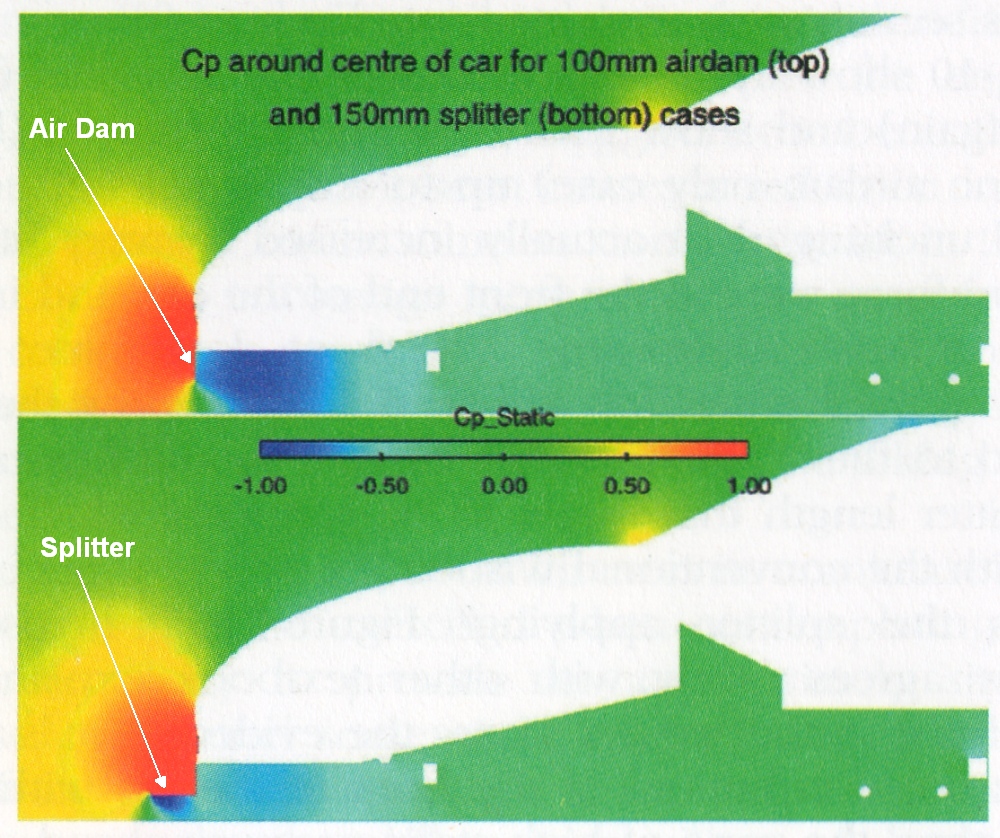
The graphic below is a comparison between a car with an air dam alone and an air dam with a splitter. Red is high pressure, blue is low. You can see how the splitter reaches out and chops off the bottom of the high pressure bubble on the nose of the car. The high pressure also concentrates on top of the splitter which pushes it downward for downforce. The airdam alone creates a lot of low pressure under the car so adding the splitter doesn't add much more low pressure but it does move the low pressure forward which will put more pressure on the front wheels.
This was the case with the RX7 R1. The splitter decreased front lift significantly, but the rear wing only countered the rear lift induced by the downforce at the front of the car in front of the front wheels.
The R1 aero mods produced greater drag (.31 vs. 0.29 Cd), but only reduced lift up front.
Which is why it was stupid of me not to remove the splitter before running the Texas Mile with no rear wing!
Joined: Jun 2009
Posts: 3,689
Likes: 21
Just a minor note on an excellent post/thread:
The splitter increases front downforce by taking advantage of the significant positive pressure at the front of the car. That pressure pushes down on the splitter, that's where the big increase in front downforce comes from.
If the only effect was moving the low pressure forward, then it would be a net wash on downforce, as any added to the front would be taken away at the rear.
This was the case with the RX7 R1. The splitter decreased front lift significantly, but the rear wing only countered the rear lift induced by the downforce at the front of the car in front of the front wheels.
The R1 aero mods produced greater drag (.31 vs. 0.29 Cd), but only reduced lift up front.
Which is why it was stupid of me not to remove the splitter before running the Texas Mile with no rear wing!
The splitter increases front downforce by taking advantage of the significant positive pressure at the front of the car. That pressure pushes down on the splitter, that's where the big increase in front downforce comes from.
Originally Posted by robrob' timestamp='1369230496' post='22559302
The graphic below is a comparison between a car with an air dam alone and an air dam with a splitter. Red is high pressure, blue is low. You can see how the splitter reaches out and chops off the bottom of the high pressure bubble on the nose of the car. The high pressure also concentrates on top of the splitter which pushes it downward for downforce. The airdam alone creates a lot of low pressure under the car so adding the splitter doesn't add much more low pressure but it does move the low pressure forward which will put more pressure on the front wheels.
This was the case with the RX7 R1. The splitter decreased front lift significantly, but the rear wing only countered the rear lift induced by the downforce at the front of the car in front of the front wheels.
The R1 aero mods produced greater drag (.31 vs. 0.29 Cd), but only reduced lift up front.
Which is why it was stupid of me not to remove the splitter before running the Texas Mile with no rear wing!
Interesting....I would think that a front splitter angle is critical...suppose the static angle is 0 degrees, but the car encounters a bump raising the front of the car so the splitter is at a positive angle...wouldn't that create a huge amount of front lift of a moment?
Also, can anyone comment on the CR front lip? Why did Honda decide on such an unusual design for a street car?. How much does in increase drag do you experts think?


Joined: Jan 2008
Posts: 1,279
Likes: 9
Originally Posted by MSRS2K' timestamp='1369331448' post='22562515
[quote name='robrob' timestamp='1369236317' post='22559555']
I'm going to attempt to bend some 1 inch aluminum angle stock to follow the top of the rear trunk edge between the wing supports to act as a short spoiler to add some downforce with very little added drag. I'm going to try a 30º spoiler angle.
I'm going to attempt to bend some 1 inch aluminum angle stock to follow the top of the rear trunk edge between the wing supports to act as a short spoiler to add some downforce with very little added drag. I'm going to try a 30º spoiler angle.

[/quote]
I think I vaguely remember some issues people had with riser equipped gtc 200's. u may wanna do some research should u decide to go that route
Thread Starter
Former Moderator
Joined: Jul 2005
Posts: 4,634
Likes: 28
From: West Virginia
I think I vaguely remember some issues people had with riser equipped gtc 200's. u may wanna do some research should u decide to go that route