


Voltex VS J's Racing



Joined: Nov 2006
Posts: 4,961
Likes: 1
From: SF Bay Area, CA

Originally Posted by digitalHorizon,Jul 22 2008, 06:28 AM
This is in essence true. The endplate is there to reduce the low pressure/high pressure airflow interaction in order to reduce the strength of the wing tip vortex that is shed. This vortex contains a vertical velocity component ("downwash") that tilts the local velocity (and thus the lift force) vector, resulting in a lift force component that is parallel to the free stream velocity and thus a drag force, which we call "induced" drag.
It could be, or it could be a means of "tuning" the tip vortex. Because the wing is a complex 3 dimensional shape that has both fluid interactions with the body and structural deformations affecting its aerodynamic efficiency, it may be present to allow for a certain amount of spillage in order to relieve a less than ideal flow situation around the trailing edge of the wing tips.
It could be, or it could be a means of "tuning" the tip vortex. Because the wing is a complex 3 dimensional shape that has both fluid interactions with the body and structural deformations affecting its aerodynamic efficiency, it may be present to allow for a certain amount of spillage in order to relieve a less than ideal flow situation around the trailing edge of the wing tips.
 Great input!
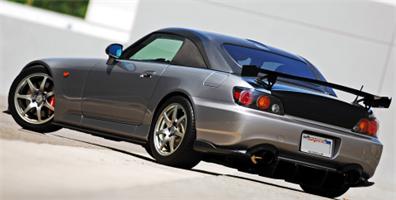
Regarding to the Hasport, are you referring to this one?




Joined: Aug 2002
Posts: 1,602
Likes: 3
From: St. Louis
Originally Posted by digitalHorizon,Jul 22 2008, 01:03 PM
Wind tunnel time and CFD codes are very expensive, so unless a company has millions of dollars to spend or expects to be able to sell these parts for a considerable amount, TLAR engineering and ass dyno testing is just about the most plausible thing for them to do. You can do your best based on your knowledge of theory and experience with previous designs, but getting out there and actually testing these things in technical detail is very very difficult, especially considering the relatively low price these things fetch. I'm merely offering another possible reason as to why the endplate was designed the way it was that nobody had previously mentioned.
Throw the wing on, hook up the instruments, and go for a drive. Cheap. Yet no one does it.
Theory gets you your design, testing verifies your theory (and provides information for the consumer for marketing purposes). Without verification, we have no idea whether the part does what we think. As you said, low Reynolds number aerodynamics is far from intuitive.

Registered User
Joined: Jun 2007
Posts: 14
Likes: 0
Getting a basic force measurement doesn't tell a very complete story and that wasn't what I was talking about in reference to "technical details." I'm talking about flow interactions, boundary layer transitions, and unsteady effects. These can't be measured by putting a load cell on a wing support... so even if you get some net downforce numbers, you're far from having "all of the relevant data." All it will tell you is "yep, it yields a force." So does sitting on the trunk, but obviously there's more to planting the rear tires than putting Dr. Phil back there and telling him to hold on tight.
I'd venture to say most companies have some form of test data that shows a net force at the wing supports, but there's no need to release the data as it is probably proprietary information anyway.
And as for the comment that development is expensive and verification is not, I'm staring at a USN contract where the verification cost exceeds that for development. Maybe aerodynamicists cost less when they're working on cars?
I'd venture to say most companies have some form of test data that shows a net force at the wing supports, but there's no need to release the data as it is probably proprietary information anyway.
And as for the comment that development is expensive and verification is not, I'm staring at a USN contract where the verification cost exceeds that for development. Maybe aerodynamicists cost less when they're working on cars?

Registered User
Joined: Aug 2007
Posts: 651
Likes: 0
From: ATL, Bitches
from what I have heard from people who sell J's and voltex is that Voltex manufacturs the J's wings and that you are getting a voltex wing just with J's stickers... I dont know if this is 100% truth but they do look ALOT alike...

Registered User
Joined: Sep 2005
Posts: 5,962
Likes: 0
From: Hong Kong/California
Originally Posted by bullitt5897,Jul 23 2008, 11:38 AM
from what I have heard from people who sell J's and voltex is that Voltex manufacturs the J's wings and that you are getting a voltex wing just with J's stickers... I dont know if this is 100% truth but they do look ALOT alike...

Joined: Aug 2002
Posts: 1,602
Likes: 3
From: St. Louis
Originally Posted by digitalHorizon,Jul 23 2008, 01:48 PM
Getting a basic force measurement doesn't tell a very complete story and that wasn't what I was talking about in reference to "technical details." I'm talking about flow interactions, boundary layer transitions, and unsteady effects. These can't be measured by putting a load cell on a wing support... so even if you get some net downforce numbers, you're far from having "all of the relevant data." All it will tell you is "yep, it yields a force." So does sitting on the trunk, but obviously there's more to planting the rear tires than putting Dr. Phil back there and telling him to hold on tight.
I'd venture to say most companies have some form of test data that shows a net force at the wing supports, but there's no need to release the data as it is probably proprietary information anyway.
And as for the comment that development is expensive and verification is not, I'm staring at a USN contract where the verification cost exceeds that for development. Maybe aerodynamicists cost less when they're working on cars?
I'd venture to say most companies have some form of test data that shows a net force at the wing supports, but there's no need to release the data as it is probably proprietary information anyway.
And as for the comment that development is expensive and verification is not, I'm staring at a USN contract where the verification cost exceeds that for development. Maybe aerodynamicists cost less when they're working on cars?
While I appreciate Dr. Phil humor, the logical fallacy doesn't provide for the fact that Dr. Phil will not be proving us with lift versus speed, drag versus speed, and L/D numbers all for every angle of attack the wing could be run at in the real world air flow mounted on the car. A basic load cell hooked to a data logger would do all this. "Yep, it yields a force" is a much different statement than, "Yep, it yields X lbs lift and Y lbs drag at Z AoA." These numbers would not only be useful in comparing the efficiency of competing brands, but also in selecting the wing best suited to your personal application and the settings to use for that wing at your current event. Additionally, those numbers are not at all proprietary data. The secret to protect is how to generate those numbers, obviously none of which would be revealed.
Verification is less expensive than development in this context. Aerodynamicists are needed for development of the element, they aren't needed to run a strain gauge.
Registered User
Joined: Jun 2007
Posts: 14
Likes: 0
I just typed a whole long paragraph, then I realized I just don't give a shit. Too much time wasted trying to share some thoughts on the topic, I've learned my lesson to never do it again.
Enjoy your strain gauge.
Enjoy your strain gauge.

Registered User
Joined: May 2007
Posts: 749
Likes: 1
From: Denver, CO
Forgive me for interjecting, but the above conversation seems to have just ended, and this seems like a good time/place to ask.
What's the purpose of the "3D" wings vs. a flat shape? Is it anything other than aesthetics?
What's the purpose of the "3D" wings vs. a flat shape? Is it anything other than aesthetics?


Joined: Jan 2008
Posts: 1,279
Likes: 9
Originally Posted by digitalHorizon,Jul 23 2008, 12:45 PM
I just typed a whole long paragraph, then I realized I just don't give a shit. Too much time wasted trying to share some thoughts on the topic, I've learned my lesson to never do it again.
Enjoy your strain gauge.
Enjoy your strain gauge.
we can tell the net downforce thru a test like that but drag numbers might be harder to tell. MPH down a straight from a rolling start might give some numbers but only as an indication of relative amount of drag as compared to another wing.
ultimately, consumers need to make an informed choice.
And its sorely needed where I live but by far the rarest option we have here.