


Silencers and stoechiometric efficiency


Thread Starter
Registered User
Joined: Sep 2007
Posts: 666
Likes: 0
From: Germany - Spain
 Silencers and stoechiometric efficiency
Hi!
I have read many post about silencers having a huge impact on performance, but I still have not quite understood the point of the affirmation "all silencers have negative impact on performance"
Let's imagine we have the "right" silencer. That would mean that the diameter of the silencer is the same (or slightly bigger) than the exhaust pipe. Also would mean that theres no gap between the end of the exhaust pipe and the start of the silencer and that the silencer is not extremely long (lets say that it ends in the middle of the muffler (im speaking about Invidia or Tanabe Concept-G style mufflers).
As far as I understand, the impact of a silencer in the performance of the car can only occurs when the stoechiometric efficiency is affected (or A/F ratio is changed). In other words, the exhaust is designed too maximize both flow and speed and any alteration of those variables could have impact on performance (negative or positive)
How can a silencer (of the kind I described below) impact on any of the previous variables? (speed and flow) in a way that can impact significantly the performance?
I can imagine that with the wrong silencer you can have this negative impact.
For example if the silencer has a smaller pipe then the flow is reduced, the speed is increased, and we will surely have more backpressure. More or less the same would happen if there's a gap between the exhaust pipe and the silencer.
But whats the explanation of the performance impact of enlarging the exhaust pipe pipe 6cm? (while keeping the same total exhaust length).
Personally I see that the impact (positive or negative) on those circumstances is negligible (But I want that someones proves me wrong)
I have read many post about silencers having a huge impact on performance, but I still have not quite understood the point of the affirmation "all silencers have negative impact on performance"
Let's imagine we have the "right" silencer. That would mean that the diameter of the silencer is the same (or slightly bigger) than the exhaust pipe. Also would mean that theres no gap between the end of the exhaust pipe and the start of the silencer and that the silencer is not extremely long (lets say that it ends in the middle of the muffler (im speaking about Invidia or Tanabe Concept-G style mufflers).
As far as I understand, the impact of a silencer in the performance of the car can only occurs when the stoechiometric efficiency is affected (or A/F ratio is changed). In other words, the exhaust is designed too maximize both flow and speed and any alteration of those variables could have impact on performance (negative or positive)
How can a silencer (of the kind I described below) impact on any of the previous variables? (speed and flow) in a way that can impact significantly the performance?
I can imagine that with the wrong silencer you can have this negative impact.
For example if the silencer has a smaller pipe then the flow is reduced, the speed is increased, and we will surely have more backpressure. More or less the same would happen if there's a gap between the exhaust pipe and the silencer.
But whats the explanation of the performance impact of enlarging the exhaust pipe pipe 6cm? (while keeping the same total exhaust length).
Personally I see that the impact (positive or negative) on those circumstances is negligible (But I want that someones proves me wrong)

Registered User
Joined: Jul 2008
Posts: 4,531
Likes: 0
exhaust flow depends on velocity and pressure...
too big of a exhaust will slow down the velocity of gasses escaping, which result in less evacuation of cylinder. Thats basically why people used to think 'backpressure' was a good thing..
not sure if that answers your question...lol
also, a diameter increase, then decrease would hurt the flow..(dont quotte me on this, from what i learned in fluid dynamics class..it will hurt the flow).
its basically like a moped 'test pipe' - you can tune your exhaust for one particular rpm.....high/low...whatever. and rem that having high hp does not equal faster... torque coming in @ low rpm may more than make up for the hp loss up top!
too big of a exhaust will slow down the velocity of gasses escaping, which result in less evacuation of cylinder. Thats basically why people used to think 'backpressure' was a good thing..
not sure if that answers your question...lol
also, a diameter increase, then decrease would hurt the flow..(dont quotte me on this, from what i learned in fluid dynamics class..it will hurt the flow).
its basically like a moped 'test pipe' - you can tune your exhaust for one particular rpm.....high/low...whatever. and rem that having high hp does not equal faster... torque coming in @ low rpm may more than make up for the hp loss up top!
Thread Starter
Registered User
Joined: Sep 2007
Posts: 666
Likes: 0
From: Germany - Spain
Originally Posted by ikeyballz,Sep 29 2008, 01:33 AM
also, a diameter increase, then decrease would hurt the flow..(dont quotte me on this, from what i learned in fluid dynamics class..it will hurt the flow).
What we are doing is to enlarge the thin area (the pipe) and shorten the big area (the muffler). By doing that I not only see the possibility of a negative impact on the performance but I even see a positive impact (because of the reduced muffler length I can hope that the gases are evacuated quicker). The backpressure in this case (if any) would be minimal (because we are not making the pipe thiner).
The main problem is that this cannot be proved because the common measurement error of a dyno would not let us see that we have negative or possitive impact (so, it's all theory).

Joined: Mar 2005
Posts: 5,946
Likes: 7
From: honolulu, hawaii
i dont really understand where you are getting at with the "perfect silencer" the most common silencer used does hinder performance. this silencer you talk about which keeps the same diamter would really just end up being another muffler/resonator.
Thread Starter
Registered User
Joined: Sep 2007
Posts: 666
Likes: 0
From: Germany - Spain
Originally Posted by jzz30,Sep 29 2008, 02:45 AM
i dont really understand where you are getting at with the "perfect silencer" the most common silencer used does hinder performance. this silencer you talk about which keeps the same diamter would really just end up being another muffler/resonator.
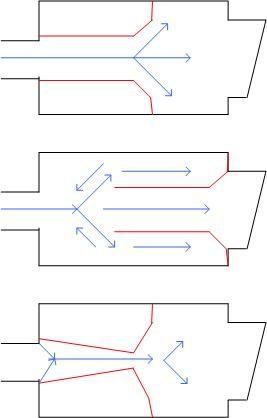
That's a minimal pic or 3 kinds of silencers (exhaust border is in black, silencer in red, and air-flow in blue)
The first picture is what I mean with "right silencer" it's just an extension of the exhaust pipe. This one I don't think that works as a resonator (in fact what it makes is to reduce the sice of the muffler resonator).
The next two ones is what I mean with "bad" silencer, in the first one the silencer does not start where the exhaust pipe ends (thefore it creates a chamber that works like a resonator). In the third one there's a reduction of the pipe size an increase of exhaust speed and a reduction of the flow (backpressure)


Registered User
Joined: Aug 2007
Posts: 651
Likes: 0
From: ATL, Bitches
Yea I agree. The silencers decrease the actual outlet diameter as well as cause excessive back pressure which hurts performance.
Take for example a stock s2000...
add a 63mm exhaust and you will get great throttle response power in the mid range and a lil on top.
add a 70mm exhaust and you will get more low end torque and alot more power up top at the sacrifice of throttle response in the mid range which correlates directly to mid range HP.
now when you add the silencers to 63mm it causes too much back pressure by trapping the exhaust gases inside the canister. On a N/A s2000 63mm seems to be about perfect for a N/A driven goal. adding this extra backpressure negates the reason for going 63mm in the first place.
Now on a 70mm the goal is least restrictive exhaust possible for high end N/A and FI purposes. The extras back pressure causes a loss on the top end and low end power range. but, in some cases can increase the mid range only slightly though.
Silencers hold the gases in the canister longer thus slowing down the velocity and creating less sound audible disturbance.
hope that helps.
Take for example a stock s2000...
add a 63mm exhaust and you will get great throttle response power in the mid range and a lil on top.
add a 70mm exhaust and you will get more low end torque and alot more power up top at the sacrifice of throttle response in the mid range which correlates directly to mid range HP.
now when you add the silencers to 63mm it causes too much back pressure by trapping the exhaust gases inside the canister. On a N/A s2000 63mm seems to be about perfect for a N/A driven goal. adding this extra backpressure negates the reason for going 63mm in the first place.
Now on a 70mm the goal is least restrictive exhaust possible for high end N/A and FI purposes. The extras back pressure causes a loss on the top end and low end power range. but, in some cases can increase the mid range only slightly though.
Silencers hold the gases in the canister longer thus slowing down the velocity and creating less sound audible disturbance.
hope that helps.
Trending Topics

Registered User
Joined: Aug 2007
Posts: 8,504
Likes: 0
I see where the original poster was going. There are several books written on silencer theory and application.
Diameter is just 1 variable, which poster 2 was getting at. Total length of the exhaust piping is a variable, design of silencer chambers is another, degree of cam overlap is the third I can think of.
Open headers produce the most horsepower. (Not true if you have a "smog" engine with a ton of overlap designed by monkeys.) But the sound is obviously too much. (For doubters show me a F1, Indy or other true race engine that runs mufflers...)
The next compromise is a straight through muffler with flush perforations (many Borla and most "race" mufflers). These can still be quite loud, so most manufacturers use a "noise cancelling" muffler that uses wave theory to cancel out as much sound as possible. These use a tube and chamber like you showed, two tubes that split and rejoin, or angled baffles.
In any case there is no variation in stoichimetric ratio, as the 02 sensor adjusts, or in the case of a very free flowing system compared to stuck the engine would lean out a bit at full throttle when the fixed map is being used. However there are significant differences on total air flow through the motor, which is where the power comes from.
In the most extreme case, you can tune a motor to run with a particular exhaust length so that for a given RPM band you actually get a standing wave-pulse effect that artificially draws air in at hgher than atmospheric pressure. Same stoic, but much more air.
Diameter is just 1 variable, which poster 2 was getting at. Total length of the exhaust piping is a variable, design of silencer chambers is another, degree of cam overlap is the third I can think of.
Open headers produce the most horsepower. (Not true if you have a "smog" engine with a ton of overlap designed by monkeys.) But the sound is obviously too much. (For doubters show me a F1, Indy or other true race engine that runs mufflers...)
The next compromise is a straight through muffler with flush perforations (many Borla and most "race" mufflers). These can still be quite loud, so most manufacturers use a "noise cancelling" muffler that uses wave theory to cancel out as much sound as possible. These use a tube and chamber like you showed, two tubes that split and rejoin, or angled baffles.
In any case there is no variation in stoichimetric ratio, as the 02 sensor adjusts, or in the case of a very free flowing system compared to stuck the engine would lean out a bit at full throttle when the fixed map is being used. However there are significant differences on total air flow through the motor, which is where the power comes from.
In the most extreme case, you can tune a motor to run with a particular exhaust length so that for a given RPM band you actually get a standing wave-pulse effect that artificially draws air in at hgher than atmospheric pressure. Same stoic, but much more air.

Thread
Thread Starter
Forum
Replies
Last Post